



















Pieter Van Schalkwyk
CEO at XMPRO
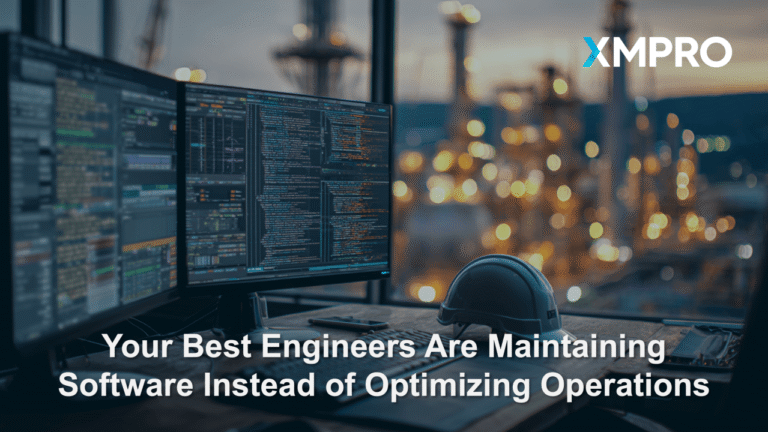
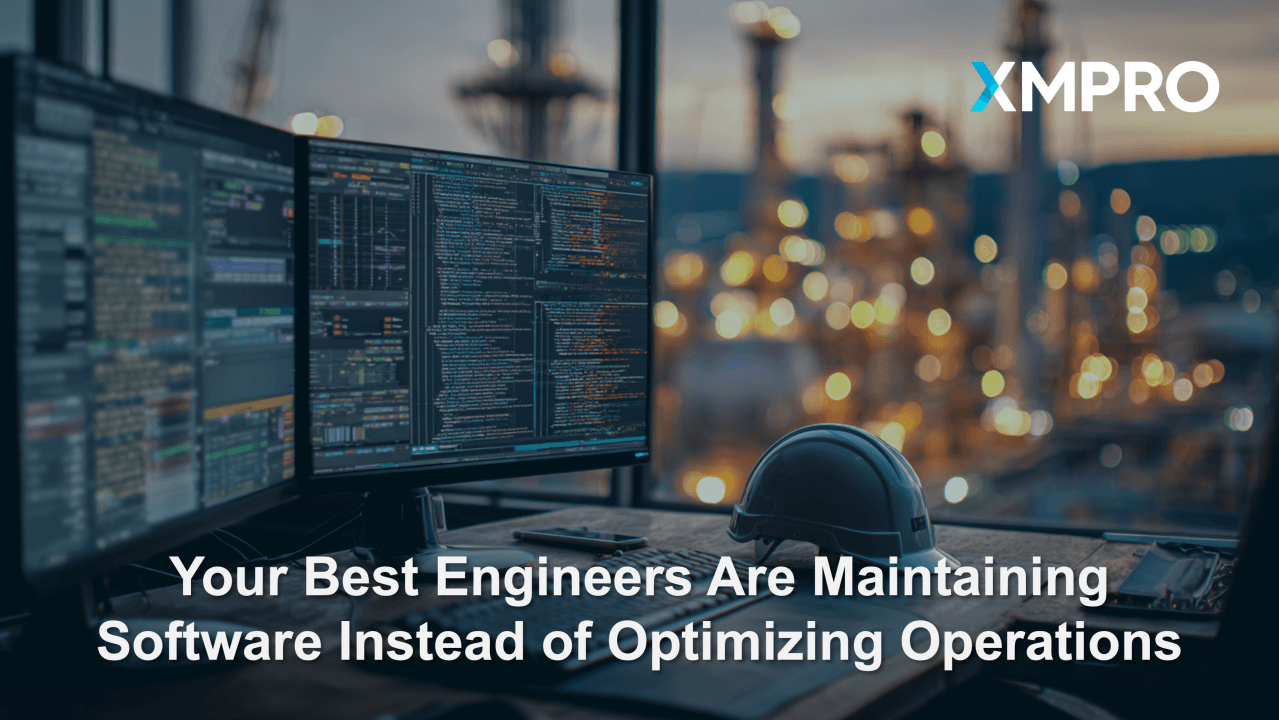
The engineers who should be building operational advantage are spending their time maintaining internal AI and Operations platforms. The people who understand your process better than anyone, who know why that compressor behaves differently in summer, who can spot a degradation pattern three months before it shows up in the data, are debugging integration code and patching OT connectors.
This is the most expensive misallocation of talent in industrial operations right now.
How It Starts
AI coding tools have gotten remarkably good. Every industrial CIO and COO is having the same conversation: "We know our operations better than anyone. We have the domain expertise. Why not build our own agent orchestration layer and develop our core capabilities from scratch?"
The logic sounds right. Your domain expertise is real. Your operational context is unique. And the first year proves it.
- Year one looks great. Your team builds something that works for your specific use case. It's tailored. It's cheaper. Leadership is impressed.
- Year two, the maintenance tax arrives. OT protocols change. Safety standards evolve. Edge cases multiply. Your best engineers (the ones you need building operational advantage) are now maintaining an internal software platform. Worse, the senior engineer who understood how to build it gets a better offer from a competitor, and suddenly your bespoke platform is an orphan that nobody fully understands. (Sounds familiar? I recall some Access solutions that suffered the same fate). The system isn't just recording transactions. It's the foundation your differentiating decisions run on.
- Year three, you discover what "proven" actually means. Proven guardrails for industrial AI agents aren't built from first principles over a few sprints. They accumulate over years of production deployments across different operating conditions, failure modes, and safety scenarios. They get refined through thousands of edge cases where an AI agent almost made the wrong call and the safety boundary caught it.
The Question Nobody Is Asking About the Right Things
Nobody is building their own process historian or CMMS from scratch. That debate is settled. The real debate is happening one level up: when you build the operational capabilities that differentiate you, what do you build them on?
Process optimization strategies, predictive maintenance models, production planning intelligence: these are what make you a top-quartile operator. This is where your best people should spend their time. But in industrial operations, building these capabilities still requires proven guardrails, safety governance, and a managed runtime underneath. The decisions are increasingly more autonomous. The consequences are physical. A pump that destroys itself because an AI agent didn't respect physics constraints. A process unit that exceeds safety limits because a learned pattern overrode an engineering rule.
The platform your engineers build on needs non-bypassable safety boundaries embedded in the architecture. Boundaries that AI agents cannot override, even if instructed to. The bar for that isn't policy documents. It's safety certifications like IEC 62443.
Geoffrey Moore Got This Right for Enterprise. It's Sharper for Industrial.
Geoffrey Moore's Core vs. Context framework maps this precisely. He argues that what is mission-critical context for you is mission-critical core for the vendors who specialize in it. They recruit better talent for that specific problem. They have bigger budgets for it. They've accumulated proven workflows across hundreds of customers.

Moore applies this to enterprise SaaS: don't build your own CRM or ERP. Fair enough. But the industrial version cuts deeper, because it applies to how you build your core capabilities, not just your context systems.
Here's how the four quadrants map to industrial operations.
- Your mission-critical core is where the real stakes are. The operational decisions that define whether you're a top-quartile or bottom-quartile operator. Process optimization, predictive strategies, production planning at machine speed. This is where you invest your best people. This is where domain expertise creates competitive advantage nobody can copy. But building these differentiating capabilities in industrial operations still requires an industrial-grade platform with proven guardrails, governance, and a managed runtime. Your subject matter experts should focus on optimization strategies and operational decisions, not on building and maintaining the platform those decisions run on. The ideal platform lets them build what differentiates you in a controlled, governed environment where safety is structurally guaranteed.
- Your mission-critical context is the transactional backbone: historians, maintenance management, ERP, process control. Don't rebuild these. Connect to them. The strength of a good industrial platform is that it integrates with your existing SCADA, OSIsoft PI, SAP, Maximo, and the dozens of other systems that already work. You get operational context from proven systems of record without reinventing them.
- Your enabling core is where experimentation happens. Novel maintenance approaches, operational pattern discovery, new optimization strategies your competitors haven't tried. The right platform lets you run these experiments on the same governed infrastructure that runs your mission-critical operations. Fast failure without physical consequences.
- Your enabling context is routine monitoring, standard reporting, basic alerting. Automate these aggressively. AI agents handle these workflows with minimal risk.
Put Your Talent Where It Compounds
The vendors who've built industrial-grade platforms have spent years at elite operators. They've accumulated the edge cases, the safety patterns, the failure modes. They've proven that autonomous operations can run continuously. Not in a demo, but in a live facility with real consequences. And they've built platforms where your best people can focus on what differentiates you, while the governance, safety, and runtime are handled underneath.
Building that foundation yourself with AI tools? You could. But every sprint your engineers spend maintaining platform infrastructure is a sprint they're not spending on the process optimization, predictive models, and operational intelligence that actually create competitive advantage.
The question isn't whether you can build it. It's whether that's the best use of the people who understand your operations.
Where are your best engineers spending their time right now: building operational advantage or maintaining the platform underneath it?
At XMPro, we focus on core enablement. We obsess over how to help elite operators differentiate and innovate on a governed, industrial-grade platform so their best people stay focused on the operational decisions that create competitive advantage. If you want to explore what that looks like for your operations, reach out to me or Gavin Green.
Pieter van Schalkwyk is the CEO of XMPro, specializing in industrial AI agent orchestration and governance. XMPro MAGS with APEX provides cognitive architecture and DecisionGraph capabilities for agent networks operating on existing industrial systems.
Our GitHub Repo has more technical information. You can also contact myself or Gavin Green for more information.
Read more on MAGS at The Digital Engineer