































Pieter Van Schalkwyk
CEO at XMPRO
Why I'm Writing This
I don't often write direct responses to LinkedIn posts, but Michael Carroll's commentary on Ron Hetrick 's economic analysis demanded attention. They're identifying fundamental structural problems that most technology investors and enterprise leaders are actively avoiding. When someone cuts through the noise to address what actually matters, especially when it connects directly to the architectural principles we've built XMPro MAGS around, it deserves a substantive response.
This article is my attempt at explaining why the architectural choices we made years ago align precisely with the economic reality Michael and Ron describe. The validation matters because it confirms we're solving real problems, not chasing hype cycles.
Michael Carroll's Framing: The Architecture Mismatch
Michael Carroll frames Ron Hetrick's economic analysis with a critical observation about architectural alignment:
"When enterprise architecture and labor economics no longer align with the architecture of intelligence, every gain feels hollow because value will no longer be defined by what we used to understand."
This insight captures why so much AI investment feels disconnected from real value creation. The enterprise architectures being deployed were designed for the old economic model. They automate processes built for expanding markets and growing workforces. When the fundamental economic architecture changes, optimizing the old processes simply accelerates misalignment.
Michael's key insight:
"AI will not fix this, at least not in the form built over the past decade. Only the new pioneers rebuilding AI as reasoning systems, not analytic tools, will restore balance between capability, consumption, and consequence."
He's describing precisely what distinguishes XMPro MAGS from conventional AI implementations. Let me explain why this architectural difference matters fundamentally.
Hetrick's Economic Data: The Inflection Point that most investors and technology leaders are missing
The Inflection Point that most investors and technology leaders are missing: we've reached the inflection point where the old economic engine (built on population growth, expanding spending, and continuous expansion) has fundamentally broken. The data shows it clearly:
- Fewer workers entering the labor force
- Fewer buyers with purchasing power
- Aging demographics reducing consumption
- AI investment burning capital faster than it creates real productivity
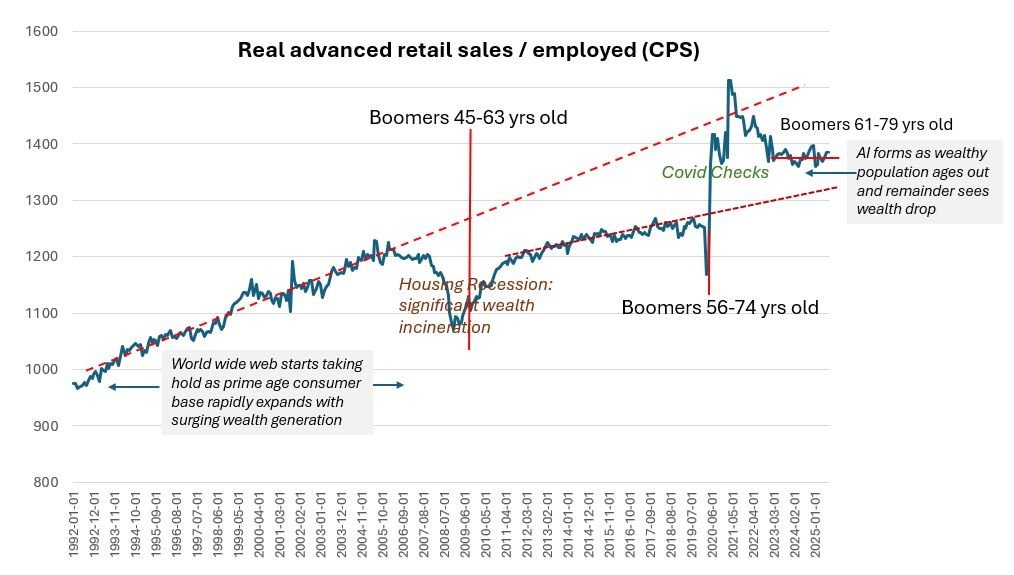
Ron Hetrick's Linkedin post
The traditional consumerism model that powered capitalism since the 1990s is exhausting itself. AI companies are making massive capital investments while the consumer base that would justify those investments is shrinking and aging out of peak spending years.
Carroll's Vision - Redesigning the Feedback Loop
Michael's commentary goes beyond critique to describe what's needed... "They are not chasing scale. They are redesigning the feedback loop of civilization. They are using ubiquitous connectivity to build explainable reasoning at the edge, democratizing logic itself, and connecting it all through the transparent architecture of permission and trust called access."
This describes the XMPro MAGS architectural approach precisely. Let me unpack each element.
- Not Chasing Scale XMPro MAGS doesn't optimize for processing more data or running more automations. It optimizes for better reasoning and decision quality.
- Redesigning the Feedback Loop Traditional automation creates one-way execution paths. XMPro MAGS creates continuous learning loops where every outcome improves future decisions.
- Explainable Reasoning at the Edge MAGS agents operate where decisions need to be made, with full transparency about their reasoning process.
- Democratizing Logic Expert knowledge becomes accessible to less experienced workers through agent support, not locked away in black-box AI systems.
- Transparent Architecture of Permission and Trust The separation of control in XMPro MAGS creates structural safety where agents can reason but the control system determines what actually happens.
Why Current AI Approaches Can't Solve This
Hetrick's argument cuts to the heart of why most AI investment is misaligned with economic reality. Current AI implementations focus on
- Destroying jobs without creating equivalent value
- Devouring capital in pursuit of scale
- Automating tasks for enterprises whose customer bases are stagnating
- Pattern matching and content generation that doesn't address the structural economic problem
These systems were built for a world of expanding markets and growing workforces. That world no longer exists. When your potential buyers are declining in number and wealth, optimizing operational efficiency through traditional automation simply accelerates the mismatch between production capacity and consumption capacity.
The Cognitive Architecture Difference: Why XMPro MAGS Embodies Carroll's Vision
Michael's observation that pioneers are "rebuilding AI as reasoning systems, not analytic tools" describes XMPro MAGS's foundational design principle. The distinction matters fundamentally.
Analytic Tools vs. Reasoning Systems
Current AI approaches are analytic tools. They:
- Process data to find patterns
- Generate content based on training data
- Automate repetitive tasks
- Replace human labor with machine execution
Reasoning systems like XMPro MAGS operate differently. They:
- Understand causal relationships, not just correlations
- Make decisions based on first principles and domain expertise
- Optimize for multiple variables simultaneously
- Preserve and extend human knowledge rather than replacing human judgment
The Economic Value of Cognitive Architecture
In a world of declining consumption and stagnating markets, the economic model shifts from "produce more efficiently" to "optimize what actually matters." This requires understanding cause and effect, not just automation of existing processes.
XMPro MAGS creates value in this new economic reality through:
Causal Understanding Over Pattern Matching
- Agents don't just detect anomalies; they understand why events occur
- This prevents wasted activity on non-causal factors
- Organizations escape the "Activity Trap" where busy work replaces effective work
Multi-Variable Optimization for Real Efficiency
- Instead of optimizing single metrics (which often creates problems elsewhere), MAGS agents optimize across multiple objectives simultaneously
- This creates genuine resource efficiency, not just shifted costs
- In resource-constrained environments, this matters exponentially more than in growth environments
Knowledge Preservation and Democratization
- As experienced workers retire (part of the demographic shift Hetrick describes), their expertise doesn't disappear
- XMPro MAGS captures expert reasoning as causal models and decision logic
- This knowledge becomes accessible to less experienced workers, democratizing expertise
Explainable Decision Making
- Every decision has a transparent reasoning chain
- This creates trust and allows humans to verify, learn from, and improve agent recommendations
- Contrast this with black-box AI that demands blind faith
Reasoning at the Edge: Carroll's Vision Realized
Michael describes pioneers "using ubiquitous connectivity to build explainable reasoning at the edge, democratizing logic itself." This captures XMPro MAGS architecture precisely.
Edge Intelligence with Central Coordination
XMPro MAGS deploys cognitive agents that:
- Process information locally where decisions need to be made
- Maintain shared memory and knowledge spaces for coordination
- Operate through the ORPA Observe, Reflect, Plan, Act cycle continuously
- Scale intelligence by adding specialized agents, not just processing power
This distributed cognitive architecture aligns with economic reality. In a world where central coordination becomes more expensive and local optimization more valuable, reasoning systems that work at the operational edge while maintaining strategic coordination create competitive advantage.
The Transparent Architecture of Permission and Trust
Michael's reference to "the transparent architecture of permission and trust called access" captures another critical XMPro MAGS design principle: separation of control.
In XMPro MAGS:
- Agents can observe, reflect, plan, and recommend
- But the control system - XMPro DataStreams - determines what actually happens
- This separation creates structural safety
- Every action has an audit trail showing the reasoning and the permissions
This architectural transparency builds trust without requiring blind faith in AI systems. Organizations can deploy cognitive agents while maintaining explicit control over what those agents can actually do.
The New Feedback Loop of Civilization
Michael describes the pioneers as "redesigning the feedback loop of civilization." This isn't hyperbole when you understand what's actually changing.
From Scale to Intelligence
The old economic model optimized for scale:
- More production
- More consumption
- More automation of the same processes
- More data processed the same way
The new model must optimize for intelligence:
- Better decisions with fewer resources
- Understanding what actually drives outcomes
- Adapting to changing conditions
- Learning from experience rather than just executing instructions
XMPro MAGS as Organizational Intelligence Infrastructure
XMPro MAGS creates a new organizational capability: distributed cognitive intelligence that operates at human collaboration speeds but with machine consistency and memory.
Memory Architecture That Learns
- Observations from sensors and systems
- Reflections that capture learned patterns and insights
- Plans with strategic reasoning
- Actions with outcome tracking
- This creates genuine learning, not just pattern replication
Collaborative Agent Teams
- Multiple specialized agents work together
- Each maintains domain expertise
- They coordinate through shared knowledge spaces
- Consensus mechanisms ensure quality decisions
- This mirrors how effective human teams operate, but at scale
Continuous Improvement Loops
- Every human intervention enriches the causal models
- The system gets smarter with experience
- Knowledge doesn't disappear when experts retire
- Organizations build institutional intelligence that compounds over time
Why This Matters More as Markets Contract
In expanding markets, inefficiency is tolerable. Growth covers mistakes. But in contracting or stagnant markets, every wasted resource becomes critical.
Traditional AI automation optimizes specific processes but often creates inefficiency elsewhere in the system. You reduce labor costs but increase coordination overhead. You speed up production but create quality problems downstream. You cut operational expenses but lose institutional knowledge.
XMPro MAGS takes a different approach:
System-Level Optimization
- Agents understand interdependencies across processes
- They optimize for multiple objectives simultaneously
- This prevents local optimization that creates global problems
Resource Efficiency Through Better Decisions
- When you understand causal relationships, you stop wasting resources on non-causal factors
- This creates real efficiency gains, not just cost shifting
- In resource-constrained environments, this difference becomes existential
Capability Enhancement Rather Than Labor Replacement
- MAGS agents make human expertise more effective, not obsolete
- Less experienced workers can make better decisions with agent support
- This addresses the skills gap that Hetrick's demographic shifts create
The Path Forward: Cognitive Systems for a Different World
Carroll and Hetrick together make the case that AI as built over the past decade won't fix the structural economic problem. Scale-focused, pattern-matching systems were designed for the old economic model.
What's needed are reasoning systems that:
- Understand cause and effect
- Optimize across multiple variables
- Preserve and extend human expertise
- Operate transparently with explainable logic
- Work at the edge while coordinating centrally
XMPro MAGS embodies these principles because it was designed for complex industrial operations where mistakes are costly, resources are constrained, and understanding causality is essential.
The economic inflection point Hetrick describes makes these capabilities valuable everywhere, not just in industrial settings. Organizations that adopt cognitive reasoning architectures will navigate the new economic reality successfully. Those that continue investing in scale-focused automation will burn capital chasing growth that no longer exists.
Carroll's vision of redesigning the feedback loop of civilization requires this architectural shift. The question is whether organizations will recognize this and invest in the right approach before the mismatch between capability and consumption becomes catastrophic.
Building for the Reality We're In, Not the One We Left
Michael's framing and Ron's data together reveal a fundamental misalignment between economic reality and technology investment. XMPro MAGS represents the type of architectural thinking Carroll describes as necessary to navigate this new reality:
- Reasoning systems rather than analytic tools
- Causal understanding rather than pattern matching
- Multi-variable optimization rather than single-metric automation
- Knowledge democratization rather than labor replacement
- Transparent, explainable intelligence rather than black-box AI
The pioneers rebuilding AI as reasoning systems aren't chasing scale. They're designing the cognitive infrastructure that aligns enterprise architecture with the new economic architecture. They're building systems that create value through better decisions, not just faster execution of old models.
Michael sees this clearly: when enterprise architecture and economic architecture no longer align, every gain feels hollow. XMPro MAGS was architected to restore that alignment through reasoning systems that understand causality, optimize across multiple variables, preserve knowledge, and operate transparently.
That's the inflection point that matters. And that's what XMPro MAGS was built to address.
I’ll get off my soapbox now . . .
Pieter van Schalkwyk is the CEO of XMPro, specializing in industrial AI agent orchestration and governance. Drawing on 30+ years of experience in industrial automation, he helps organizations implement practical AI solutions that deliver measurable business outcomes while ensuring responsible AI deployment at scale.
About XMPro: We help industrial companies automate complex operational decisions. Our cognitive agents learn from your experts and keep improving, ensuring consistent operations even as your workforce changes.
Our GitHub Repo has more technical information. You can also contact me or Gavin Green for more information.
Read more on MAGS at The Digital Engineer