





















Pieter Van Schalkwyk
CEO at XMPRO
Something happened in our engineering team recently that made me rethink what expertise means in 2025. We have young engineers, three to four years out of university with undergraduate degrees in mechanical, electrical, and automation engineering. Classical training in thermodynamics, control systems, and process engineering. Some have added postgraduate work in data science, but their foundation is traditional engineering.
These engineers are now building and deploying multi-agent systems that coordinate predictive maintenance, quality control, and energy optimization across industrial facilities. They're configuring agents that analyze vibration signatures, optimize process parameters, and recommend interventions based on real-time operational data. Five years ago, this would have required specialist teams with deep software engineering expertise, extensive data science experience, and years of industrial AI practice working together for months.
Now it happens in weeks, led by engineers whose undergraduate training focused on heat transfer and fluid dynamics, not distributed systems or reinforcement learning. They're not more brilliant than previous generations. They're orchestrating AI capabilities that simply didn't exist when they started their degrees, and watching this unfold raises uncomfortable questions about what experience means and where human expertise creates value.
I've spent 30 years in this field, watching how we develop industrial expertise and build complex operational systems. What I'm seeing now isn't just faster development. It's the emergence of what I call Agentic Operations for Industrial Enterprises, where multiple AI agents coordinate autonomously to execute, optimize, and continuously improve operational processes. This represents a fundamental restructuring of three constraints that have limited industrial operations for decades: complexity, skills, and scarcity.
The Skills Paradox
Here's what's both fascinating and unsettling: junior engineers can now produce outputs that previously required senior-level expertise. But this doesn't mean experience has become worthless. It means what experience is for has changed completely.
The bottleneck has moved. Five years ago, the limiting factor was execution capability, whether you could write the integration code, configure the control logic, or build the data pipelines. Today, AI handles much of that execution. The new bottleneck is judgment, specifically knowing when AI-generated solutions are right, when they're subtly wrong, and when they're dangerously wrong.
In industrial contexts, this distinction matters profoundly:
- Software bugs can be patched with minimal consequence
- Manufacturing quality failures create warranty claims and customer losses
- Safety incidents have human and regulatory consequences that can shut down operations
Working with operators in mining, oil and gas, and manufacturing, I see this play out daily. A junior engineer can configure a predictive maintenance agent that analyzes vibration data, identifies bearing degradation patterns, and recommends intervention timing. The AI can generate sophisticated algorithms and the engineer can deploy them quickly. But only someone with years of operational experience knows whether the model is picking up real failure signatures or just curve-fitting to coincidental patterns in the training data.
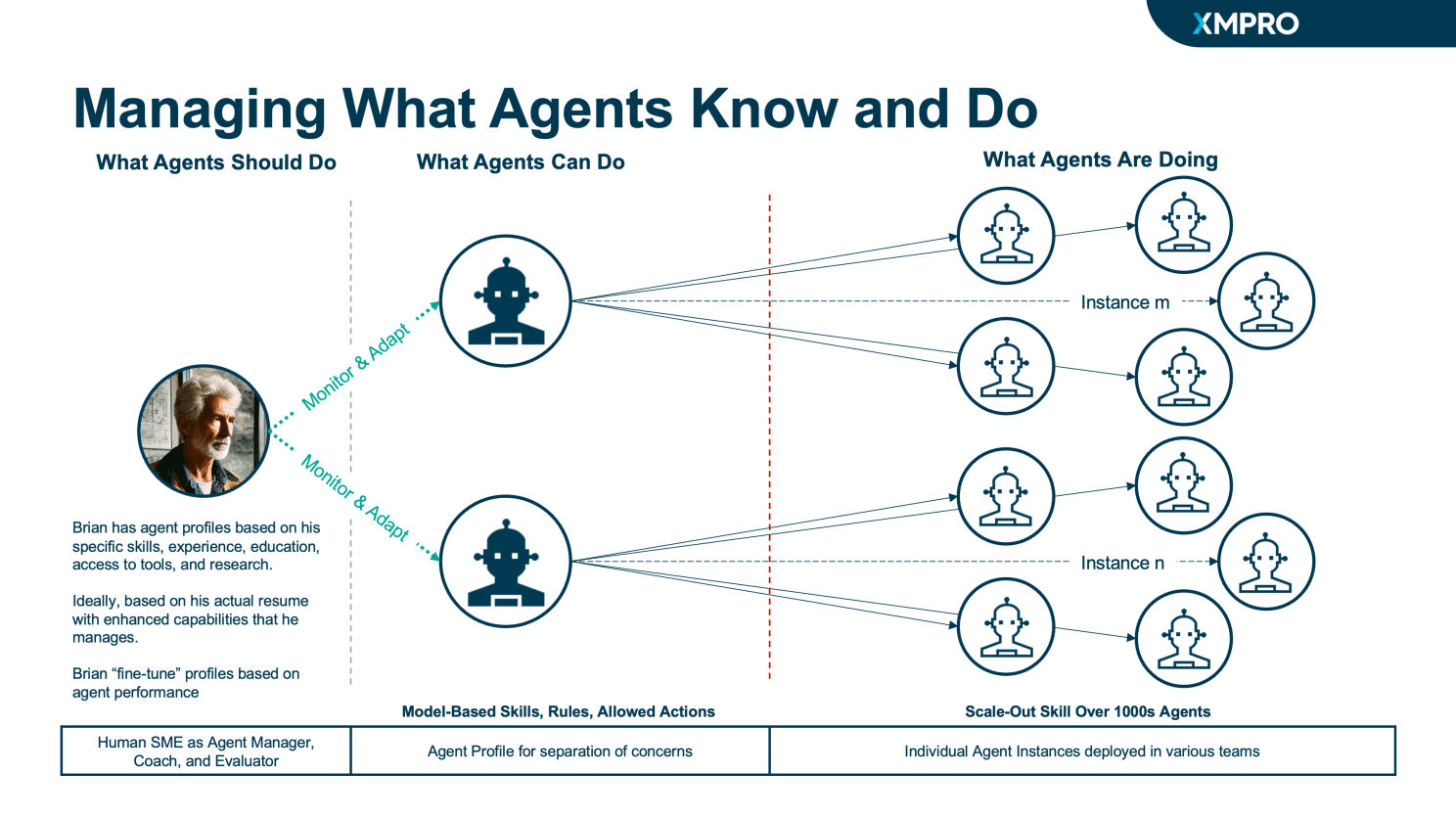
Experience is now available at scale
The senior engineers who validate those configurations, understand the edge cases, and architect for reliability are more valuable than ever. The difference is they're not writing code anymore. They're supervising intelligent systems, validating AI recommendations against operational reality, and making architectural decisions about human-agent collaboration patterns.
The Complexity Reality
Modern industrial facilities generate massive data streams across hundreds of interdependent systems. Process optimization requires synthesizing insights across operations, maintenance, quality, safety, and energy simultaneously. No human can monitor everything or optimize holistically through direct observation anymore.
This is where Agentic Operations changes the equation fundamentally. We're not facing a productivity problem, we're facing a cognitive capacity problem because the systems we operate have exceeded human ability to comprehend them as integrated wholes. Multi-agent coordination doesn't just speed up existing work. It addresses activities at scales and complexities that teams of humans working in isolation simply couldn't manage.
Consider what autonomous operations actually requires:
- Real-time monitoring of thousands of process variables and equipment conditions
- Pattern recognition across multiple time scales from milliseconds to months
- Optimization that balances competing objectives across operational domains
- Coordination of sequential and parallel activities with complex dependencies
- Exception handling that escalates novel situations to human oversight
We're seeing early examples of extended autonomous operations where multiple agents coordinate process optimization, quality control, and safety-critical decisions without human intervention for days or weeks at a time. That's not automation of existing manual work. That's operational capability that didn't exist before because humans couldn't physically coordinate that many decisions simultaneously while maintaining safety and quality standards.
But here's the critical insight: autonomous operations become possible only after human experts spend months architecting the agent behaviors, defining the handoff protocols, and establishing the governance frameworks. The agents execute autonomously. The humans architected the autonomy.
The Scarcity Solution
There aren't enough experienced engineers to meet global industrial demand, and we're losing senior expertise to retirement faster than we can train replacements. The traditional response of hiring more people and training them for 10 to 15 years can't scale because qualified candidates don't exist at any wage level that makes economic sense.
Junior engineers orchestrating AI capabilities change this equation fundamentally. They're not just more productive at existing tasks. They're accessing patterns learned from millions of deployments and building on frameworks that encode decades of collective knowledge. This shifts the constraint from "how many engineers do we have" to "how effectively have we architected human-agent collaboration."
At one global mining operator, experienced engineers now oversee multiple facilities through intelligent digital twin systems. Each facility would have previously required dedicated engineering teams monitoring control rooms, analyzing data, and coordinating interventions. The engineers haven't been replaced. They've been elevated to roles where their expertise has broader impact, focusing on architecture, validation, and strategic optimization while agents handle routine monitoring and standard responses.
This approach addresses both the availability problem (we don't have the people) and the economics problem (we couldn't afford them if we did) by preserving expert knowledge and extending its application. But it only works if we architect it thoughtfully, because quick AI-generated solutions deployed without proper validation, governance, or human oversight create new risks.
What Experience Means Now
The difference between using AI effectively and not using it well is becoming larger than the traditional gap between junior and senior engineers. But let me be clear: this doesn't mean experience doesn't matter. It means experience matters differently.
You don't need 15 years to learn syntax or memorize API documentation anymore. You need 15 years to develop:
- Judgment about when AI recommendations are trustworthy versus when they're extrapolating beyond reliable bounds
- Architectural thinking to design robust human-agent collaboration that leverages both human and artificial intelligence effectively
- Operational wisdom to understand what "good enough" means in safety-critical contexts where perfection is impossible but failure is unacceptable
- Systems perspective to see how process changes cascade through interconnected operations in ways that models trained on historical data can't anticipate
For industrial engineers working in mechanical, process, quality, environmental health and safety, or continuous improvement roles, this shift is particularly profound. The engineers who thrive will be those who can orchestrate intelligent systems rather than directly execute tasks, validate AI outputs against operational reality and safety requirements, architect human-agent collaboration patterns that leverage both effectively, and learn continuously as AI capabilities evolve while staying grounded in unchanging physical laws.
The work is becoming more strategic, more architectural, and more about judgment and context. Less about execution mechanics and more about designing the systems that execute. This isn't a loss of technical work. It's an elevation to work that requires deeper technical understanding applied at higher levels of abstraction.
The Real Transformation
When I watch our young engineers accomplish in weeks what took specialist teams months just a few years ago, my instinct is to think about productivity gains and competitive advantage. But the deeper question is what this means for every engineer's career, learning journey, and sense of contribution.
We're not just adopting new tools. We're creating a new category of industrial operations where AI agents and human experts work together in coordinated systems. Agentic Operations redefines what expertise means, where human intelligence adds unique value, and how industrial facilities actually run. The complexity that overwhelmed us becomes manageable through coordinated multi-agent systems. The skills that took years to develop become accessible earlier through AI that encodes collective knowledge. The scarcity that constrained us becomes solvable by multiplying expert capacity through thoughtful human-agent architecture.
But only if we're thoughtful about how we architect this collaboration. The velocity advantage of AI-accelerated development becomes a liability if our organizations can't safely absorb what gets built at ten times the speed.
We need to preserve the judgment that only comes from experience while elevating engineers to focus on challenges that truly require human wisdom.
That's the transformation we're really navigating. Not just faster development or better tools, but a fundamental shift in what it means to be an industrial engineer and where human expertise creates irreplaceable value.
How are you seeing AI change what expertise means in your domain? What aspects of your work are being accelerated, and what aspects are becoming more important because they can't be automated?
Pieter van Schalkwyk is the CEO of XMPro, specializing in industrial AI agent orchestration and governance. Drawing on 30+ years of experience in industrial automation, he helps organizations implement practical AI solutions that deliver measurable business outcomes while ensuring responsible AI deployment at scale.
About XMPro: We help industrial companies automate complex operational decisions. Our cognitive agents learn from your experts and keep improving, ensuring consistent operations even as your workforce changes.
Our GitHub Repo has more technical information. You can also contact me or Gavin Green for more information.
Read more on MAGS at The Digital Engineer