























Pieter Van Schalkwyk
CEO at XMPRO
In Part 1, we explored how agentic organizations fundamentally change business models and operating structures. Now we'll tackle the two most challenging aspects of this transformation: governance that operates at machine speed and workforce evolution.
These aren't optional considerations. They're the difference between successful agentic operations and expensive failures. Let's examine how to get them right.
Governance: Embedded Controls at Machine Speed
The governance transformation may be the most critical and most difficult aspect. Traditional governance operates through periodic review: quarterly audits, weekly compliance checks, and monthly performance reviews. This cadence assumes human execution speed. It accepts that governance lags behind operations.
Agentic Systems Demand Real-Time Governance
Agents operate continuously at machine speed. You cannot audit agent decisions quarterly when agents make thousands of decisions daily. Instead, governance must become embedded in the agent architecture itself. It operates as a continuous control system rather than a periodic review process.
This is where many organizations stumble. They try to apply traditional governance processes to agentic systems. The result? Either unacceptable risk or agents slowed to human speed (eliminating the benefit).
How XMPro MAGS Implements Governance
XMPro MAGS implements governance through three integrated mechanisms:
The Deontic Framework defines formal behavioral rules that agents cannot violate. These include obligations that agents must fulfill. They include prohibitions that agents cannot transgress. They include permissions that define allowed actions. They include conditional duties that depend on context.
These rules aren't post-hoc checks. They're structural constraints that shape agent reasoning before actions occur. An agent physically cannot recommend an action that violates a prohibition, the same way a car cannot exceed the governor speed limit.
Supervisor Agents provide continuous oversight with configurable monitoring cycles. They detect when specialist agents deviate from expected patterns. They identify when operational conditions require human escalation. Think of them as automated compliance officers that never sleep and review every decision in real time.
Complete Audit Trails document not just what agents did but why they made particular decisions. This creates real-time compliance validation rather than periodic verification. When a regulator asks "why did you take this action?", you have immediate, detailed answers.
Finding the Right Balance
The challenge is finding the right balance between governance rigor and operational speed. Excessive oversight requirements slow agent decision-making to human speed. This eliminates much of the agentic advantage. Insufficient oversight creates unacceptable risk, particularly in industrial operations where physical safety is non-negotiable.
The solution involves graduated autonomy. Agents operate in monitoring and recommendation modes initially. They gain execution authority only after their behavior proves reliable within specific boundaries. This is similar to how you train a new operator: observation first, then supervised execution, then independent operation.
Governance as Capability, Not Constraint
Governance transforms from a constraint that slows operations to a capability that enables safe autonomy. Embedded controls allow agents to operate at machine speed precisely because the controls operate at machine speed as well.
Consider process safety management. Traditional approaches define safe operating limits, train operators on these limits, and audit compliance. An agentic approach builds these constraints into the agents themselves. A production optimization agent cannot recommend operating conditions outside safety envelopes. A maintenance agent cannot defer inspections beyond regulatory limits. Compliance becomes embedded in the agent architecture rather than being a separate oversight function.
Workforce Transformation: Three Emerging Roles
McKinsey identifies three roles that define the agentic workforce. Each role represents a genuine evolution rather than a simple skill upgrade. Understanding these roles helps you plan your workforce transition.
Role 1: M-Shaped Supervisors
M-shaped supervisors possess breadth across multiple domains combined with depth in orchestrating agent networks. In industrial operations, this might be a reliability leader who understands:
- Production economics
- Equipment failure modes
- Maintenance logistics
- Regulatory requirements
- Organizational dynamics
They also know how to define agent objectives, tune agent behavior, and interpret agent performance metrics. This isn't a traditional reliability engineer with AI training added. This is a fundamentally different role combining systems thinking with agent fluency.
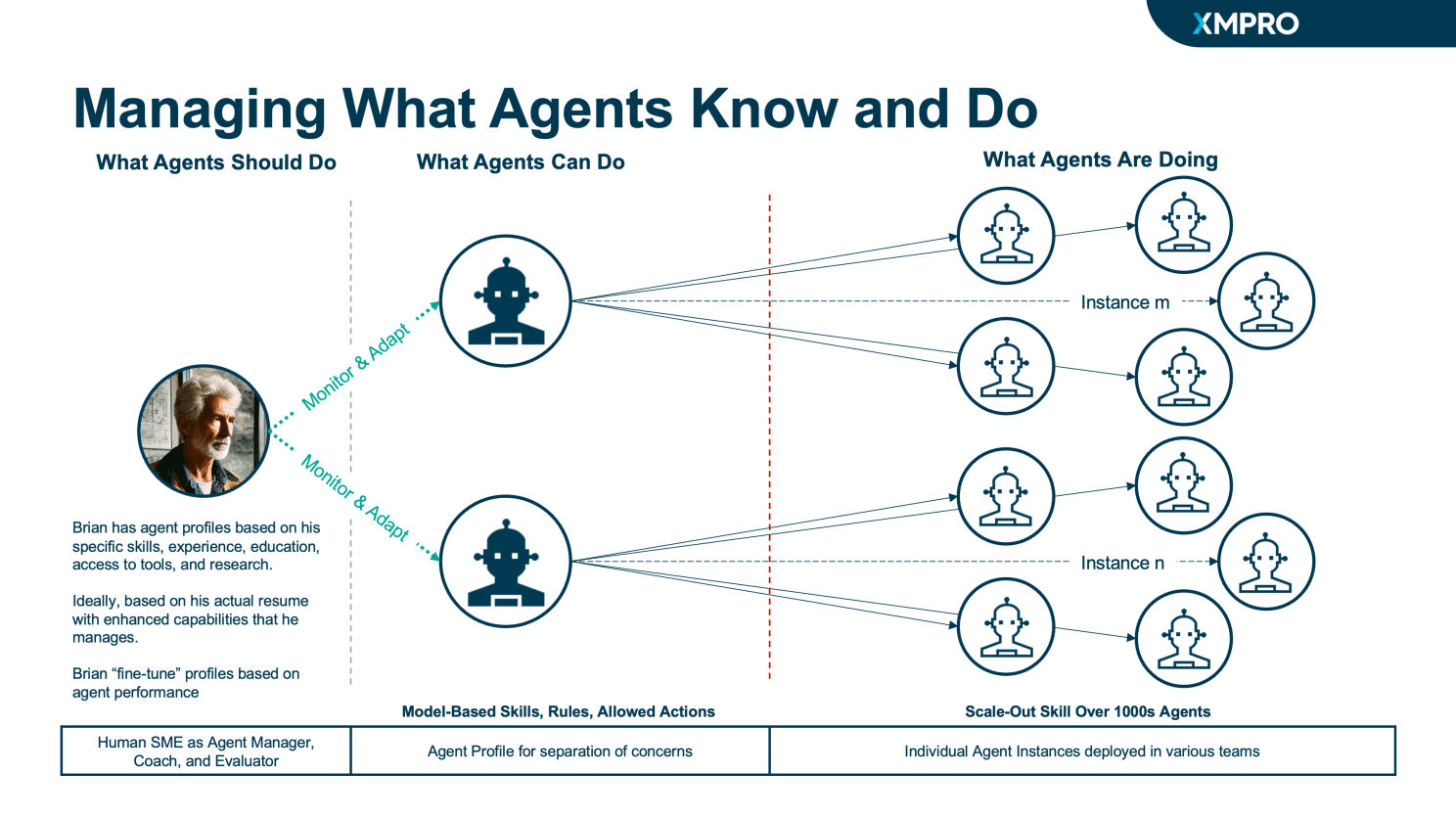
Role of M-Shaped Supervisors in XMPro MAGS for Enterprise Scale
Developing M-Shaped Supervisors
Traditional industrial careers build functional depth. You become an expert process engineer, then a senior process engineer, then a principal engineer. You gain limited cross-functional experience.
The M-shaped path builds breadth earlier through rotations across operations, maintenance, engineering, and quality. It combines this with immersion in agentic systems. Organizations need to identify individuals with integrative mindsets and systematically develop their capabilities.
This requires deliberate career design, not accidental development. You must create rotation programs, mentorship structures, and learning pathways specifically for this role.
Role 2: T-Shaped Experts
T-shaped experts provide deep domain knowledge in specific technical areas: metallurgy, process chemistry, rotating equipment, control systems. Their role shifts from executing analysis themselves to teaching agents how to analyze. They handle exceptions that exceed agent capabilities. They continuously improve agent performance based on operational learning.
An expert process engineer spends less time analyzing every process upset. They spend more time codifying response patterns that agents can execute autonomously. They reserve human attention for novel situations requiring genuine expertise.
The Knowledge Codification Challenge
This shift demands new capabilities around knowledge codification. Much industrial expertise exists as tacit knowledge. Experienced operators know when "something doesn't feel right" but cannot easily articulate what patterns they detect. Making this knowledge explicit enough for agents to learn from it represents substantial cognitive work.
XMPro's approach builds agent knowledge through operational patterns and domain models. This provides tools for codification, but the fundamental work remains human. You must help your experts develop this translation capability.
Role 3: AI-Augmented Frontline Workers
AI-augmented frontline workers focus on tasks requiring physical presence, stakeholder interaction, or ethical judgment. Maintenance technicians execute physical repairs. Operators handle non-routine situations requiring human perception. Supervisors address people management issues.
These roles become more skilled rather than less skilled. Agents handle routine aspects (diagnostics, work order generation, parts logistics, documentation). This allows humans to focus on complex problem-solving and judgment. Human actions are recorded and can be used as synthetic memories for agents after validating their effectiveness.
Elevating Rather Than Eliminating
This is a critical distinction. The agentic transformation doesn't eliminate frontline workers. It elevates their work by removing routine burden. A maintenance technician no longer spends hours diagnosing a problem, searching for procedures, and ordering parts. They arrive on-site with the diagnosis complete, procedures ready, and parts in hand. They focus on the skilled physical work of repair.
This means your frontline workforce becomes more valuable, not less valuable. But they need new capabilities to work effectively with agent support.
Capturing Ground-Truth Operational Intelligence
Before agents can operate effectively, they need to learn from actual operational experience. This goes far beyond traditional SCADA data.
What Leading Organizations Capture
The most successful implementations systematically capture operational intelligence that traditional systems miss:
- Operator action sequences linked to specific alarm events and process conditions. These show what experienced operators actually did, not just what procedures say they should do.
- Structured expert knowledge from HAZOP studies and operational reviews. We've seen knowledge bases with 500+ process scenarios capturing the "why" behind expert decisions.
- High-frequency monitoring at 5-second cycles across 200+ parameters. This enables correlation of human interventions with process states, revealing patterns that slower sampling misses.
- Event logging systems that document not just what sensors showed, but what operators observed and how they responded. This captures the ground-truth context that makes interventions successful.
The Causal AI Difference
This is where implementation approaches diverge. Traditional machine learning finds correlations. Causal AI understands why things happen. Causal reasoning for agents combines M and T-Shaped skills to understand the "why", similar to field operators.
Floris Wyers used this example in his question in Part 1. Here is how Agents with Causal understanding address the challenge. Consider an operator who notices a "stiff valve" before a pressure drop occurs. Traditional ML might eventually correlate valve position lag with pressure drops. Causal AI understands the mechanism: stiff valve creates flow restriction, local cooling occurs, pressure drops follow.
The causal model learns this observation. Next time it sees early indicators (temperature profile changes, valve position lag), it understands why these matter. It predicts the consequence chain before the pressure drop occurs.
What Real Operator Data Reveals
When we analyze actual operator actions from production facilities, we discover something important. They're inconsistent. Different operators handle the same situation differently. Many don't follow standard operating procedures.
This isn't a criticism of operators. It reflects the reality that tacit knowledge varies, experience levels differ, and contextual factors influence decisions. Some approaches work better than others under specific conditions.
Agents don't just learn what operators did. They learn why certain interventions worked by understanding the causal mechanisms. Then they execute best practices consistently across all shifts, regardless of time of day or operator fatigue.
The Two-Way Loop in Production
This creates the bi-directional loop that makes agentic systems different from traditional automation:
- Human to AI: Operator response sequences show what actions worked in specific contexts. Historical intervention data reveals tacit knowledge. Expert reasoning captured in cause-consequence relationships validates the causal models.
- AI to Human: Real-time safety zone monitoring with predictive alerts based on causal understanding. Root cause analysis that traces back through causal chains, not just pattern matching. Clear escalation protocols when situations exceed learned boundaries.
When humans intervene for edge cases or novel situations, those observations don't just get logged. They enrich the causal models. This creates genuine process understanding, not just pattern matching. The system gets smarter with every human intervention.
The Workforce Transition Challenge
The workforce transition creates substantial challenges. Industrial organizations often have limited digital fluency. How do you bridge this gap?
The Encouraging Evidence
Early implementations provide encouraging insights. Employees without technical backgrounds can learn to manage agentic workflows as quickly as trained engineers. This suggests the learning curve is manageable with appropriate support.
However, you need significant investment in:
- Training programs tailored to different roles
- Change management that addresses fears and builds confidence
- Career development pathways that show progression opportunities
- Performance systems that reward new behaviors
Addressing the Fear Factor
The biggest barrier isn't technical capability. It's fear. Workers fear replacement. Managers fear loss of control. Experts fear obsolescence.
Address this directly. The agentic transformation changes what humans do, not whether humans are needed. Organizations that handle this transition well communicate clearly:
- What stays the same (human judgment, strategic thinking, complex problem-solving)
- What changes (routine execution, coordination overhead, documentation burden)
- What opportunities emerge (more interesting work, better work-life balance, career growth)
Building Trust Through Transparency
Trust builds through transparency about agent behavior. When workers understand how agents make decisions, they're more comfortable relying on agent support. When they see that agents escalate appropriately, they trust the handoff process.
XMPro MAGS provides this transparency through explainable agent reasoning and clear escalation protocols. Use these features actively in training and communication.
Practical Implementation Steps
Based on early adopter experience, here's how to approach workforce transformation:
Phase 1: Identify and Develop Champions
Find individuals who combine domain expertise with openness to new approaches. These become your M-shaped supervisor candidates. Invest heavily in their development. They'll lead the transformation and mentor others.
Phase 2: Create Safe Learning Environments
Let people experiment with agent systems in low-risk contexts. Start with monitoring and recommendation modes before moving to execution. Allow mistakes and learning without penalty.
Phase 3: Demonstrate Quick Wins
Show concrete examples of how agents make work easier, not just more efficient. The maintenance technician who goes home on time because diagnostics are complete. The operator who catches problems early because agents monitor continuously.
Phase 4: Scale Systematically
Build training programs, documentation, and support structures. Don't rely on heroic individual effort. Create systems that enable widespread adoption.
What Success Looks Like
Successful workforce transformation shows these characteristics:
- Workers actively seek ways to use agents rather than avoid them
- Domain experts contribute to agent knowledge bases voluntarily
- Frontline workers trust agent recommendations and escalate appropriately
- Managers focus on strategic questions rather than operational details
- The organization continuously improves agent behavior based on operational learning
You'll know you've succeeded when people cannot imagine going back to the old way of working.
Coming in Part 3
In the final article, we'll cover the technology architecture and practical implementation roadmap. You'll learn:
- How agent-to-agent protocols simplify integration
- Why dynamic sourcing prevents vendor lock-in
- The lighthouse implementation approach
- Concrete steps to start your agentic transformation
The governance and workforce changes we've covered here enable the technical transformation we'll discuss next. Get these human elements right, and the technology implementation becomes much smoother.
Pieter van Schalkwyk is the CEO of XMPro, specializing in industrial AI agent orchestration and governance. Drawing on 30+ years of experience in industrial automation, he helps organizations implement practical AI solutions that deliver measurable business outcomes while ensuring responsible AI deployment at scale.
About XMPro: We help industrial companies automate complex operational decisions. Our cognitive agents learn from your experts and keep improving, ensuring consistent operations even as your workforce changes.
Our GitHub Repo has more technical information. You can also contact me or Gavin Green for more information.
Read more on MAGS at The Digital Engineer