



















The Complete Guide to Agentic AI in Industrial Operations: How AI Agents Are Transforming Manufacturing, Mining, and Asset-Intensive Industries in 2025
Executive Summary: The Agentic AI Revolution Transforms Industrial Operations
Bottom Line Up Front: Gartner has named agentic AI as the top technology trend for 2025, representing autonomous machine agents that move beyond simple chatbots to perform complex enterprise tasks without human guidance. Deloitte projects that 25% of enterprises using GenAI will deploy autonomous AI agents in 2025, doubling to 50% by 2027.
The Paradigm Shift: Unlike traditional automation systems that follow predetermined rules, agentic AI demonstrates autonomous decision-making, continuous learning, and adaptive behavior that fundamentally transforms industrial operations. These systems evolve from content generators to autonomous problem-solvers capable of reasoning, planning, and taking action independently.
Market Impact: The autonomous AI and agents market is projected to reach $156 billion by 2034, with industrial implementations already delivering documented ROI exceeding 250% within 24 months for predictive maintenance applications.
Key Industry Indicators
Global spending on AI systems is expected to soar to $300 billion by 2026, growing at 26.5% year-on-year, with agentic AI driving significant portions of this investment. Research indicates that 70% of organizations will operationalize AI designed for autonomy by 2025, while manufacturing leaders report 10,000+ man-hours saved annually through multi-agent deployments. Advanced industrial implementations are processing over 50 million monitoring events daily.
Understanding Agentic AI: The Evolution Beyond Traditional Automation
Defining Agentic AI in Industrial Context
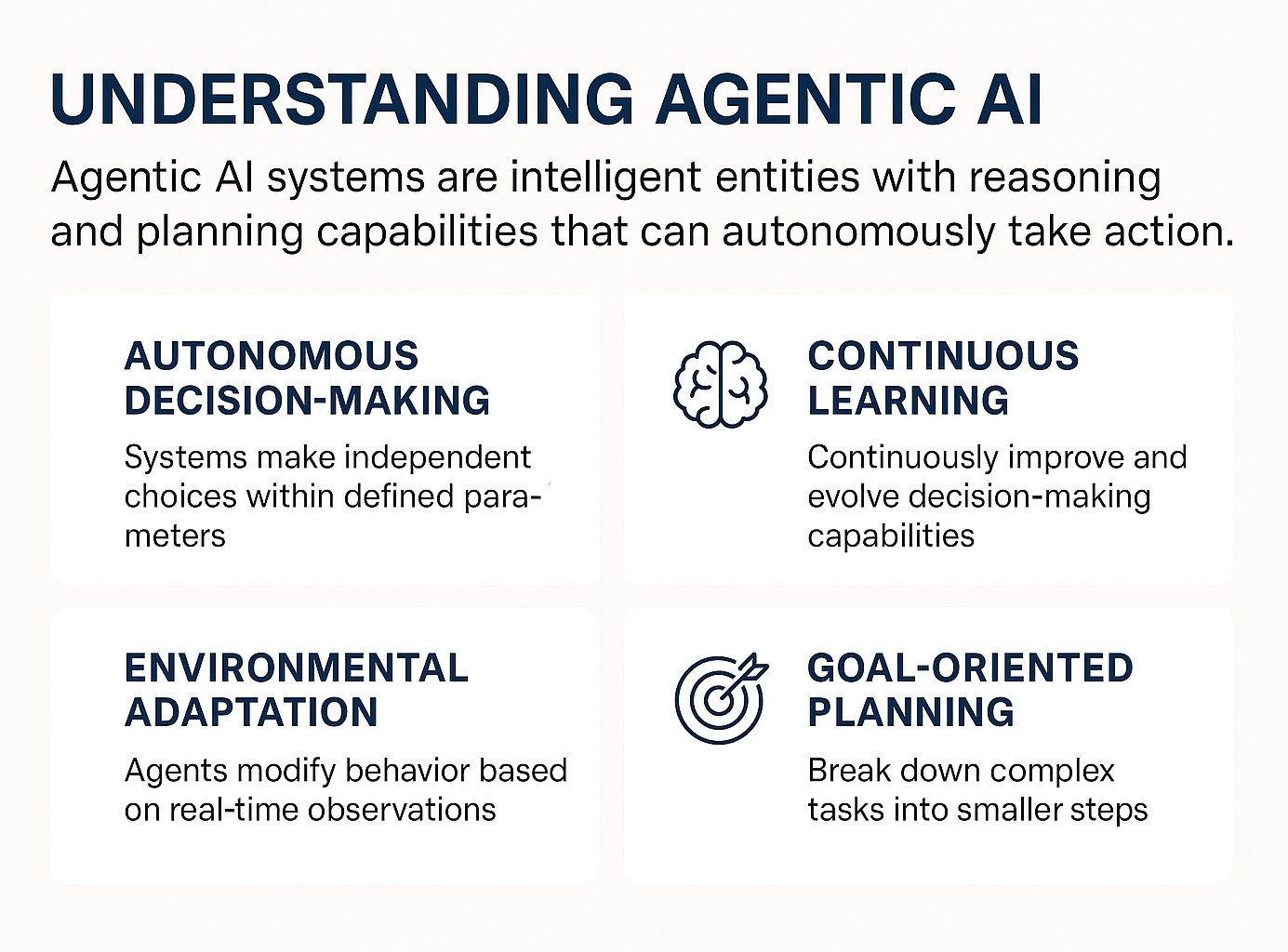
Agentic AI systems are intelligent entities with reasoning and planning capabilities that can autonomously take action. Unlike traditional AI systems constrained by predefined rules, agentic AI operates with autonomy, adaptability, and goal-driven approaches, capable of acting independently and evolving based on real-time data.
Core Agentic Capabilities include autonomous decision-making where systems make independent choices within defined parameters using reasoning processes that adapt to changing conditions rather than following static programming. Agentic AI can continuously improve and evolve decision-making capabilities through machine learning techniques such as deep learning and online learning. Agents modify behavior based on real-time observations, changing operational contexts, and unexpected conditions, while current systems enable LLMs to break down complex tasks into smaller steps through rudimentary planning and tool-calling capabilities.
The Digital Twin Consortium's AI Agent Capabilities Periodic Table (AIA CPT)
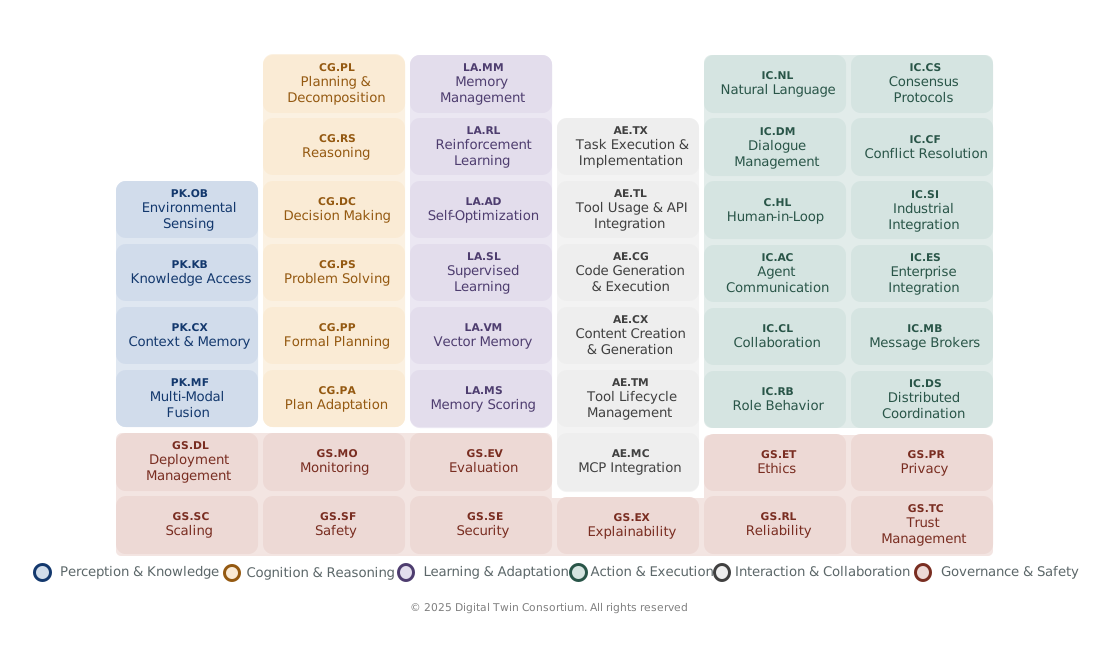
The Digital Twin Consortium has developed a comprehensive framework for understanding and implementing agentic AI systems through the AI Agent Capabilities Periodic Table (AIA CPT), which organizes 45 capabilities across six core categories. These include Perception & Knowledge for understanding operational environments through data ingestion, pattern recognition, and information synthesis, and Cognition & Reasoning for supporting decision-making through logic, problem-solving, and analytical frameworks.
The framework also encompasses Learning & Adaptation for evolving through experience-based improvement and continuous optimization, Action & Execution for enabling real-world outcomes through workflow orchestration and system interaction, Interaction & Collaboration for coordinating across humans, agents, and systems, and Governance & Safety for enforcing security, ethical operation, compliance, and risk management.
Agent Classification Framework: From Automation to Autonomy
The AIA CPT includes a progressive five-level classification system that helps organizations understand the evolution path from basic automation to sophisticated autonomous systems. Type 0 represents Static Automation with pre-programmed responses, no learning capability, and traditional rule-based systems. Type 1 involves Conversational Agents with natural language interaction, basic context management, and query-response functionality.
Type 2 encompasses Procedural Workflow Agents featuring multi-step task execution with tool integration, workflow automation, and role-based collaboration capabilities. Type 3 represents Cognitive Autonomous Agents with self-directed planning, learning from experience, sophisticated reasoning, and autonomous decision-making capabilities. Finally, Type 4 involves Multi-Agent Generative Systems (MAGS) with collaborative intelligence, emergent behaviors, distributed coordination across complex systems, and industrial automation orchestration.
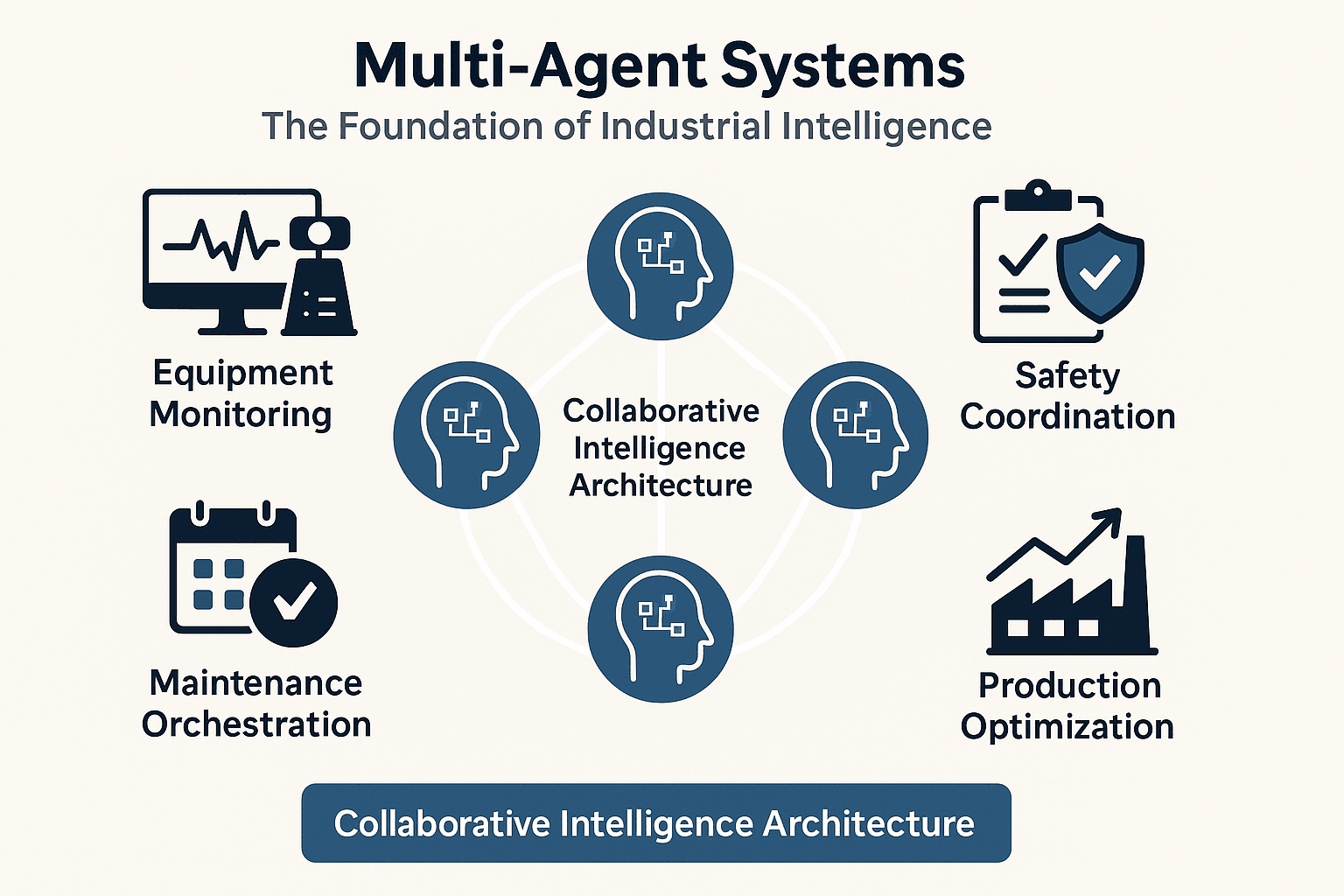
Multi-Agent Systems: The Foundation of Industrial Intelligence
Collaborative Intelligence Architecture
Multi-agent systems break down responsibilities into multiple AI agents, connected and coordinating to accomplish complex tasks, similar to how human organizations distribute specialized roles. This approach addresses the limitations of single agents by leveraging specialized capabilities and coordinated problem-solving.
Individual agents specialize in operational domains while coordinating through structured communication protocols, eliminating bottlenecks and enabling rapid local responses. Agent teams develop capabilities greater than individual components through collaborative problem-solving, with inter-agent communications done in a manner that guarantees encapsulation of responsibilities. The system maintains resilience through redundancy—when one agent fails, others adapt to maintain operational continuity.
Industrial Multi-Agent Coordination
Industrial implementations feature Equipment Monitoring Teams with specialized agents for sensor data analysis, anomaly detection, and performance trend identification working collaboratively to provide comprehensive asset intelligence. Maintenance Orchestration involves coordinated scheduling agents managing resource allocation, parts inventory, and optimal maintenance windows while communicating with production planning systems.
Production Optimization Networks utilize process parameter agents, quality control systems, and throughput maximization agents working together to optimize manufacturing operations. Safety Coordination Systems employ risk assessment agents, compliance monitoring systems, and emergency response coordinators ensuring comprehensive safety management.
Communication and Coordination Protocols
Agents respond to operational events and share relevant information with team members through standardized protocols like MQTT and DDS. Collaborative learning enables agents to contribute insights to shared repositories, creating institutional knowledge that persists beyond individual agent lifecycles. Automated negotiation protocols manage competing objectives and resource requirements through structured decision-making frameworks.
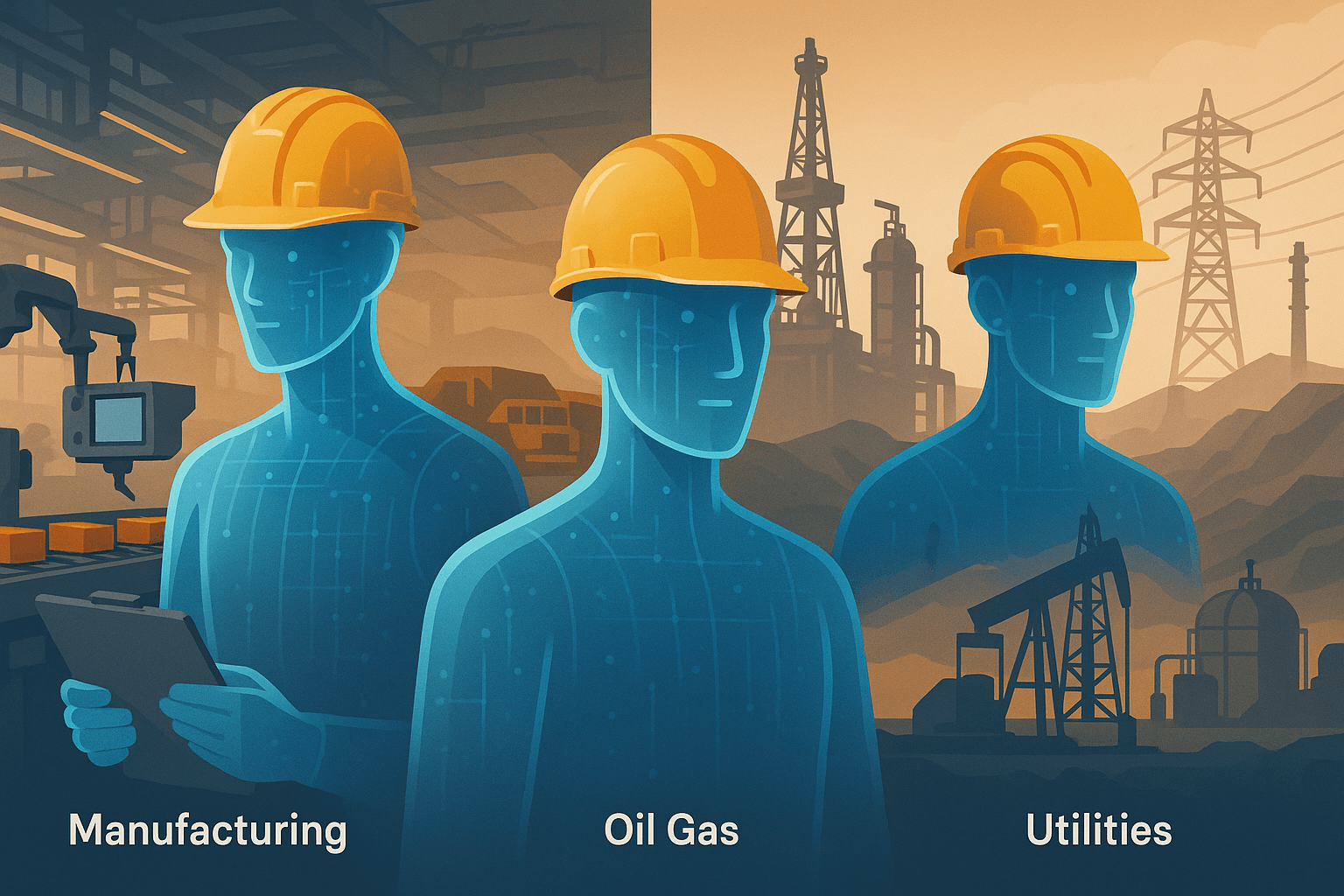
Industry Applications: Real-World Agentic AI Implementations
Manufacturing: Intelligent Factory Orchestration
Agentic systems coordinate quality control through computer vision and spectroscopy analysis, automatically adjusting process parameters when deviations are detected while communicating with upstream and downstream processes. Multi-agent systems optimize inventory levels, supplier relationships, and logistics coordination through autonomous decision-making based on real-time market conditions and production requirements. Autonomous load balancing systems participate in demand response programs while optimizing renewable energy utilization and maintaining production requirements through coordinated decision-making.
Case Study - Microsoft and Partners at Hannover Messe 2025: Husqvarna's AI Vision Companion enhances visual quality control for chainsaw production, while AI chatbots assist night workers with troubleshooting, improving efficiency and reducing downtime. Husqvarna expects to double their connected devices and boost robotic sales, expanding Azure IoT Operations from two to 40 factories globally by summer 2025.
Mining: Autonomous Extraction and Processing
Self-organizing equipment teams optimize routes, loads, and maintenance schedules through distributed decision-making and real-time coordination protocols. AI-guided exploration and extraction strategies analyze geological data, commodity prices, and operational constraints to optimize development timing and methods. Continuous hazard monitoring through atmospheric analysis, structural assessment, and personnel tracking with coordinated emergency response capabilities ensures comprehensive safety management.
Oil & Gas: Complex Process Optimization
Real-time parameter adjustment based on geological conditions, equipment performance, and safety requirements occurs through coordinated multi-agent decision-making. Continuous monitoring through inspection data analysis, pressure monitoring, and external factor assessment enables predictive failure prevention. Multi-agent workflow management balances feedstock quality, product specifications, energy costs, and equipment constraints through autonomous optimization.
Utilities: Grid Management and Optimization
Autonomous load balancing, fault response, and generation optimization occur through coordinated multi-agent systems managing distribution and transmission. Dynamic coordination of mixed energy sources based on weather forecasts, demand patterns, and grid stability requirements happens through intelligent agent networks. The smart grid market is expected to reach $85 billion by 2025, with significant gains attributed to automation and optimization from multi-agent systems that learn from user behavior and environmental conditions.
Technical Implementation: Building Industrial Agentic AI Systems
Intelligent Architecture for Industrial Environments
Industrial agentic AI systems operate above the real-time control layer. Their purpose is to orchestrate decisions across operations without interfering with deterministic safety systems. To function effectively, they require deep integration into event-driven, semantically enriched architectures that span edge, on-premise, and cloud environments.
XMPro’s Multi-Agent Generative Systems (MAGS) are built specifically for this role. They enable context-aware, bounded-autonomy agents to reason, act, and coordinate across complex industrial environments while maintaining clear separation from low-level control logic and respecting operational guardrails.
System Architecture Layers
Agentic systems are not embedded in safety loops. Instead, they function in supervisory and decision-support layers that complement and inform the underlying control infrastructure.
At the edge, agents have access to real-time observability by collecting data from sensors, PLCs, historians, and control systems using protocols like OPC UA and MQTT. This data is tagged with operational context for immediate awareness. Local or on-premise processing handles time-sensitive tasks such as alert routing, performance monitoring, and domain-specific reasoning under latency and network constraints. Cloud environments provide the foundation for cross-site pattern recognition, simulation, long-horizon optimization, and coordinated planning across multiple agent teams.
This tiered model supports high-frequency visibility and coordinated action, while respecting the determinism and safety-critical role of control systems.
Standards-Based Integration and Interoperability
Agentic systems must integrate seamlessly with both IT and OT layers. XMPro does this through support for established industrial standards and protocols.
OPC UA is used for modeling equipment and contextualizing operational data. MQTT and DDS provide lightweight, event-driven messaging for high-speed communication. ISA-95 helps map agent decisions to enterprise-level systems such as MES and ERP. XMPro is also aligned with IEC 62443 principles to support layered cybersecurity across industrial environments.
These integration points allow XMPro agents to observe and coordinate without disrupting the integrity of existing infrastructure.
Agent-Ready Infrastructure: More Than APIs
Contrary to common assumptions, becoming agent-ready involves more than simply exposing APIs. Most legacy or even modern enterprise systems are not structured to support autonomous decision-making. To be truly agent-ready, a system must emit meaningful, event-driven data streams, not just provide static endpoints. It must also include semantic models that describe assets, processes, and system states in machine-interpretable form.
XMPro integrates beyond APIs by embedding into event buses, tapping directly into operational historians, and synchronizing with live digital twins. This ensures that agents operate with real-time visibility, semantic awareness, and actionable feedback loops. Integration includes both passive observation and active orchestration across IT and OT domains.
Agent Lifecycle and Coordination
XMPro supports the full lifecycle of intelligent agents. Authoring and configuration are done through low-code tools such as the Data Stream Designer and Composable Applications interface. Simulation and validation take place in sandbox environments that use historical operational data or digital twin simulations. Once tested, agents are deployed with scoped autonomy, governed by objective functions, operational limits, and role-based hierarchies.
Agents communicate with one another through structured protocols, share decision memory, and negotiate conflicts as part of a distributed decision architecture. This coordination infrastructure is designed to manage both parallel workflows and cross-domain optimization strategies.
Governance, Safety, and Explainability
Autonomous systems in industrial operations must be auditable, explainable, and controllable. XMPro addresses these governance requirements through built-in observability and alignment with frameworks such as the EU AI Act and ISO/IEC 42001:2023.
All agent decisions are logged with attribution, traceability, and decision paths available for inspection. Operators can override agent actions at any time, and high-risk actions are gated through approval workflows. Explainability is supported through embedded reasoning outputs that clarify why an agent acted a certain way, based on available data and its objective function.
If outcomes deviate from expected parameters, XMPro includes rollback and failover capabilities that allow agents to revert to previous states or defer to human intervention.
Testing for Operational Resilience
Testing agentic systems is fundamentally different from testing traditional software. These agents interact not just with data, but with dynamic operational environments and other agents. XMPro supports simulation-based validation, stress-testing under abnormal or degraded conditions, and scenario-based modeling to ensure agent behavior is reliable and safe.
Progressive autonomy is encouraged. Most deployments begin with passive observation and alerting. They then progress to recommendations, and only after validation, to semi-autonomous or fully autonomous action within bounded parameters.
Summary: Agentic AI with Control-System Awareness
Agentic AI platforms such as XMPro are not designed to replace SCADA or PLC systems. Instead, they augment those systems by adding intelligence, coordination, and adaptive planning to the supervisory and enterprise layers. The goal is to inform decisions, orchestrate processes, and close feedback loops, all while ensuring that deterministic control systems remain in charge of immediate safety-critical operations.
XMPro’s architecture respects this separation of concerns. Control loops remain secure and deterministic. Agent decisions are transparent and explainable. Actions are taken within clearly defined limits. In high-stakes industrial environments, control, context, and collaboration are not optional. XMPro is designed to operate within those realities.

2025 Trends and Future Evolution
Current Market Dynamics
32% of top executives place AI agents as the top technology trend in data and AI for 2025, with generative AI entering the dawn of 'agentification' where systems evolve from isolated tasks to specialized, interconnected agents. AI agents don't work in silos—they collaborate across departments like seasoned teams, with HR agents syncing with finance agents for real-time approvals and AI-driven inventory systems conducting autonomous audits.
Technology Developments
Thanks to increasing capabilities of logical reasoning in Gen AI models, these will start operating more autonomously while providing reliable, evidence-based outputs, managing tasks such as supply chains and predictive maintenance without constant oversight. In 2025, technology will become mature enough to have multiple AI agents work together and feed into each other to orchestrate multi-step objectives, transforming into agentic workflows with memory, intelligence, and adaptability.
2026-2030 Evolution Trajectory
Progressive deployment of "lights-out" manufacturing with full automation capabilities for specific processes and comprehensive workflow management will emerge. Global optimization across multiple sites through autonomous agent coordination, supply chain orchestration, and resource allocation will become standard practice. Companies will need to reevaluate work processes and create new types of teams where humans oversee groups of autonomous AI agents.
Platform and Vendor Landscape – Through the Lens of the Digital Twin Consortium's AIA Framework
As Agentic AI becomes a central focus in industrial transformation, the market has rapidly filled with platforms marketing "AI agents" for a range of use cases—from content generation to process automation. However, very few platforms support the full lifecycle of autonomous industrial decision-making, and even fewer enable cross-agent orchestration with governance, explainability, and control-loop execution.
To meaningfully evaluate these platforms, we turn to the Digital Twin Consortium's AI Agent Capabilities Periodic Table (AIA CPT), which defines 6 essential capability categories for agent-based systems: Perception & Knowledge for understanding environments via data ingestion, sensing, and synthesis; Cognition & Reasoning for logic, inference, problem-solving, and scenario evaluation; Learning & Adaptation for continuous improvement through feedback and model evolution; Action & Execution for orchestrating responses, automations, and physical interactions; Interaction & Collaboration for multi-agent negotiation, task coordination, and human-machine teaming; and Governance & Safety for auditability, ethical boundaries, cybersecurity, and explainability.
These domains provide a robust framework for differentiating Level 1–2 systems (content and workflow agents) from Level 4–5 platforms that enable multi-agent decision intelligence.
Capability Comparison Table (Mapped to AIA CPT and Agent Typology)
Microsoft Copilot Studio provides coverage in Perception and Interaction domains, representing Type 1 Conversational Agents with limited industrial readiness. The platform proves useful for internal task support and documentation but lacks comprehensive autonomous capabilities.
Salesforce Agentforce focuses on Cognition and Interaction capabilities, functioning as Type 2 Procedural Workflow Agents with limited industrial applicability. The system excels in CRM and sales process automation but offers restricted operational orchestration.
IBM Watson demonstrates strong Cognition and Learning capabilities, operating as Type 2-3 Cognitive Assistants with moderate industrial readiness. The platform provides robust analytics capabilities but limited autonomous orchestration functionality.
ServiceNow emphasizes Action and Interaction domains, functioning as Type 2 Procedural Workflow Agents with moderate industrial applicability. The system offers workflow-centric capabilities but limited autonomous reasoning capacity.
XMPro (MAGS) delivers comprehensive coverage across all six AIA CPT domains, operating as Type 4-5 MAGS/Decision Agents with high industrial readiness. The platform was purpose-built for industrial multi-agent orchestration and autonomous decision-making.
XMPro: Built for Decision Intelligence at Industrial Scale
XMPro's Multi-Agent Generative Systems (MAGS) represent a rare category of platforms that deliver full-spectrum capability across the AIA CPT framework. XMPro enables industrial organizations to deploy autonomous agent teams that perceive operational environments through live integration with sensors, machines, and enterprise systems while reasoning and deciding using composite AI, planning algorithms, and bounded autonomy via the Agent Objective Function.
The platform adapts and learns through embedded feedback loops and performance-based behavior tuning, acts by orchestrating workflows, triggering automation, or engaging human operators with structured decisions, collaborates across agent roles in a distributed decision architecture (quality agents, maintenance agents, safety coordinators), and governs with traceability, audit logs, sandbox testing, and explainability.
XMPro's MAGS agents communicate using structured, event-driven protocols within a composable architecture, supporting safe, scalable decision automation in mission-critical operations across manufacturing, mining, energy, water, and defense.
Selecting the Right Platform for Agentic AI
Industrial leaders should evaluate platforms not by surface-level agent features, but by capability alignment to AIA CPT domains and readiness for real-world orchestration. Key criteria include coverage of all six AIA capability domains, support for multi-agent coordination and team objectives, edge-to-cloud actionability with event-driven response, transparent governance, compliance, and safety controls, and composable architecture with digital twin integration.
"Most platforms support interaction. Few support action. XMPro supports both—at the speed, scale, and safety levels required for real operations."
Key Takeaways: Leading the Agentic AI Transformation
The emergence of agentic AI represents the most significant advancement in industrial operations since computer-controlled automation. The question is no longer whether organizations should embrace Agentic AI, but how quickly they can implement it to capture value.
Critical Success Factors
Organizations should focus on high-impact use cases with clear ROI potential and measurable business outcomes rather than technology-driven deployments. Implementation should start with human oversight and gradually increase agent autonomy as systems prove reliability and stakeholders develop trust. Leveraging specialized agent teams working collaboratively to manage complex industrial workflows and optimize across operational domains proves essential for success.
Seamless integration with existing industrial systems through established protocols while avoiding vendor lock-in scenarios ensures sustainable implementation. Transparent, auditable systems supporting regulatory compliance and stakeholder confidence in autonomous operations provide the foundation for long-term success.
Strategic Implementation Principles
Choosing platforms enabling incremental deployment and organic growth without infrastructure replacement requirements provides flexibility and reduces risk. Utilizing no-code platforms allowing operational specialists to develop solutions without technical dependencies democratizes agent development. Establishing systems that improve performance through operational experience while maintaining safety and reliability standards ensures continuous improvement.
Positioning agentic AI as capability amplification rather than replacement, emphasizing collaborative workflows and strategic oversight, maintains human expertise while leveraging autonomous capabilities.
The industrial agentic AI transformation is accelerating rapidly, with leading organizations already demonstrating substantial competitive advantages through autonomous operations, predictive intelligence, and optimized performance. Organizations that master agentic AI implementation will establish lasting market leadership in an increasingly AI-driven industrial landscape.
Ready to begin your agentic AI transformation? The convergence of proven technologies, documented ROI frameworks, and comprehensive implementation methodologies provides the foundation for successful deployment. Focus on high-impact use cases, leverage collaborative multi-agent systems, and prioritize measurable business outcomes to ensure your organization leads the industrial AI revolution.

Sources and References
- Gartner. "Top 10 Strategic Technology Trends for 2025." 2024.
- Deloitte Insights. "Agentic AI trends and projections for enterprise deployment." 2025.
- IBM Think. "AI Agents in 2025: Expectations vs. Reality." 2025.
- Microsoft Industry Blogs. "Industrial AI in action: How AI agents and digital threads will transform manufacturing industries." March 2025.
- Digital Twin Consortium. "AI Agent Capabilities Periodic Table (AIA CPT) Interactive Framework." 2025.
- Codewave. "Top Trends Defining Agentic AI in 2025 for Businesses." May 2025.
- IoT World Today. "Automation, Autonomy and Accountability, Agentic AI in 2025." January 2025.
- World Economic Forum. "How to ensure the safety of modern AI agents and multi-agent systems." 2025.
- Aalpha. "How to Build a Multi-Agent AI System In-Depth Guide." May 2025.
- Tech Informed. "2025 Informed: the year of Agentic AI." January 2025.
- U.S. Department of Energy. "Predictive Maintenance ROI Studies." Referenced by multiple industry sources.
- PWC Study. "Predictive Maintenance Implementation Results." 2023.
- Deloitte. "Predictive maintenance cost reduction white paper." 2023.
- Senseye/Siemens AG. "Readiness for Predictive Maintenance at scale report 2023."
- Rockwell Automation. "Increase ROI and boost efficiency with Predictive Maintenance." 2024.
- Jones Lang LaSalle. "Preventive Maintenance ROI Study with Telecommunications Firm." 2024.
- XMPro Customer Case Studies. "Digital Twins in Mining Operations and Maintenance." 2023.
- ComparisonSoft. "Predictive Maintenance Software ROI Analysis." October 2023.
This comprehensive guide represents current market research and technological capabilities as of 2025. Industrial implementations should include appropriate safety assessments, regulatory compliance reviews, and phased deployment strategies specific to operational environments. Performance results may vary based on implementation scope, organizational readiness, and operational complexity.