























Wouter Beneke
Marketing Lead at XMPRO
Authored by Wouter Beneke, Marketing Lead at XMPro
Agentic Operations for Industrial Enterprise is becoming an operational reality. Autonomous AI agents are coordinating maintenance schedules, optimizing energy consumption, and managing production constraints across mining sites, manufacturing plants, and utility operations. These agents operate at machine speed, processing millions of data points daily to make decisions that directly impact physical assets and operational outcomes.
But a critical gap has emerged.
The Business Intelligence platforms that helped enterprises understand their operations were built for human analysts interpreting historical data, not for supervising multi-agent systems coordinating real-time industrial operations. This governance gap represents the defining challenge for industrial organizations deploying autonomous capabilities.
Business Intelligence cannot govern autonomy.
The question is no longer whether autonomous operations will arrive. The question is whether your organization has the supervisory architecture to deploy them safely.
Why Business Intelligence and Event Intelligence Cannot Govern Autonomy
Business Intelligence transformed industrial operations by making data accessible and performance measurable. Dashboards helped leaders interpret historical performance, identify bottlenecks, and make informed decisions. Those capabilities remain valuable, but Business Intelligence was built for human interpretation, not autonomous execution.
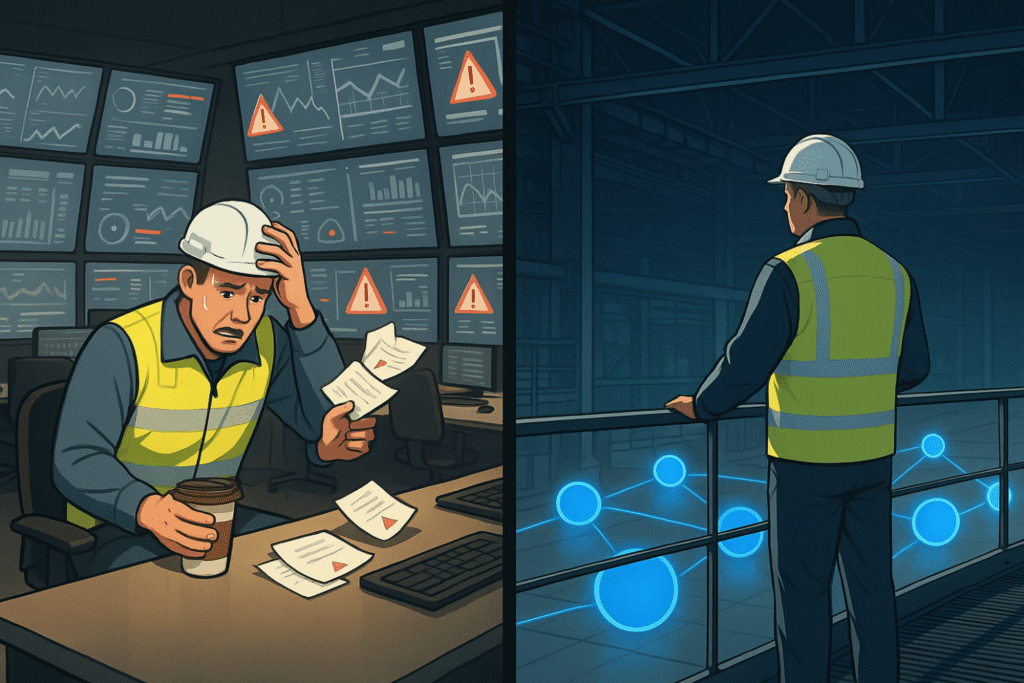
Industrial operations now generate over 1,000 alarms per operator per day compared to 60 to 100 historically. Up to 99 percent require no intervention. Adding more Business Intelligence dashboards to cope with this volume creates dashboard sprawl. Operators move between SCADA screens, historian tools, ERP views, MES consoles and IoT dashboards. All are visible, but none create coordinated operational response.
This led directly to cognitive overload. Operators had the data, but not the ability to synthesize cross domain responses quickly enough. With 2.1 million manufacturing roles projected to remain unfilled by 2030, the human capacity required to manually integrate this logic simply will not exist.
This is why organizations moved toward Event Intelligence. Event Intelligence was introduced to help reduce this cognitive burden. It filters, prioritizes, correlates and recommends actions in real time to speed up human response.
EI advanced the dashboard era. However, Event Intelligence still assumes humans remain the final decision authority.
That assumption collapses the moment autonomous agents begin coordinating thousands of decisions across industrial systems 24/7 at machine speed.
As operations shift toward Agentic Operations, the challenge no longer becomes “Which alerts matter?”
The challenge becomes: How do we govern, shape, and direct the intent of AI Agent Teams acting autonomously across physical operations?
Event Intelligence can accelerate human decision-making.
But it cannot supervise autonomy.
Research shows that 96 percent of industrial companies believe they need autonomous agents, yet 67 percent are unwilling to grant them full control because they lack the governance required to make autonomy safe, explainable and bounded.
This is the architectural gap Supervisory Intelligence fills.
What Is Supervisory Intelligence?
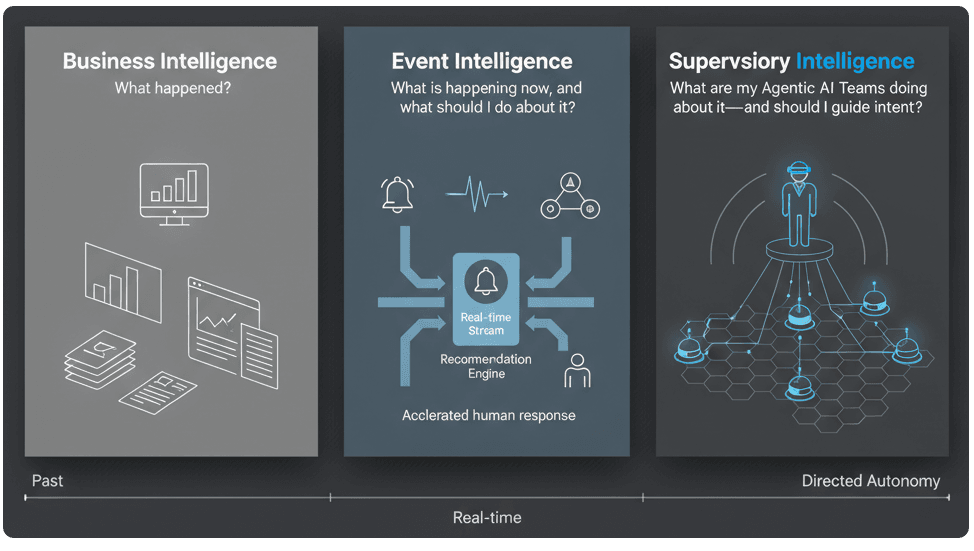
Supervisory Intelligence operates as the governance layer between autonomous agents and business outcomes. It sits above the autonomous systems executing operational decisions and below the strategic objectives these systems must achieve. This architectural position is what enables SI to enforce constraints, maintain safety boundaries, and ensure operational alignment at machine speed.
Business Intelligence tells us what happened in the past. Event Intelligence tells us what is happening right now, as events unfold. Supervisory Intelligence tells us what our Agentic AI Teams are doing next and ensures they do it safely, transparently, and within defined constraints. This distinction is structural, not incremental.
SI delivers governance through five integrated capabilities. First, it provides real-time visibility into autonomous agent decision-making as decisions form, not after execution. Second, it enforces explainability, requiring every autonomous action to expose its reasoning chain and supporting evidence. Third, it maintains bounded autonomy through safety constraints that agents cannot override regardless of optimization pressure. Fourth, it manages multi-agent coordination, resolving conflicts and orchestrating consensus when multiple agents must coordinate responses. Fifth, it preserves human oversight authority, ensuring strategic decisions remain human-controlled while operational execution scales autonomously.
This governance architecture makes Agentic Operations for Industrial Enterprise achievable in safety-critical environments. Organizations can deploy autonomous capabilities confidently because SI ensures those capabilities operate transparently, safely, and aligned to operational intent. Without this layer, autonomous systems either remain constrained to low-risk pilot projects or operate with unacceptable risk exposure.
The analytics era was about understanding. The Agentic Operations era is about directing.
The Evolution From Understanding to Orchestration
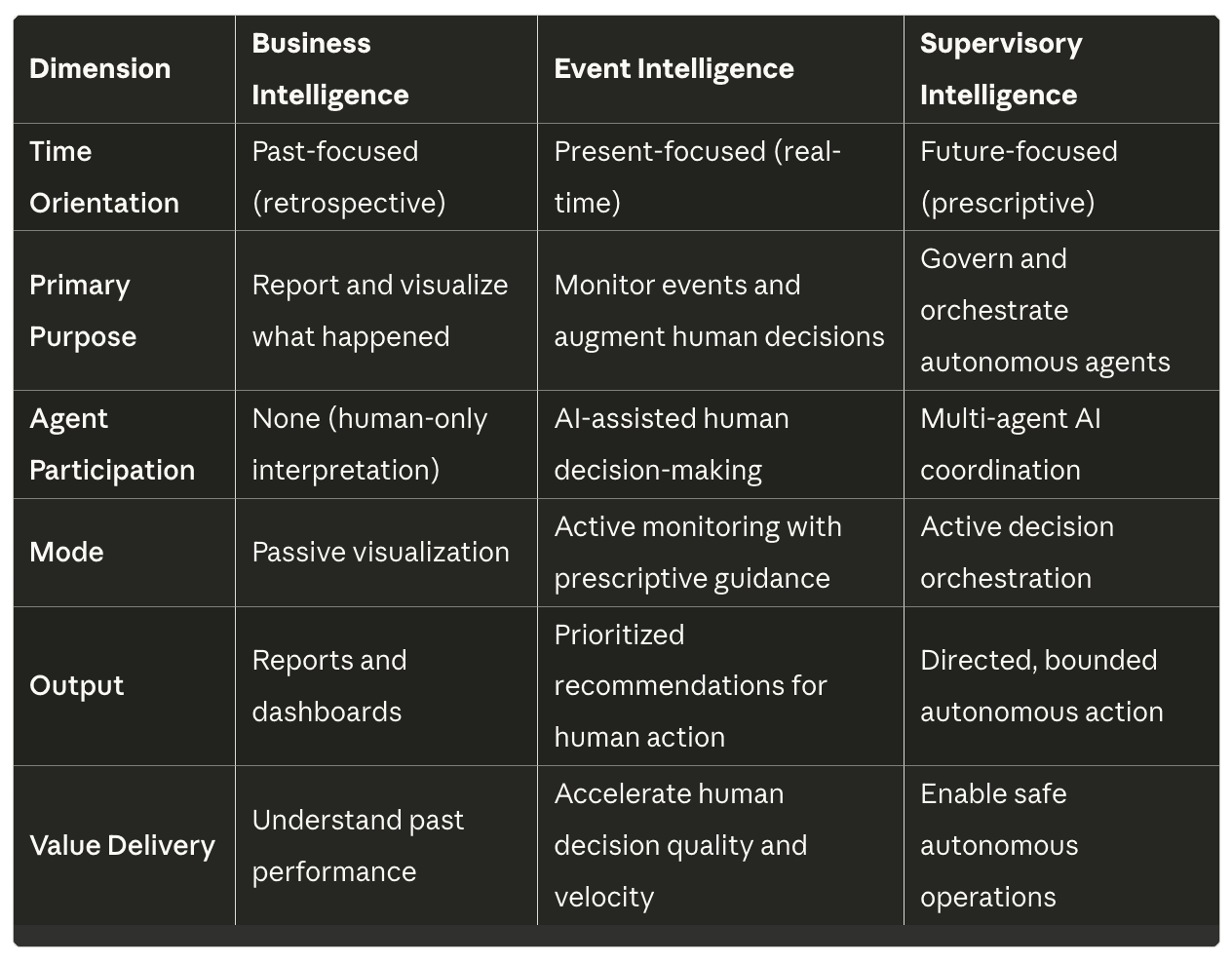
BI optimized understanding, SI governs direction.
Supervisory Intelligence is the prerequisite for safe autonomous scale.
This table captures the progression from retrospective analysis to real-time response to autonomous governance. BI serves human decision-makers by organizing historical data into interpretable patterns. Event Intelligence accelerates human decision-making through real-time monitoring and AI-augmented recommendations. Supervisory Intelligence governs autonomous systems, enforcing operational constraints while enabling coordinated action at industrial scale.
The distinction matters because industrial operations increasingly require decision velocity that humans cannot sustain manually. When a pump exhibits early vibration signatures indicating bearing failure, multiple decisions must cascade within minutes. Maintenance teams require scheduling coordination. Parts inventory needs validation. Production planning must adjust throughput targets. Safety protocols need confirmation. Energy management should reoptimize around the constraint.
BI dashboards surface each of these domains independently, leaving synthesis to human operators. Event Intelligence filters and prioritizes these alerts, providing AI-augmented recommendations to accelerate human response. But Supervisory Intelligence coordinates autonomous agents across all domains simultaneously, reaching optimal consensus within safety boundaries while maintaining complete transparency for human supervisors. This coordination happens at machine speed with human oversight, not human bottlenecks.
Example: In autonomous haul truck operations, a single early engine health deviation may require coordinated changes to maintenance planning, haul routes, loading sequence and energy optimization within seconds. This is not a reporting problem. It is a supervised autonomous coordination problem.
Why Supervisory Intelligence Enables Agentic Operations Now
Four industrial forces converge to make Supervisory Intelligence essential for organizations deploying Agentic Operations.
Knowledge Exodus Accelerates. The manufacturing skills gap will leave 2.1 million jobs unfilled by 2030, potentially costing $1 trillion annually in lost productivity. Decades of operational expertise are retiring faster than replacements enter the workforce. BI documents what experts did historically. SI captures how experts think and operationalizes that decision-making logic in autonomous systems that execute continuously, preserving institutional knowledge as executable intelligence rather than static documentation.
Autonomous Capabilities Are Operational Today. AI agents are not emerging technology. They are making operational decisions now across industrial environments. The trust gap remains severe because organizations need autonomous capabilities but cannot accept black-box decision-making in safety-critical operations. SI bridges this gap structurally by providing the transparency, explainability, and bounded execution that makes autonomous operations trustworthy at industrial scale.
Operational Complexity Exceeds Human Capacity. Modern industrial operations generate data velocity that surpasses human cognitive processing limits. A single mining operation can process 42 million messages daily across interconnected systems. Multi-agent systems coordinate this complexity at machine speed, but only with supervisory governance that prevents autonomous optimization from drifting into unsafe or operationally unacceptable states. SI provides this governance layer.
Regulatory and Safety Requirements Demand Transparency. Autonomous operations in physical environments require explainability for operational safety and regulatory compliance. When an agent recommends shutting down a production line or adjusting process parameters, supervisors need visibility into proposal logic, trade-offs evaluated, and confidence levels supporting the recommendation. SI provides complete audit trails, reasoning transparency, and bounded execution that satisfies both operational governance and regulatory oversight requirements.
These converging pressures explain why industrial enterprises are moving beyond BI toward Agentic Operations with Supervisory Intelligence as the enabling governance layer. Gartner research projects that by 2028, 15% of day-to-day work decisions will be made autonomously through agentic AI, up from near zero today. Organizations architecting this capability now, with proper supervisory governance, will establish competitive advantages that lagging competitors cannot quickly replicate.
The Governance Layer Industrial Autonomy Requires
Business Intelligence created value by making operational data accessible and historical performance measurable. Event Intelligence advanced this further with real-time monitoring and AI-augmented decision support. These capabilities remain foundational for root cause analysis, performance trending, operational response, and strategic planning.
But Agentic Operations require governance, not just visibility or augmented decision-making. Autonomous systems coordinating physical operations at machine speed need architectural controls that ensure transparency, enforce safety boundaries, maintain explainability, and preserve human oversight authority. These requirements exceed both BI and Event Intelligence architectural capabilities by definition.
Supervisory Intelligence provides this governance layer. It sits between autonomous agents and business outcomes, directing agent behavior while ensuring operational alignment and safety compliance. This positioning enables organizations to deploy autonomous capabilities confidently, knowing that SI enforces the constraints, transparency, and human oversight that industrial operations demand.
This architectural distinction is why XMPro has focused on building Supervisory Intelligence as the governance foundation for Agentic Operations, not as an enhanced dashboard layer. Industrial organizations need governance infrastructure purpose-built for autonomous multi-agent coordination, not visualization tools adapted for a problem they were never designed to solve.
Organizations that recognize this distinction and architect accordingly will operate with decision velocity, coordination capability, and autonomous scale that competitors relying on BI platforms cannot match. The evolution from understanding to directing is not incremental improvement. It is categorical transformation.
The Path Forward Is Architectural
Industrial operations are entering the Agentic Operations era whether enterprises are prepared or not. Autonomous agents will coordinate maintenance, optimize production, and manage constraints at increasing scale. The competitive question is whether your organization has the governance architecture to deploy these capabilities safely and effectively.
This shift is inevitable. The only choice executives have is whether they architect the governance now or chase competitors later.
Business Intelligence served the analytics era well. Event Intelligence serves the real-time response era. Both will continue providing value for historical analysis, performance reporting, and augmented human decision-making. But neither can govern the autonomous systems that will define operational advantage in the decade ahead.
Supervisory Intelligence provides the governance layer that makes Agentic Operations achievable in industrial environments where safety, compliance, and operational reliability are non-negotiable. Organizations architecting this capability now are not incrementally improving their BI platforms. They are establishing the foundation for autonomous operations at industrial scale.
The organizations that lead in Agentic Operations will not be those with the best dashboards. They will be those with the strongest governance architecture for the autonomous systems coordinating operations behind those dashboards.
XMPro: Agentic Operations for Industrial Enterprise
To make this more tangible, the short video below demonstrates this pattern in an autonomous haul truck scenario. Notice how Supervisory Intelligence does not simply report an anomaly, but reveals how agents coordinate next actions, negotiate trade-offs, and reach bounded consensus at machine speed. This is how Agentic Operations move from concept to governed operational reality in physical industrial environments.
This is what modern industrial leadership will look like in the next decade: Supervisors directing outcomes, not manually driving every decision step.
Wouter Beneke leads global marketing at XMPro, where he works closely with industrial clients to communicate the measurable impact of Decision Intelligence and autonomous operations. He brings a background in engineering-first storytelling, helping operations leaders distinguish between AI hype and operational reality.
#AgenticOperations #DecisionIntelligence #AgenticAI #IndustrialAI #SupervisoryIntelligence #EventIntelligence #BusinessIntelligence #DigitalTransformation #IndustrialOperations #OperationalExcellence #XMPro
References
- Deloitte & The Manufacturing Institute (2021). 2021 Manufacturing Talent Study.
- Abnormal Situation Management Consortium (ASM Consortium). Industrial Alarm Management Benchmarking.
- LNS Research (2024). The State of Industrial AI Agents and Operational Decision Intelligence.
- Gartner (2025). Hype Cycle for Emerging Technologies: Autonomous & Agentic AI Category Forecast.