
























Autonomous Supply Chain Optimization Team
Introduction Fast-Moving Consumer Goods (FMCG) and other consumer products supply chains rarely fail because of missing data — they fail when demand, supply, logistics, and finance teams cannot coordinate decisions fast enough. Traditional planning systems optimize each function in isolation, missing the trade-offs that directly affect service levels, costs, working capital, and resilience. XMPro’s Supply
Introduction
Fast-Moving Consumer Goods (FMCG) and other consumer products supply chains rarely fail because of missing data — they fail when demand, supply, logistics, and finance teams cannot coordinate decisions fast enough. Traditional planning systems optimize each function in isolation, missing the trade-offs that directly affect service levels, costs, working capital, and resilience.
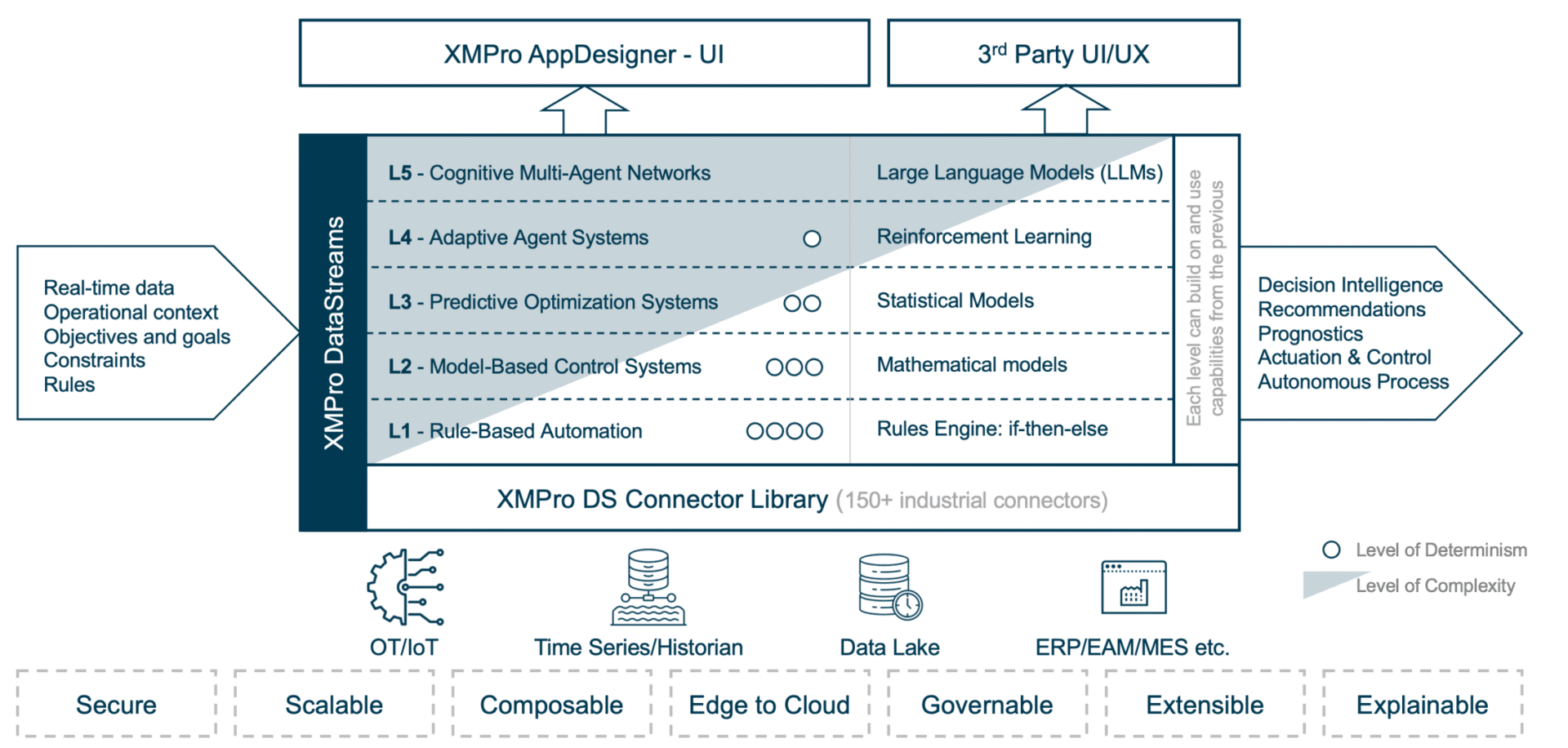
XMPro’s Supply Chain Intelligence MAGS overcomes these challenges with a coordinated team of specialized agents orchestrated in XMPro Agentic Platform EXperience - APEX. Agents reason with bounded autonomy, executing decisions through XMPro StreamDesigner's extensible integration library. This separation of decision control from operational execution keeps every action explainable, auditable, and aligned with business policy and financial priorities.

The Challenge
The Challenge: Multi-Dimensional Supply Chain Coordination
Consumer product and FMCG supply chains operate across tightly interdependent functions — demand sensing, inventory positioning, procurement, logistics, financial constraints, and strategic priorities. Yet most organizations still rely on siloed planning tools and manual coordination. The result: critical interactions are missed, and decisions lag behind market reality.
Key Challenge Areas
-
Cross-Functional Complexity
-
Demand forecast changes ripple into inventory allocations, procurement timing, and logistics capacity.
-
Supplier disruptions require simultaneous action across sourcing, inventory rationing, customer communication, and financial risk assessment.
-
Promotional events demand alignment across demand sensing, supplier capacity, and transportation readiness.
-
Quality issues cascade through procurement, inventory, logistics, and service teams.
Traditional systems optimize each function independently, creating suboptimal outcomes across the whole supply chain.
-
-
Exception Response Delays
-
Urgent supply chain exceptions often trigger multi-hour coordination calls, long email chains, and fragmented decision-making.
-
Critical trade-offs — service vs. cost, margin vs. resilience — are delayed by manual analysis.
-
Inconsistent decisions depend on which stakeholders are available, with response times often stretching beyond four hours.
The cost is lost service performance, higher penalties, and missed revenue.
-
-
Strategic–Operational Disconnect
-
Cost optimization targets can undermine strategic customer commitments.
-
Market intelligence and competitive insights rarely influence day-to-day planning decisions.
-
Long-term supplier relationships are damaged by short-term cost or service pressures.
-
Financial guardrails are often bolted on, not integrated into daily trade-off analysis.
-
The Compound Impact
These interconnected challenges create a multi-variate optimization problem that traditional supply chain approaches cannot solve. Silos lead to service disruptions and cost escalation, manual coordination delays responses, and strategic priorities become disconnected from daily execution. To overcome this, supply chains need more than faster individual optimizers — they require intelligent, governed coordination across all decision domains.
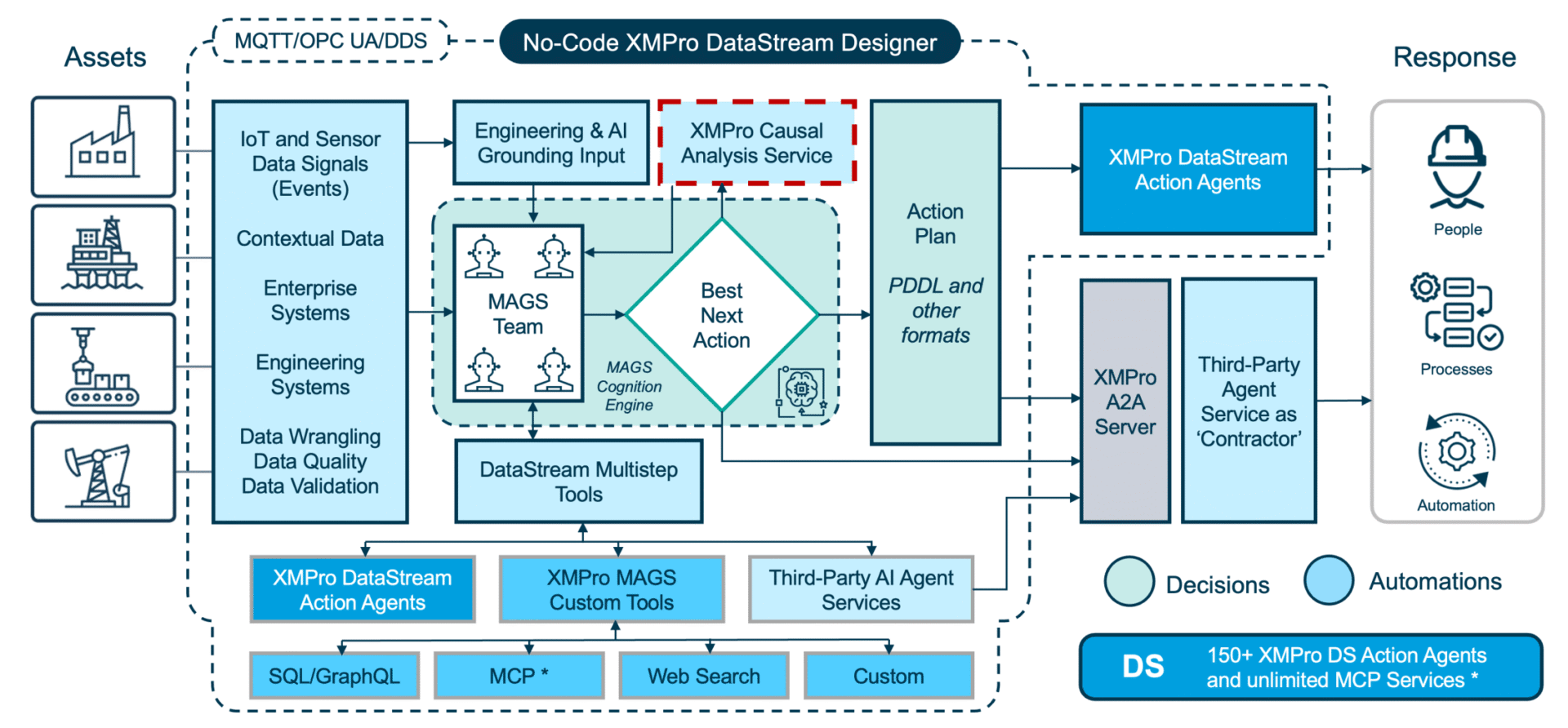
XMPro Supply Chain Intelligence MAGS Team
From Coordination Bottlenecks to Autonomous Collaboration
The coordination challenges facing FMCG and consumer product supply chains are not solved by faster spreadsheets or isolated planning modules. What’s missing is a way to continuously balance demand, supply, logistics, market shifts, and financial constraints as one connected system.
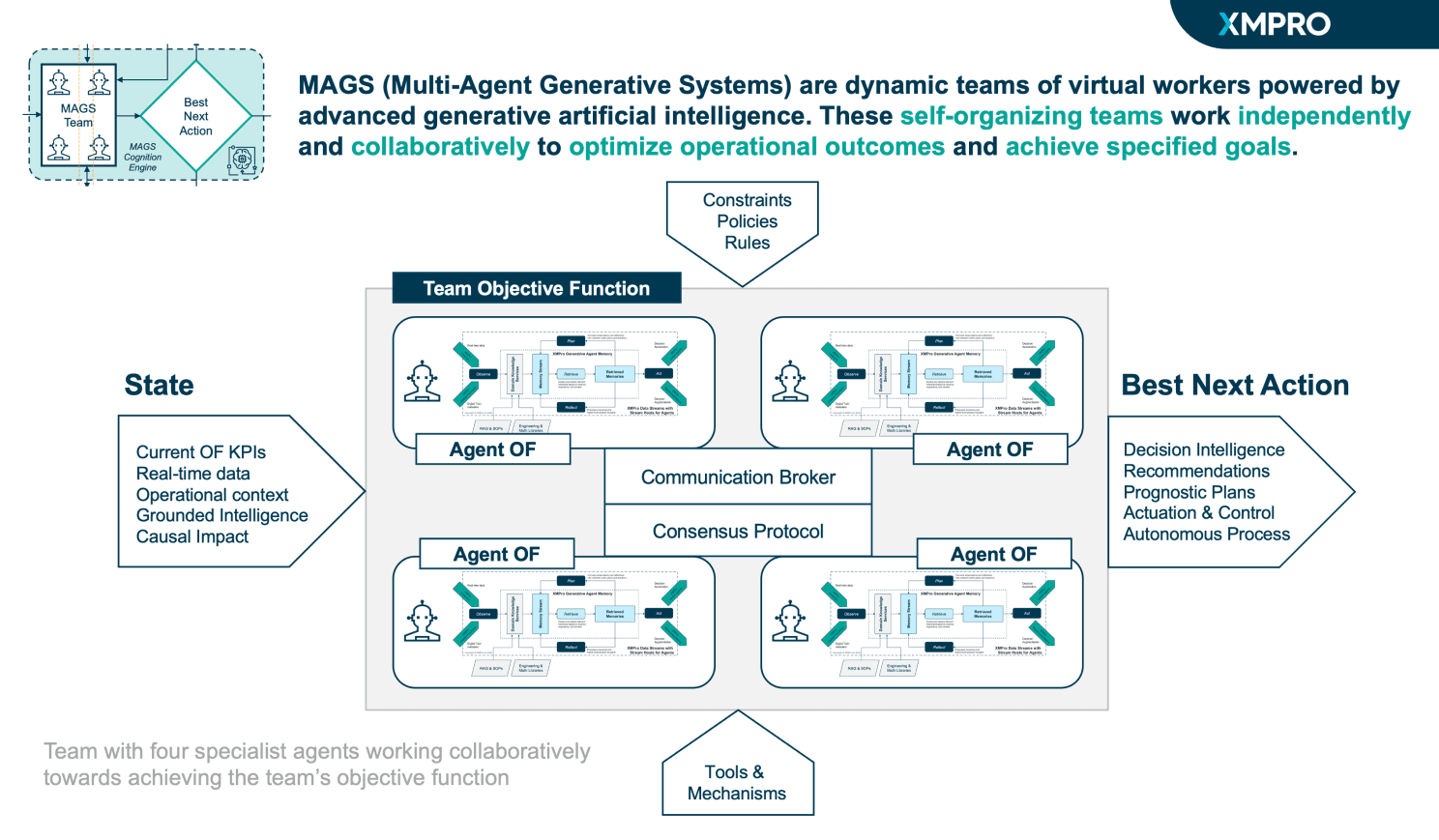
XMPro’s Supply Chain Intelligence MAGS Team delivers this capability. Specialized agents collaborate as a governed team, each with a defined objective function and domain authority. Together, they manage trade-offs in real time, anticipate disruptions, and adapt strategies as conditions change.
Because agents operate within XMPro’s governed architecture, every action is explainable, traceable, and aligned with business policy. The result is a supply chain that no longer lags behind events but actively coordinates itself — maintaining service, protecting margins, and preserving resilience without the drag of constant manual intervention.
Key Features
Key Features of the Supply Chain Intelligence MAGS Team
Multi-Agent Collaboration
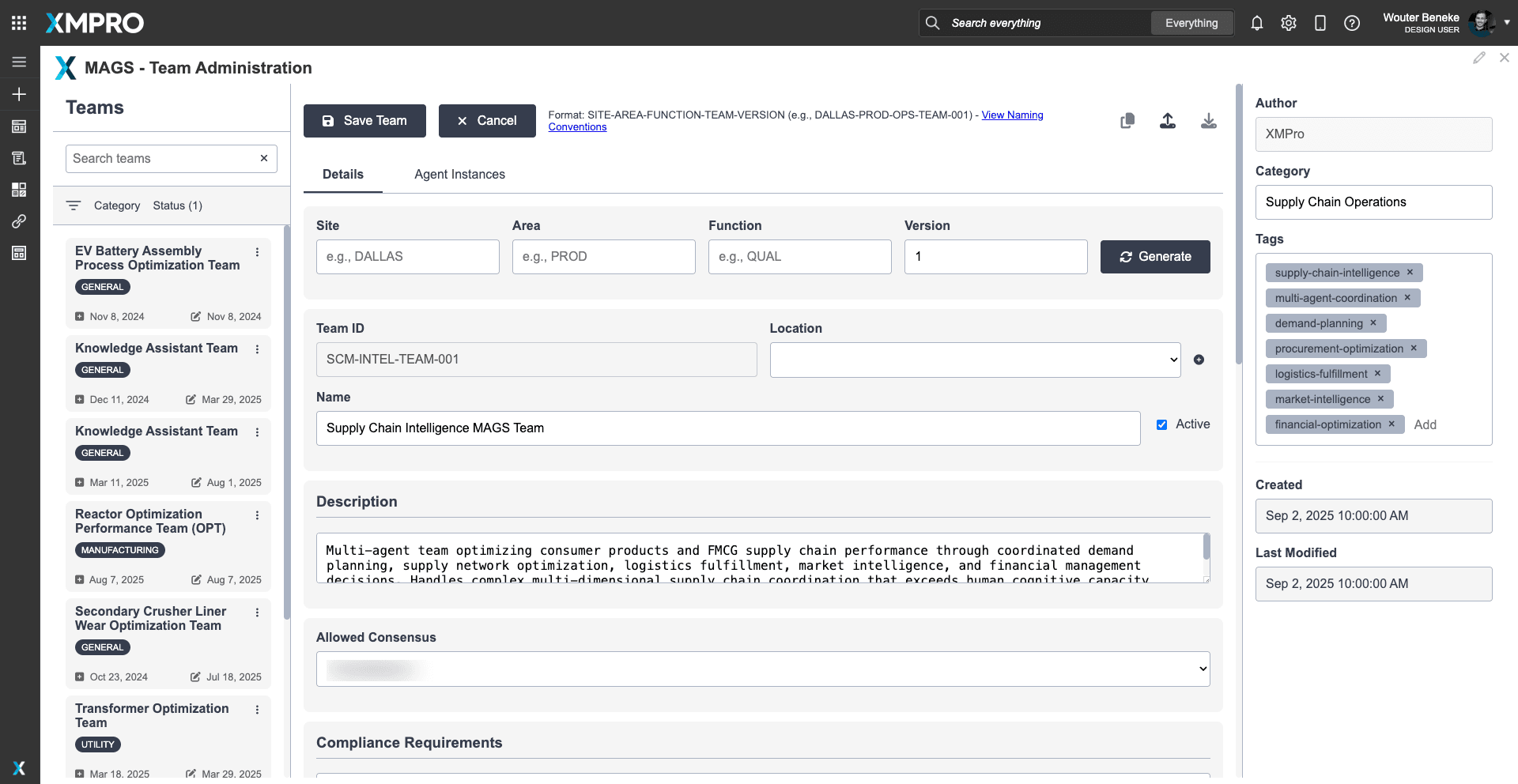
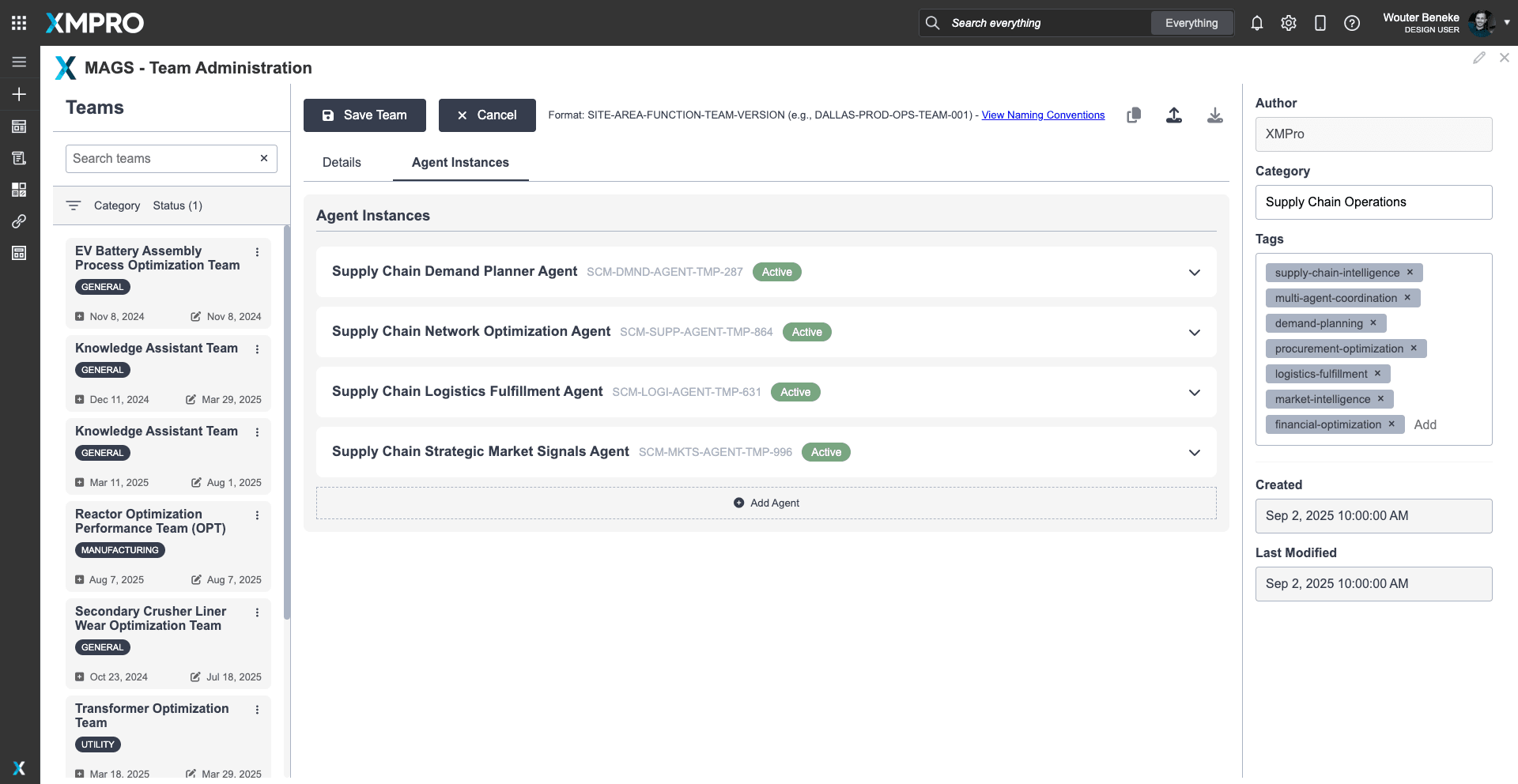
Five specialized agents (Demand Intelligence, Supply Network Optimization, Logistics Operations, Market & Strategic Intelligence, Financial Performance) work together to optimize service levels, inventory, costs, and resilience across the consumer products supply chain.
Parametric Configuration
Customizable to your business priorities — from service level targets to inventory thresholds, cost weights, and financial constraints — ensuring the team operates according to your strategy.
Continuous Cognitive Cycle
Each agent follows observe–reflect–plan–act cycles, continuously learning from outcomes and improving coordination across demand, supply, logistics, and finance.
Real-Time Digital Twin
A living digital representation of your supply chain with predictive simulation capabilities, enabling proactive interventions before issues cascade into customer service or financial performance.
Multi-Model Reasoning
Blends statistical forecasting, optimization models, causal analysis, and financial simulation with market intelligence to produce robust, explainable decisions.
Graduated Autonomy
Start with monitoring and recommendations, progress to governed decision automation at your pace — always maintaining transparency, auditability, and business oversight.
Objective Function Optimization
Mathematical optimization of competing goals — service, cost, working capital, and resilience — with configurable weights to fit your business context.
MAGS Team Composition
Meet Your Intelligent AI Team For Supply Chain Intelligence
CORE TEAM AGENT

Demand Planner Agent
(Forecasting Specialist)
Key Expertise: Chief demand sensing and prioritization specialist, ensuring forecasts align with service and revenue goals.
Team Contribution: Provides demand signals and prioritization that guide supply, logistics, and financial planning
CORE TEAM AGENT
Supply Network Optimization Agent
(Procurement & Inventory Specialist)
Key Expertise: Supplier performance management, procurement strategy, safety stock optimization, risk assessment
Team Contribution: Balances cost, service, and risk across the supply base and inventory positioning
CORE TEAM AGENT
Logistics Fulfillment Agent
(Transportation & Logistics Specialist)
Key Expertise: Carrier selection, route optimization, capacity utilization, delivery scheduling
Team Contribution: Secures reliable, efficient transport capacity while minimizing delivery exceptions
OPTIONAL AGENT
Strategic Market Signals Agent
(External Intelligence Specialist)
Key Expertise: Competitor pricing, regulatory shifts, macroeconomic drivers, disruption alerts, news and sentiment feeds
Team Contribution: Injects early market signals (pricing, regulation, macro trends) that inform demand, sourcing, and logistics adjustments.
OPTIONAL AGENT
Financial Performance Agent
(Supply Chain Finance Specialist)
Key Expertise: Margin optimization, working capital management, cost-to-serve analysis, ROI and variance assessment
Team Contribution: Injects early market signals (pricing, regulation, macro trends) that inform demand, sourcing, and logistics adjustments.
Team Objective Function
Collective Success Metrics
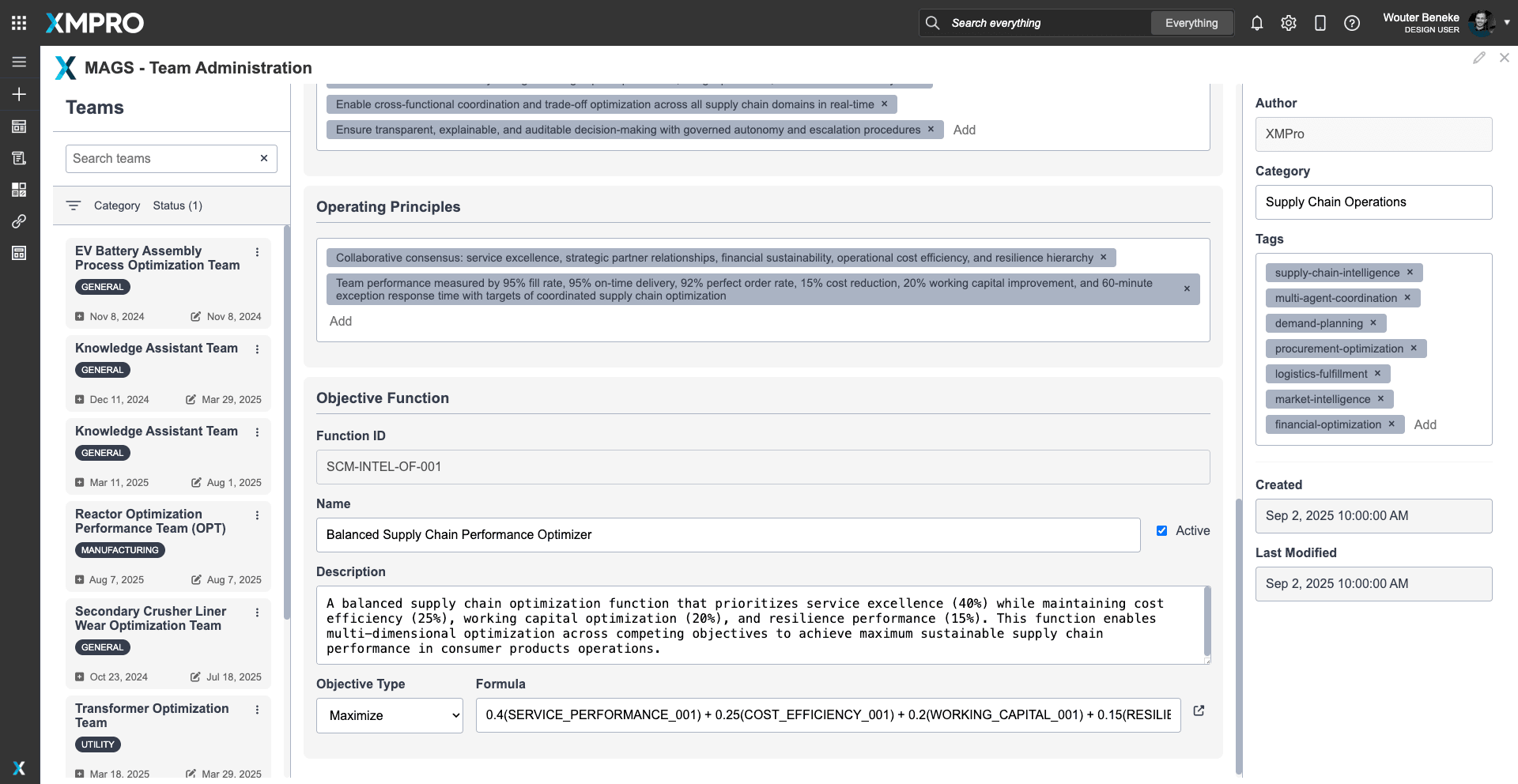
Team Objective Function: Collective Success Metrics
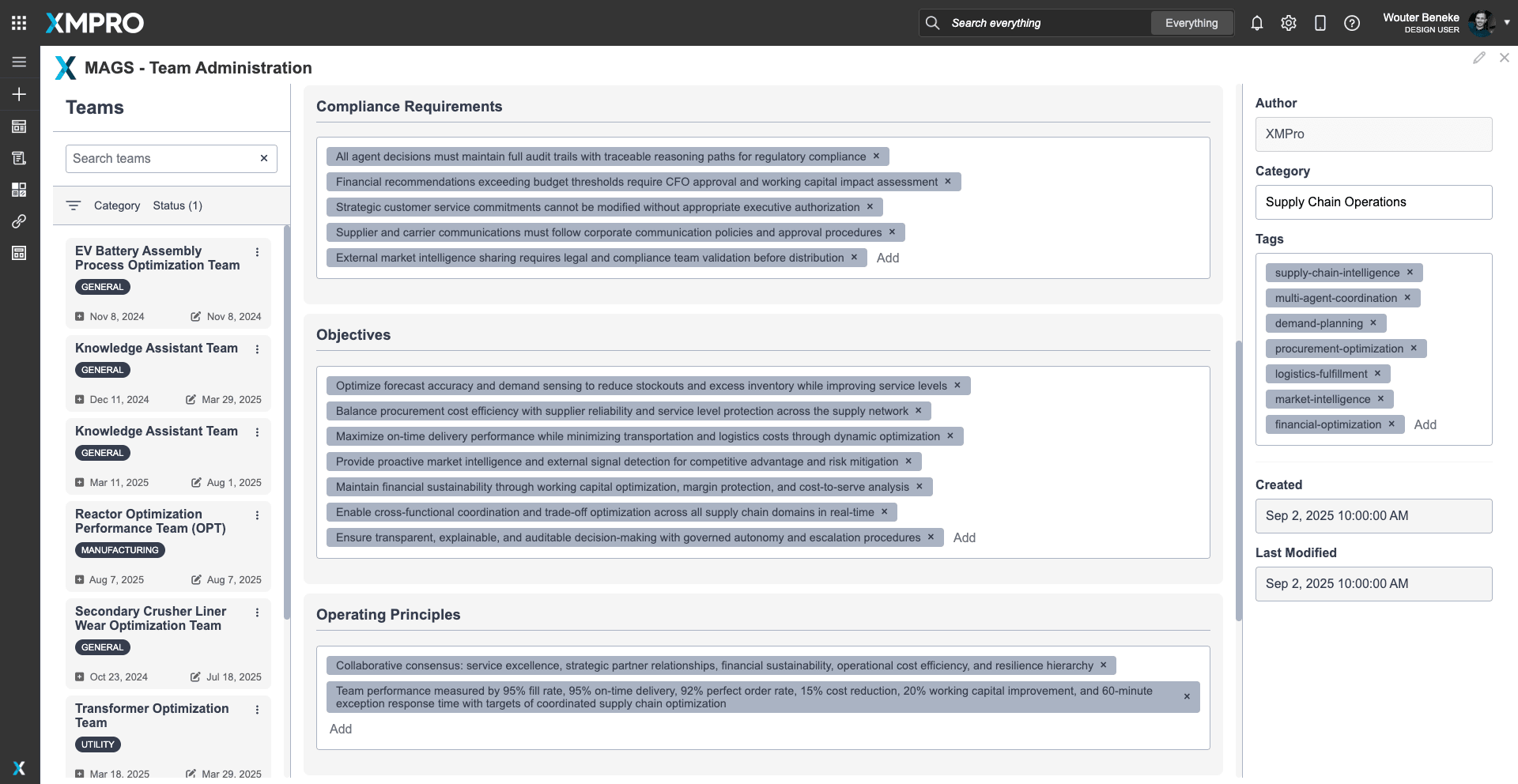
Each agent in the Supply Chain Intelligence MAGS Team optimizes within its own domain — forecasting accuracy, supplier performance, logistics efficiency, financial outcomes, or external signals. But supply chains succeed or fail at the team level, where these objectives must be balanced against each other.
Individual vs. Team Objectives
-
Individual Objective Functions:
-
Demand Planner Agent: maximizes forecast accuracy and fill rate.
-
Supply Network Agent: minimizes procurement cost and optimizes inventory turns.
-
Logistics Fulfillment Agent: maximizes on-time delivery and reduces exception costs.
-
Strategic Market Signals Agent: improves responsiveness to external disruptions.
-
Financial Performance Agent: balances working capital, cost-to-serve, and margin.
-
-
Team Objective Function: integrates these contributions into a single parametric framework, ensuring no single function dominates at the expense of the whole supply chain.
Collective Success Metrics
The team-level objective function is configurable, allowing businesses to weight KPIs according to strategic priorities:
-
Service → Fill Rate, On-Time Delivery, Perfect Order Rate
-
Financial → Gross Margin %, Working Capital Turns, Cost-to-Serve
-
Resilience → Exception Response Time, Supplier/Logistics Reliability
-
Forecasting → Demand Forecast Accuracy
Configurable Weighting Modes
-
Service-first: prioritizes customer service and reliability
-
Cost-optimization: emphasizes procurement, inventory, and logistics cost efficiency
-
Resilience-focused: weights agility and exception response higher
-
Balanced: distributes weights across service, cost, and financial goals
Why It Matters
This mirrors how real cross-functional supply chain teams operate: demand planners, procurement leads, logistics managers, and finance business partners each bring their own KPIs to the table — but performance is only maximized when trade-offs are coordinated around collective business outcomes. The MAGS architecture enforces this coordination automatically, ensuring consistent, explainable trade-offs across all domains.
Individual Agent Contributions
Individual Agent Contributions
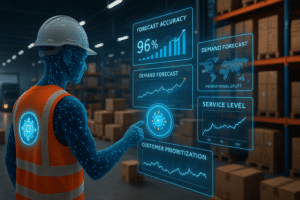
Demand Planner Agent optimizes Forecast Accuracy and Fill Rate by sensing demand shifts, modeling promotional impacts, and prioritizing customer service to reduce stockouts and lost sales.
Supply Network Agent balances Procurement Cost and Inventory Turns by managing supplier performance, optimizing sourcing strategies, and configuring safety stocks to ensure both efficiency and resilience.
Logistics Fulfillment Agent maximizes On-Time Delivery and Perfect Order Rate while reducing Transportation Cost through carrier selection, route planning, capacity utilization, and delivery scheduling.
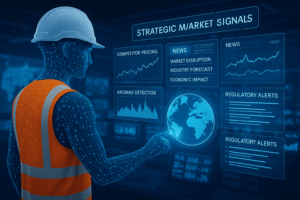
Strategic Market Signals Agent improves Strategic Responsiveness and reduces Disruption Risk by detecting competitor moves, regulatory changes, and macroeconomic or geopolitical signals, providing early warnings for tactical and strategic planning.
Financial Performance Agent optimizes Gross Margin and Working Capital while controlling Cost-to-Serve by quantifying trade-offs across demand, supply, and logistics decisions, guiding the team toward financially sustainable choices.
Compound Benefits
Compound Benefits
Cross-Functional Optimization
Synergies emerge when demand, supply, logistics, market, and finance agents coordinate decisions. Trade-offs that would normally cause conflict are resolved collectively, ensuring service, cost, and resilience targets are met simultaneously.
Strategic–Operational Alignment
Daily operational decisions are continuously aligned with strategic priorities — from key customer commitments to long-term financial objectives — preventing disconnects between planning and execution.
Resilience Through Foresight
Early detection of risks from suppliers, logistics partners, or market signals enables the team to intervene before disruptions cascade across service levels, inventory, or cost.
End-to-End Visibility
The combined view across demand sensing, supplier performance, logistics capacity, external signals, and financial constraints creates a live, shared picture of the entire supply chain.
Adaptive Trade-Offs
Agents rebalance objectives dynamically as conditions change — shifting between service-first, cost-focused, or resilience-driven strategies without the lag of manual coordination.
Accelerated Learning
Insights from one domain train others: forecast anomalies improve sourcing decisions, logistics exceptions inform financial risk models, and market signals refine promotional planning. This creates a continuously learning supply chain team.
Team Dynamics Summary
Communication Protocol
Continuous Data Sharing
Agents share validated data and insights across domains every few minutes, with immediate broadcasts when exceptions occur. This ensures that demand changes, supplier disruptions, logistics delays, or financial updates are instantly visible to the whole team.
Contextual Awareness
Each agent provides structured updates — not raw data — contextualized in terms of impact (e.g., “Forecast deviation exceeds 8% for Product X; service risk flagged”). This prevents noise and keeps communication actionable.
Priority Alerts
Critical events (e.g., missed supplier delivery, high-value order at risk) trigger team-wide collaboration within minutes, ensuring cross-functional coordination happens in real time.
Human-in-the-Loop Integration
Agents communicate with humans via the same channels teams already use — Microsoft Teams, Slack, email, and dashboards — making them “present” in existing workflows. All alerts, recommendations, and escalations are explainable, with reasoning paths included.
External Interfaces
Where relevant, agents also communicate through governed integrations with suppliers, carriers, distributors, and partners (via APIs, EDI, or structured messages), ensuring that external stakeholders are aligned with the team’s actions.
Governed by APEX
All communications are logged, auditable, and subject to role-based access controls, ensuring messages remain secure, consistent, and policy compliant.
Decision Framework
Domain-Weighted Authority
Each agent has primary authority in its domain — forecasts, procurement, logistics, market signals, or financial performance. When a decision is predominantly in one domain, that agent leads the proposal while others provide input.
Collaborative Consensus
For cross-functional trade-offs (e.g., expediting a shipment for a key customer), agents share perspectives and reach a governed consensus using the built-in MAGS architecture. No single domain dominates — decisions are optimized across service, cost, resilience, and financial impact.
Strategic Alignment
The Financial Performance Agent ensures all decisions remain within profitability and working capital guardrails, while the Strategic Market Signals Agent injects external context (competitor moves, regulatory changes, macro shifts) into tactical and strategic planning.
Human-in-the-Loop Oversight
When a decision exceeds confidence thresholds (e.g., high-value financial impact, strategic account at risk), the team escalates with a structured recommendation to human managers through Teams, Slack, or email. Humans can adjust weights, override decisions, or authorize exceptions.
Traceability and Auditability
Every decision is logged with its reasoning path, contributing agents, and objective trade-offs. This ensures transparency, compliance, and the ability to learn from outcomes.
Conflict Resolution
Business-Driven Priorities
Conflicts are resolved using a governed hierarchy of business priorities: customer service excellence, strategic partner relationships, financial sustainability, operational cost efficiency, and resilience. This ensures that service-critical issues are never sacrificed for short-term cost savings.
Collaborative Trade-Off Analysis
When agents propose conflicting actions — such as expediting a shipment versus minimizing cost — the system evaluates each option against multiple objectives. Outcomes are scored across service, cost, resilience, and financial impact, ensuring the decision reflects the best overall business value.
Architected Consensus
Rather than voting, agents contribute domain-specific insights. The MAGS framework weighs these inputs dynamically and synthesizes them into a coordinated decision. Each action is explainable, showing how priorities were balanced.
Escalation to Human Oversight
When complexity exceeds predefined thresholds — for example, significant financial exposure, a strategic customer at risk, or regulatory uncertainty — the decision is escalated to human managers. Escalation packages include the following:
-
Options evaluated
-
Quantified business impacts
-
Agent reasoning and recommendations
-
Coordinated resolution pathway
Learning from Every Resolution
All conflicts and outcomes are logged. Agents learn from resolutions, improving trade-off handling and reducing the likelihood of repeated coordination issues. Over time, this creates a progressively more effective and self-improving supply chain team.
Load Balancing
Dynamic Response Patterns
Agents automatically adjust their monitoring intensity and communication frequency based on current supply chain conditions. During demand surges, demand-focused agents increase their observation cycles and contribute more frequently to team coordination — all while maintaining peer-level collaboration.
Condition-Based Adaptation
When supply disruptions occur, supply network and logistics agents intensify monitoring and elevate communication frequency. The financial performance agent simultaneously evaluates all coordination options against budget constraints through the standard consensus process.
Collaborative Attention Allocation
The team reallocates monitoring focus dynamically:
-
Demand volatility → increased observation from demand and logistics agents
-
Supplier disruptions → enhanced monitoring from supply network and finance agents
-
Cost pressures → financial agent raises analysis frequency while all agents evaluate trade-offs
-
Market shifts → strategic market signals agent elevates communication frequency, triggering coordinated adjustments
Resilient Load Distribution
During high-stress periods, agents automatically expand monitoring scope and communication updates. Distributed processing prevents bottlenecks, ensuring comprehensive coverage across all supply chain domains.
Adaptive Equilibrium
As conditions normalize, monitoring frequencies and communication patterns return to baseline levels, maintaining balanced oversight across the entire supply chain operation.
Escalation Paths
Threshold-Based Escalation
Agents escalate decisions when risks or impacts exceed governed thresholds, such as:
-
High-value customer service risks
-
Strategic partner relationships at risk
-
Financial exposure beyond limits
-
Regulatory uncertainty requiring human judgment
Progressive Autonomy
Organizations can configure how escalations are handled based on maturity and confidence in the agent team:
-
Advisory Mode → Agents provide recommendations only; humans approve all actions.
-
Sub-Autonomous Mode → Agents execute routine, low-risk decisions autonomously while escalating exceptions and strategic issues.
-
Autonomous Mode → Agents act independently within governed thresholds, escalating only when decisions exceed confidence or impact limits.
Structured Escalation Packages
When escalation occurs, human managers receive a complete package including:
-
Options evaluated by agents
-
Quantified business impacts
-
Trade-offs considered (service, cost, resilience, financial)
-
Reasoning paths for transparency
-
Recommended coordinated resolution
Integrated Communication
Escalations are delivered via enterprise channels — Microsoft Teams, Slack, email, dashboards — and can include external partners when supplier, logistics, or distributor actions are involved.
Learning & Trust Building
Each escalation is logged and analyzed. As agent performance proves reliable, organizations can progressively adjust thresholds and weighting, allowing the team to take on more autonomy safely.