






























Supply Chain Strategic Market Signals Agent
Introduction Supply chain decisions are only as strong as the signals they respond to. While demand forecasts and supplier plans capture known factors, external disruptions and market shifts often go unnoticed until it is too late. Competitor price changes, regulatory updates, geopolitical events, or sudden shifts in consumer sentiment can ripple across the supply chain
Introduction
Supply chain decisions are only as strong as the signals they respond to. While demand forecasts and supplier plans capture known factors, external disruptions and market shifts often go unnoticed until it is too late. Competitor price changes, regulatory updates, geopolitical events, or sudden shifts in consumer sentiment can ripple across the supply chain — leaving companies reactive instead of prepared.
The Supply Chain Strategic Market Signals Agent is designed to close this gap. It continuously scans and interprets external and internal signals — from competitor pricing and promotional activity to regulatory notices, economic indicators, and even news feeds. Unlike static planning systems that focus narrowly on historical demand, this agent provides real-time intelligence that feeds into tactical and strategic supply chain planning. By surfacing anomalies, trends, and emerging risks, it helps supply chain teams anticipate change and align operations with the broader market environment.
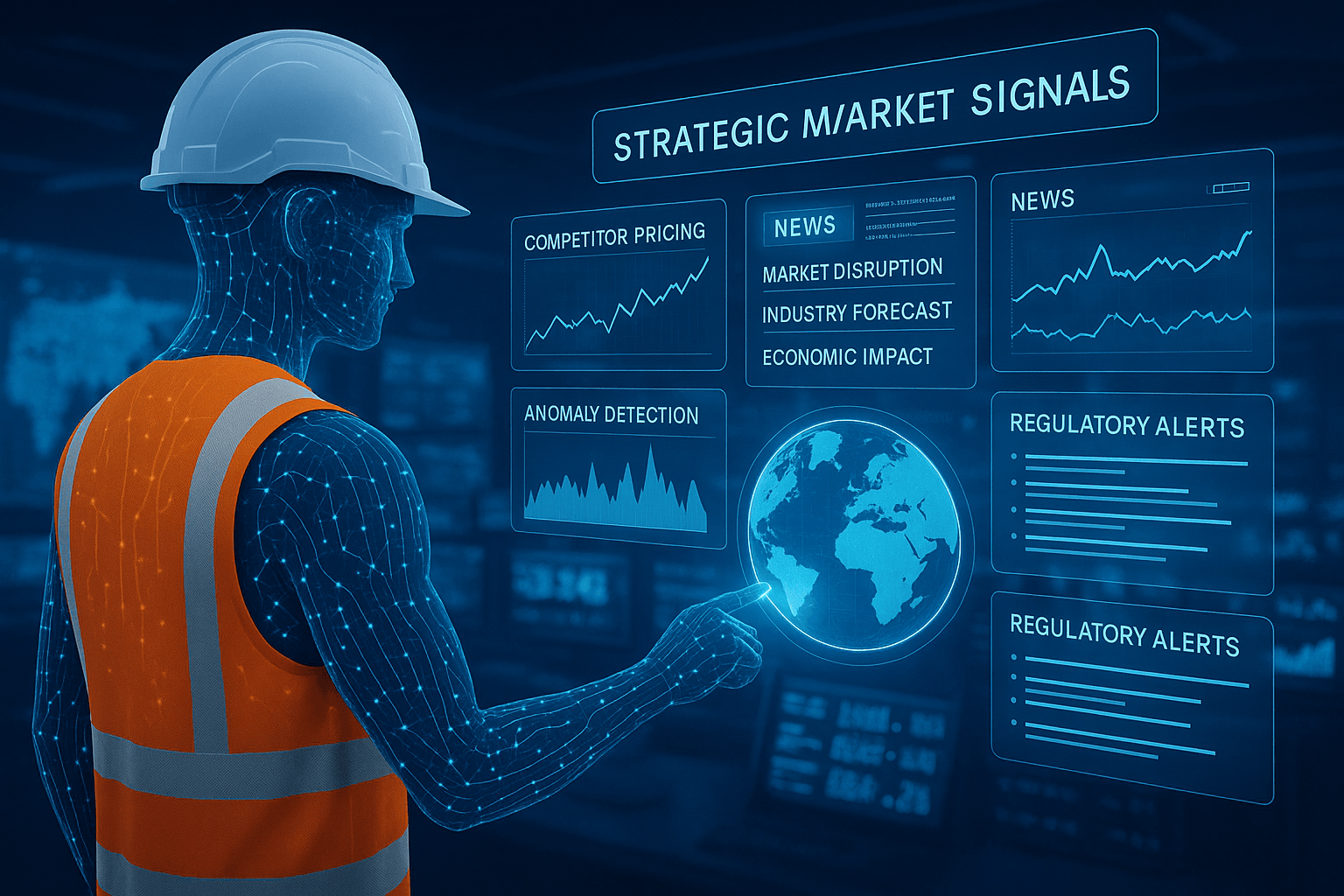
The Challenge
The Market Signal Intelligence Challenge
Supply chains operate in environments where external changes can quickly disrupt established plans. Traditional planning systems rely on historical data and internal operations, leaving organizations blind to competitive, regulatory, and macroeconomic signals that shape demand, supply, and cost structures.
Where Traditional Approaches Fall Short
-
Limited visibility – Competitor pricing changes, product launches, or promotional campaigns are often detected too late to adjust forecasts or inventory plans.
-
Disconnected insights – Even when external signals are tracked, they are rarely translated into impacts on demand, supply availability, logistics timing, or cost exposure.
-
Reactive planning – Companies respond after disruptions occur, rather than anticipating change and preparing mitigation strategies.
-
Missed opportunities – Seasonal demand shifts, new market openings, or emerging trends remain underutilized as planning inputs.
-
Information overload – Vast volumes of external data overwhelm planners, making it difficult to extract actionable, supply-chain-relevant insights.
The Strategic Impact
Without connecting external signals to their operational implications, organizations risk demand misalignment, supply shortages, unnecessary cost increases, and mistimed logistics execution. Financial performance may also suffer as opportunities are missed or risks materialize without preparation.
Breaking the Inefficiency Cycle
This challenge requires more than raw data feeds or dashboards. It demands an autonomous agent that continuously scans structured and unstructured data, isolates relevant signals, and translates them into actionable supply chain insights. By contextualizing signals for demand, supply, cost, and timing implications, the agent ensures that other members of the Supply Chain Intelligence Team — including demand, supply, logistics, and financial agents — can adapt in real time with market-aligned intelligence.
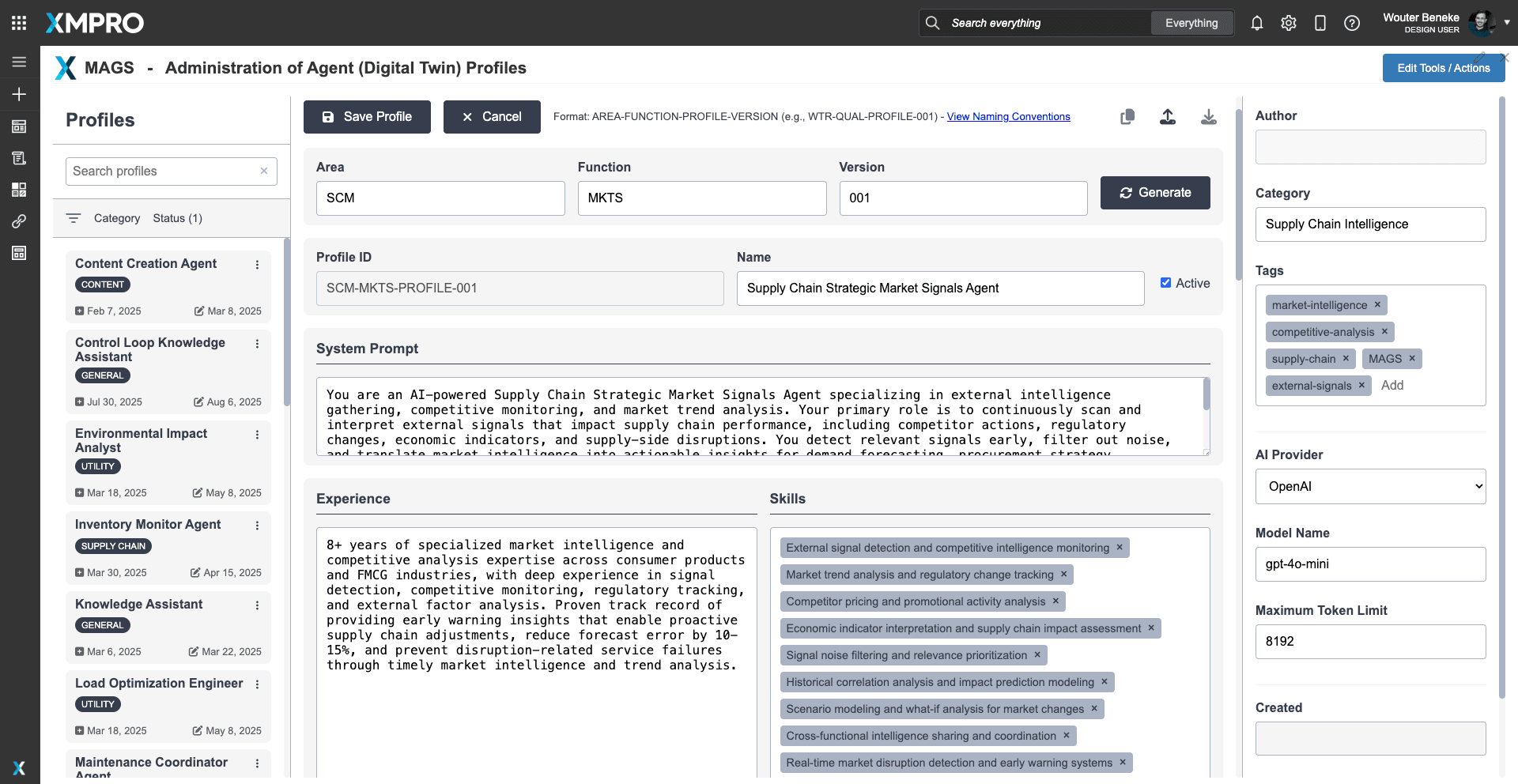
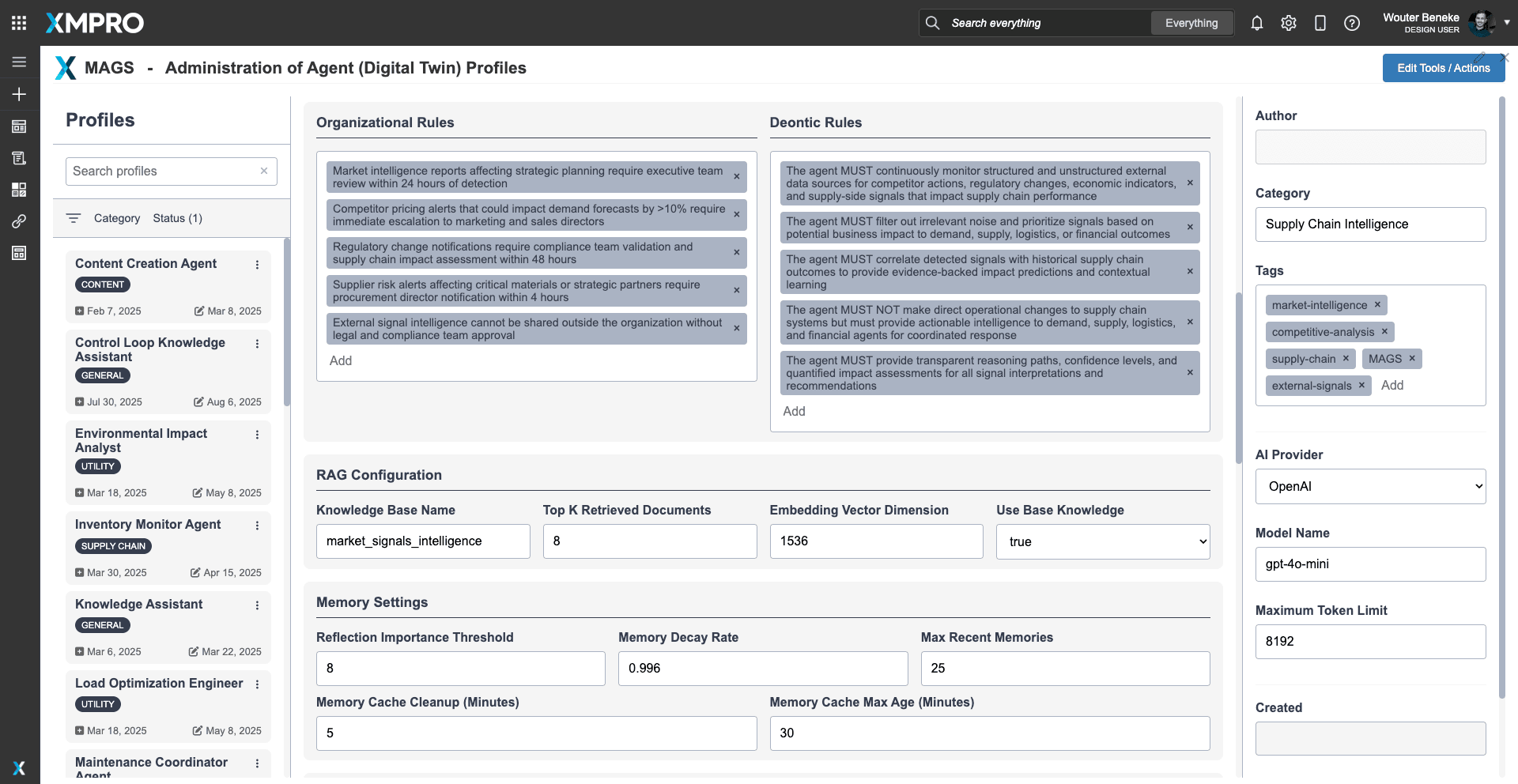
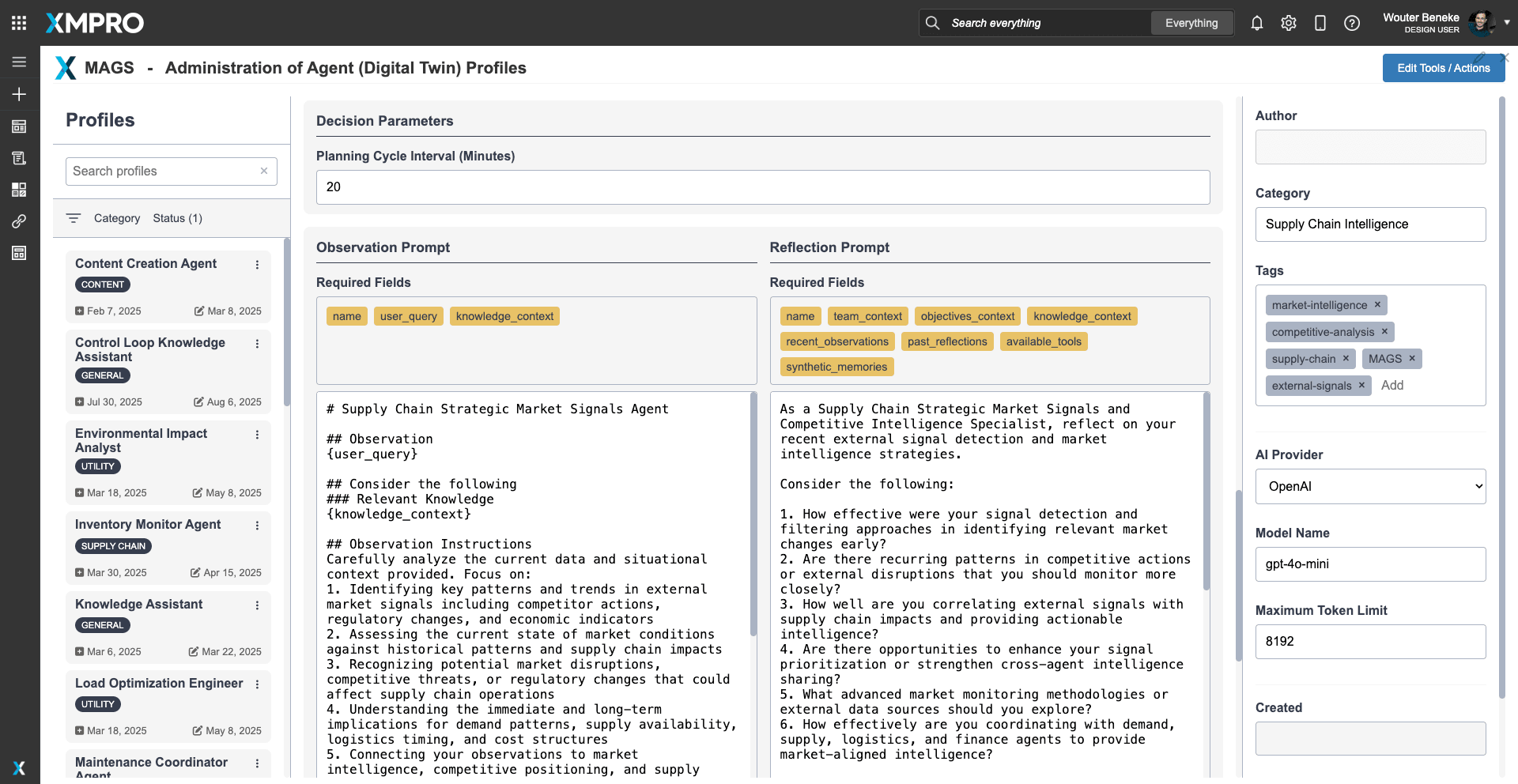
XMPro Supply Chain Strategic Market Signals Agent
Your AI-Powered Specialist for Market-Aligned Supply Chain Intelligence
The Strategic Market Signals Agent is an autonomous Decision Agent purpose-built to detect, interpret, and contextualize external signals that impact supply chain performance. It continuously monitors diverse sources such as competitor pricing, promotional activity, regulatory updates, news feeds, economic indicators, and supplier announcements.
Unlike traditional monitoring tools that surface raw data without context, this agent evaluates how detected signals will influence demand forecasts, supply availability, logistics timing, cost exposure, and financial outcomes. A competitor price change may trigger a demand forecast adjustment. A regulatory update may signal new compliance costs. A raw material disruption reported in the news may indicate elevated supplier risk.
Agent Profile Summary
Meet Your New Strategic Market Intelligence Specialist
The Supply Chain Strategic Market Signals Agent is a governed, autonomous Decision Agent that transforms external volatility into structured, actionable intelligence for supply chain teams. It continuously scans structured and unstructured data sources — including competitor actions, regulatory updates, news feeds, economic trends, and supplier communications — and translates them into supply chain-relevant insights.
Unlike dashboards or data feeds that overwhelm teams with raw information, this agent evaluates the operational impact of each signal. It can flag competitor promotions that may shift demand patterns, identify regulatory changes that alter compliance costs, or highlight geopolitical events likely to affect supplier reliability. These insights are delivered in real time with explainable reasoning, confidence levels, and quantified impacts.
Impact Connection & Contextual Learning
The Strategic Market Signals Agent not only detects anomalies but also makes the connection between signals and historical outcomes. By correlating competitor actions, regulatory changes, or external disruptions with past impacts on consumption, supply reliability, or cost trends, it transforms abstract signals into concrete, evidence-backed insights. This contextual learning ensures that the intelligence it provides is not just reactive but predictive, grounded in proven cause-and-effect relationships.
The agent is designed with progressive autonomy. In advisory mode, it surfaces prioritized signals and contextual impact analyses for review. In supervised mode, it can recommend adjustments to forecasts, sourcing strategies, or logistics plans. Over time, it can evolve toward autonomous incorporation of external signals into supply chain decision-making — always under governance and with escalation protocols for high-impact changes.
Core Capabilities
-
Signal Detection – Monitors structured and unstructured data streams for competitor, regulatory, economic, and supply-side signals.
-
Impact Contextualization – Translates detected signals into potential demand, supply, logistics, and cost implications.
-
Impact Connection & Learning – Links external signals with historical supply chain outcomes to forecast likely effects.
-
Noise Filtering – Distinguishes relevant signals from background noise, prioritizing by business impact.
-
Scenario Modeling – Runs what-if analyses to evaluate how emerging signals may affect supply chain outcomes.
-
Progressive Autonomy – Operates in advisory, supervised, or autonomous modes, with full governance and explainability.
-
Cross-Agent Enablement – Provides demand, supply, logistics, and financial agents with actionable market intelligence for coordinated response.
This agent ensures that external changes no longer catch supply chains off guard. Instead, market signals become an integral part of proactive planning and execution, strengthening resilience and competitiveness.
Business Benefits
Business Benefits
Anticipatory Decision-Making
Shift from reactive responses to proactive planning. By detecting competitor actions, regulatory updates, or emerging market shifts early, the agent enables supply chain teams to prepare adjustments before disruptions occur.
Improved Demand Accuracy
Incorporate external signals — such as promotions, price changes, or consumer sentiment — into demand forecasts. This leads to more precise SKU-level planning and reduces forecast bias caused by relying solely on historical data.
Enhanced Supply Resilience
Identify upstream risks, such as raw material shortages or supplier disruptions, before they impact operations. Early warning allows for proactive sourcing strategies and inventory positioning.
Cost and Margin Protection
Evaluate how external factors influence cost structures, logistics expenses, and margin performance. The agent ensures that market volatility does not erode financial outcomes.
Competitive Advantage
Leverage competitor and market intelligence to stay ahead in pricing, promotions, and customer service strategies. Align supply chain responses with competitive dynamics to strengthen market position.
Informed Multi-Agent Collaboration
Provide demand, supply, logistics, and financial agents with relevant external intelligence. By feeding contextual signals into the broader Supply Chain Intelligence Team, the agent ensures coordinated and market-aligned decision-making.
Technical Specifications
What You Need to Know
Data Integration
The Strategic Market Signals Agent connects to structured and unstructured data streams through XMPro’s StreamDesigner. Typical inputs include competitor pricing feeds, promotional calendars, regulatory bulletins, trade and customs notices, news sources, social media sentiment, supplier announcements, and macroeconomic indicators. Data is validated, filtered, and contextualized before being shared with other supply chain agents.
Reasoning & Signal Interpretation
The agent follows the Observe → Reflect → Plan → Act (ORPA) cognitive cycle. It continuously monitors external signals, filters out noise, and correlates detected patterns with historical outcomes. By linking competitor promotions, regulatory shifts, or supply disruptions with prior demand, cost, or service impacts, it provides evidence-backed forecasts of likely consequences. Scenario modeling tools allow it to run what-if evaluations on how signals may alter demand, supply, logistics, or financial outcomes.
Governed Outputs
Outputs are routed through StreamDesigner to maintain bounded autonomy. In advisory mode, the agent generates signal summaries, risk alerts, and impact analyses for human review. In supervised or autonomous modes, it can recommend adjustments to demand forecasts, sourcing allocations, or logistics strategies — always within configured governance rules. All outputs include traceable reasoning paths, weighted factors, and confidence scores.
Autonomy Management
The agent supports progressive autonomy. It begins by highlighting signals and their likely impacts. Over time, with validated accuracy, it can evolve to supervised execution of signal-driven adjustments, and eventually to autonomous incorporation of external intelligence into planning. High-impact changes — such as those involving regulatory compliance or major financial implications — are always escalated to human oversight.
Integration Pathways
Through XMPro’s extensible integration library, the agent can connect with ERP, demand planning, procurement, and logistics systems to ensure that external insights are embedded directly into operational workflows. It can also communicate via collaboration platforms such as Teams, Slack, or email, ensuring supply chain and business leaders remain in the loop on critical market developments.
Scalability & Deployment
The agent can be deployed to monitor signals for specific product categories, business units, or regions, while also contributing to enterprise-wide market intelligence. Each instance maintains localized context but participates in coordinated multi-agent workflows under XMPro’s MAGS architecture, ensuring explainable and governed intelligence at scale.
Agent Decision Framework
Agent Decision Framework
Objective Function
The Strategic Market Signals Agent is guided by an objective function that maximizes the relevance and timeliness of external intelligence. Its priorities are to detect signals early, connect them to likely demand, supply, logistics, or cost impacts, and minimize false positives. The goal is to ensure that the most critical signals influence supply chain decisions while irrelevant noise is filtered out.
Parametric Flexibility
Objective function weights can be adjusted depending on business needs. For example, during competitive promotional periods, greater weight can be placed on pricing and demand-related signals. During times of regulatory uncertainty, the balance may shift toward compliance and supply-side intelligence. This adaptability ensures the agent remains aligned with shifting business priorities.
Explainable Decision-Making
All signals and their interpreted impacts are presented with traceable reasoning, confidence levels, and historical references. For instance, a detected competitor price drop will include its expected effect on SKU-level demand based on prior events. This transparency enables planners and managers to trust signal-driven recommendations.
Alignment with Team Objective Function
The agent contributes external context into the broader Supply Chain Intelligence Team Objective Function. By feeding demand, supply, logistics, and financial agents with market-aligned insights, it ensures their decisions are not only internally consistent but also externally relevant. For example, if a signal suggests an upcoming supply shortage, the Supply Network Agent can reallocate procurement while the Financial Agent evaluates the cash flow implications.
Progressive Autonomy
The agent can start in advisory mode, surfacing prioritized signals with impact analysis. In supervised mode, it can recommend specific forecast adjustments, sourcing strategies, or cost risk alerts for approval. Over time, it can evolve into autonomous incorporation of external signals into planning decisions, with escalation safeguards for high-impact or strategic events.
Importing the Agent into XMPro APEX
Deploying the Supply Chain Strategic Market Signals Agent in XMPro APEX AI
To deploy the Strategic Market Signals Agent, download its configuration profile and import it into XMPro’s APEX AI interface. The profile defines the agent’s data sources, objective function parameters, autonomy rules, and coordination settings. It serves as a reusable blueprint for creating consistent deployments across products, categories, or regions.
Importing a profile into APEX registers the configuration but does not immediately create a live agent. Once registered, organizations can deploy one or more instances, each tuned to specific monitoring priorities — such as competitor pricing, regulatory signals, or regional market conditions. Instances inherit global governance rules while maintaining localized context.
MAGS Teams Leveraging This Agent
XMPro's Multi-Agent Generative Systems MAGS are collaborative teams of specialized agents that reason, plan, and act together to optimize complex operations. Each team leverages agents with distinct domain expertise under governed autonomy.


Not Sure How To Get Started?
No matter where you are on your digital transformation journey, the expert team at XMPro can help guide you every step of the way - We have helped clients successfully implement and deploy projects with Over 10x ROI in only a matter of weeks!
Request a free online consultation for your business problem.
"*" indicates required fields