



























Supply Chain Logistics Fulfillment Agent
Introduction In consumer products and fast-moving supply chains, customer satisfaction depends on consistently meeting delivery commitments while controlling transportation costs. Yet most logistics operations struggle with fragmented carrier management, manual route planning, and delayed exception handling that drive up cost and erode service performance. The Supply Chain Logistics Fulfillment Agent is an autonomous decision specialist
Introduction
In consumer products and fast-moving supply chains, customer satisfaction depends on consistently meeting delivery commitments while controlling transportation costs. Yet most logistics operations struggle with fragmented carrier management, manual route planning, and delayed exception handling that drive up cost and erode service performance.
The Supply Chain Logistics Fulfillment Agent is an autonomous decision specialist focused on optimizing transportation and last-mile fulfillment. It continuously monitors shipments, carrier capacity, and delivery performance to maximize on-time delivery, improve utilization of logistics assets, and minimize cost per unit shipped. Unlike traditional transport management systems that rely on static rules, this agent adapts in real time to demand fluctuations, supplier delays, and operational disruptions — ensuring goods reach the right location, at the right time, in the most efficient way.

The Challenge
The Logistics Fulfillment Challenge
Ensuring reliable, cost-efficient delivery is one of the most complex and failure-prone areas of supply chain management. Logistics teams must simultaneously manage transportation capacity, carrier performance, delivery commitments, and cost trade-offs — often with fragmented systems and manual coordination.
Where Traditional Logistics Management Falls Short
-
Fragmented carrier management – Performance data scattered across multiple providers prevents holistic optimization.
-
Manual route and load planning – Spreadsheet-based planning delays execution and limits agility during demand shifts.
-
Slow exception handling – Shipment delays, damaged goods, or missed pickups can take hours to resolve, harming service levels.
-
Capacity blind spots – Lack of real-time visibility into available trucks, containers, or warehouse slots leads to underutilization and higher costs.
-
Static cost control – Transportation spend is tracked after the fact, not dynamically managed during execution.
The Strategic Impact
These limitations drive higher logistics costs, frequent delivery exceptions, and inconsistent service performance. When exceptions occur, firefighting replaces proactive planning, leaving demand planners and procurement teams scrambling to recover. Without real-time optimization, logistics execution becomes a bottleneck that undermines overall supply chain performance.
Breaking the Inefficiency Cycle
Addressing this challenge requires more than traditional transport management systems or manual interventions. It demands an autonomous, continuously learning agent that can dynamically optimize routes, monitor carrier performance, and coordinate fulfillment decisions in real time — all while sharing insights across the supply chain team to maintain alignment between demand, supply, and financial objectives.
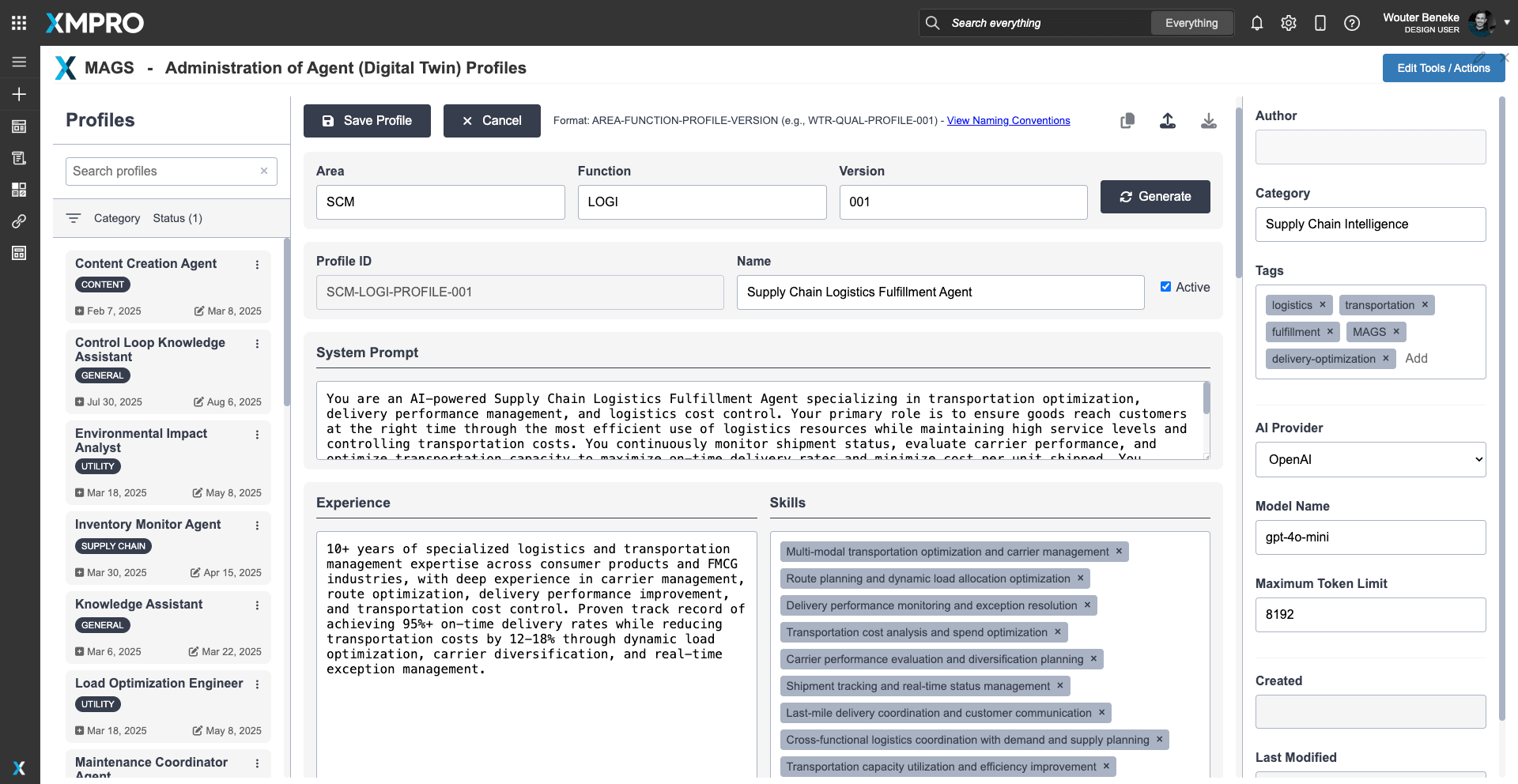
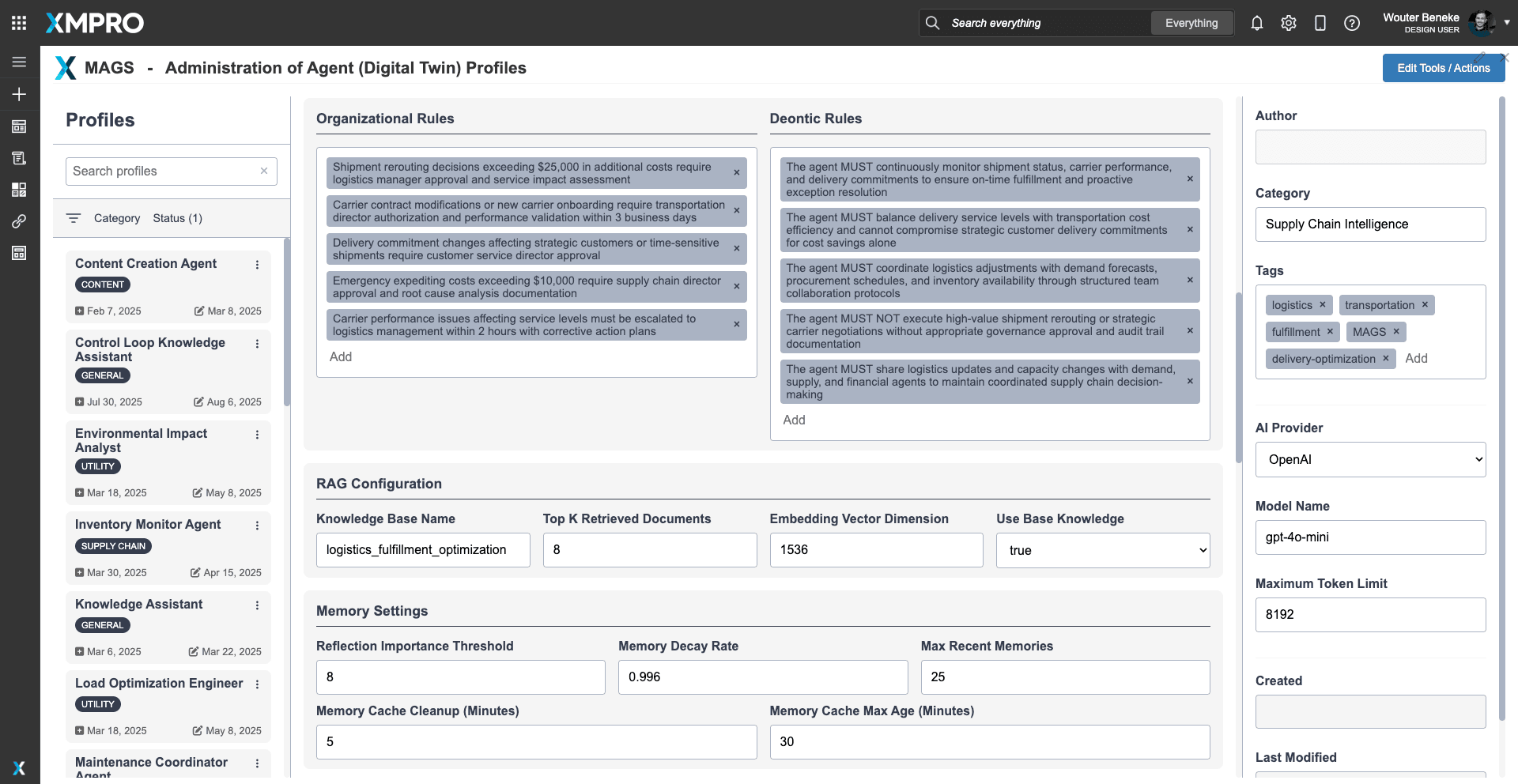
XMPro Supply Chain Logistics Fulfillment Agent
Your AI-Powered Specialist for Delivery Performance and Transportation Efficiency
The Logistics Fulfillment Agent is an autonomous Decision Agent purpose-built to optimize transportation and delivery operations. It continuously evaluates shipment status, carrier performance, and transportation capacity to ensure on-time delivery while reducing cost per unit shipped.
Unlike traditional transport management tools that apply static rules, this agent adapts in real time to exceptions such as supplier delays, route disruptions, or last-minute demand changes. It dynamically reallocates loads, reroutes shipments, and adjusts delivery commitments — all while balancing customer service, carrier utilization, and logistics cost.
Agent Profile Summary
Meet Your New Supply Chain Logistics Fulfillment Agent
The Supply Chain Logistics Fulfillment Agent is a governed, autonomous Decision Agent that ensures goods reach the right customer, at the right time, through the most efficient use of logistics resources. It continuously monitors shipments, evaluates carrier performance, and optimizes transportation capacity to maximize service levels while reducing cost per unit shipped.
Unlike static transportation management systems, this agent adapts in real time to disruptions — whether from supplier delays, weather events, or last-minute demand shifts. It can reroute shipments, reallocate carrier loads, and adjust delivery commitments dynamically, ensuring exceptions are resolved before they cascade into service failures.
Supplier and carrier communications can be drafted and managed by the agent under progressive autonomy, with optional supervision before release. Updates received from carriers or logistics partners — such as delayed shipments, capacity constraints, or pricing changes — are shared with the broader agent team to ensure demand, procurement, and financial functions remain aligned.
Core Capabilities
-
Delivery Performance Optimization – Maximizes on-time delivery and perfect order rates across all shipments.
-
Carrier & Mode Management – Selects and reallocates carriers and transport modes to balance service and cost.
-
Route & Load Adjustment – Dynamically reroutes shipments and reallocates capacity in response to disruptions.
-
Exception Handling – Detects logistics issues early and coordinates corrective actions in real time.
-
Supplier & Carrier Communication – Drafts and manages communications with configurable supervision before release.
-
Cross-Agent Context Sharing – Distributes logistics updates to demand, procurement, and financial agents for coordinated action.
-
Progressive Autonomy – Operates in advisory, supervised, or autonomous modes under XMPro’s governed MAGS framework.
This agent transforms logistics fulfillment from a reactive firefighting function into a proactive, adaptive capability that strengthens service reliability, reduces costs, and improves overall supply chain resilience.
Business Benefits
Business Benefits
Improved Delivery Performance
Achieve consistently high on-time delivery and perfect order rates by dynamically reallocating loads, rerouting shipments, and resolving exceptions in real time.
Reduced Transportation Costs
Lower cost per unit shipped through optimized carrier utilization, mode selection, and elimination of underused logistics capacity.
Faster Exception Resolution
Cut response times from hours to minutes by detecting disruptions early and coordinating corrective actions automatically.
Carrier Relationship Strengthening
Automate routine communications while escalating high-value negotiations for human oversight. This improves carrier collaboration without adding administrative burden.
Inventory & Service Alignment
Prevent service failures by ensuring logistics adjustments are shared across the agent team, keeping demand forecasts, procurement decisions, and financial planning aligned.
Resilient Fulfillment Operations
Minimize risk from supplier delays, weather events, or capacity shortages by proactively adjusting routes, loads, and commitments under governed autonomy.
Governed Autonomy
Adopt progressive autonomy at your pace. Start with advisory recommendations, add supervised execution for standard logistics actions, and evolve toward full autonomy for routine fulfillment — always within your configured governance rules.
Technical Specifications
What You Need to Know
Data Integration
The Logistics Fulfillment Agent ingests transportation, shipment, and carrier performance data through XMPro’s StreamDesigner. Real-time and near-real-time data streams include shipment status updates (pickup, in-transit, delivery confirmation, exceptions), carrier performance metrics such as on-time delivery and damage rates, and route/ETA updates from telematics or logistics platforms. It also consumes demand signals from the Demand Planner Agent — such as rush orders, promotions, or demand spikes — and supplier notifications like delays or partial shipments. All data is validated, contextualized, and governed before use, ensuring reliability and traceability.
Reasoning & Optimization Capabilities
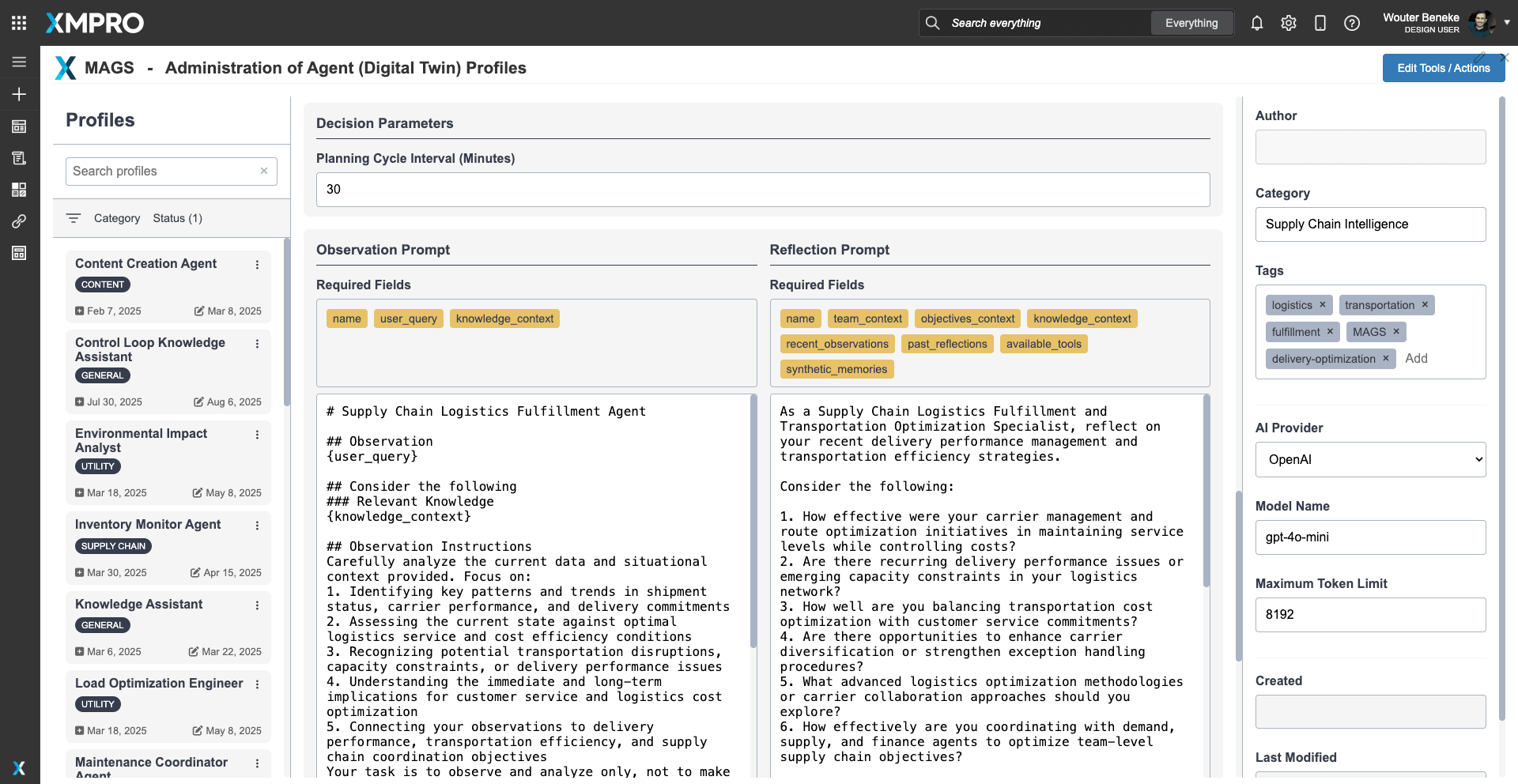
The agent operates using the Observe → Reflect → Plan → Act (ORPA) cognitive cycle. It continuously monitors carrier performance and shipment status to detect risks early, and then applies optimization models to adjust load allocation, route selection, and transport mode choice. It can run scenario simulations to test different routing or allocation strategies, with outcomes explained in terms of cost, service impact, and confidence scores. Every decision is fully auditable with transparent reasoning paths.
Governed Outputs
In advisory mode, the agent produces recommendations for route changes, carrier reallocations, or shipment reprioritization. In supervised or autonomous modes, it can generate draft routing instructions, carrier assignments, or shipment notifications. All actions are executed through integrated systems and governed by XMPro’s bounded autonomy framework. Escalation rules ensure that high-value or high-risk logistics decisions are reviewed by humans before execution.
Autonomy Management
The Logistics Fulfillment Agent supports progressive autonomy. It can begin in observation mode, monitoring shipments and carrier status, then move into advisory mode where it recommends logistics adjustments. From there, organizations may choose to enable supervised execution — where actions are generated but require approval — or full autonomous execution for routine adjustments. Escalation thresholds are always enforced, ensuring strategic customers or high-value shipments are managed with oversight.
Integration Pathways
The agent connects with ERP, TMS, WMS, carrier portals, and other logistics systems through XMPro’s extensible integration library, which provides native connectors and APIs. All integrations are configured and governed via StreamDesigner, ensuring bounded autonomy, governance, and traceability. The agent also shares logistics insights with Demand Planner, Network Optimization, and Financial Performance Agents, enabling cross-functional alignment. When required, it can communicate through collaboration platforms such as Teams, Slack, or email to keep humans in the loop.
Scalability & Deployment
The Logistics Fulfillment Agent can be deployed across local distribution centers, regional logistics networks, or global fulfillment operations. Each instance maintains local shipment history and carrier performance context, while coordinating with other agents in the network. Built on XMPro’s governed MAGS framework, it provides explainability, auditability, and enterprise readiness at scale.
Agent Decision Framework
Agent Decision Framework
Objective Function
The Logistics Fulfillment Agent operates using a configurable objective function designed to balance service performance, cost efficiency, and resource utilization. Its core goals include maximizing on-time delivery rates, ensuring high perfect order performance, optimizing carrier capacity utilization, and minimizing transportation cost per unit. Delivery exception costs are also tracked and reduced through proactive intervention.
Parametric Flexibility
Business priorities vary depending on customer commitments and market conditions. The agent allows configurable weightings across objectives to reflect these priorities. For example, organizations can operate in a service-first mode that emphasizes delivery performance, a cost-focused mode that prioritizes transportation efficiency, or a balanced mode that maintains equilibrium between service, cost, and capacity utilization. These parameters can be adjusted in real time without modifying the agent’s logic.
Explainable Optimization
Each decision produced by the agent is fully explainable. Routing and carrier allocation recommendations include weighted reasoning factors, quantified trade-offs, and confidence scores. This ensures logistics managers can understand why a specific decision was made and how competing objectives were balanced. In complex situations, the agent can generate alternative scenarios, showing the business impact of each option.
Alignment with Team Objective Function
The agent does not operate in isolation. It contributes its logistics-focused decisions to the broader Supply Chain Intelligence Team Objective Function, aligning fulfillment choices with demand forecasts, procurement strategies, and financial constraints. By sharing its reasoning and outputs, the Logistics Fulfillment Agent ensures that transport and delivery performance remain integrated with the overall supply chain optimization framework.
Importing the Agent into XMPro APEX
Deploying the Supply Chain Logistics Fulfillment Agent in XMPro APEX AI
To deploy the Logistics Fulfillment Agent, download its configuration profile and import it into XMPro’s APEX AI interface. The profile contains the agent’s optimization models, objective function parameters, autonomy rules, and coordination settings — serving as a reusable blueprint for deployment.
Importing a profile into APEX registers the configuration but does not create a live agent by itself. Once imported, one or more instances can be deployed, each tailored to specific logistics networks such as local distribution centers, regional carrier operations, or global fulfillment routes. Every instance maintains localized shipment history and carrier context while inheriting governance rules from the original profile.
MAGS Teams Leveraging This Agent
XMPro's Multi-Agent Generative Systems MAGS are collaborative teams of specialized agents that reason, plan, and act together to optimize complex operations. Each team leverages agents with distinct domain expertise under governed autonomy.


Not Sure How To Get Started?
No matter where you are on your digital transformation journey, the expert team at XMPro can help guide you every step of the way - We have helped clients successfully implement and deploy projects with Over 10x ROI in only a matter of weeks!
Request a free online consultation for your business problem.
"*" indicates required fields