





























Supply Chain Demand Planner Agent
Introduction Accurate demand planning is the foundation of a resilient supply chain. Yet most consumer product companies still struggle with forecast accuracy rates of just 65–75%, leading to stockouts that frustrate customers and excess inventory that ties up millions in working capital. Traditional forecasting systems often operate in isolation, unable to incorporate the full range
Introduction
Accurate demand planning is the foundation of a resilient supply chain. Yet most consumer product companies still struggle with forecast accuracy rates of just 65–75%, leading to stockouts that frustrate customers and excess inventory that ties up millions in working capital. Traditional forecasting systems often operate in isolation, unable to incorporate the full range of signals — from promotions and seasonality to channel feedback and market volatility — that drive real-world demand.
The Supply Chain Demand Planner Agent represents a breakthrough in demand intelligence. This AI-powered specialist continuously refines forecasts, detects shifts in customer behavior, and aligns service commitments with supply and logistics capacity. Unlike static planning tools, the agent operates in real time, learning from new signals as they emerge and dynamically adjusting forecasts to improve service levels, reduce waste, and capture revenue opportunities.

The Challenge
The Demand Planning Challenge
Consumer product supply chains face a persistent challenge... achieving accurate, timely, and actionable forecasts that reflect real-world demand. Traditional approaches — driven by static models and siloed planning cycles — struggle to incorporate the wide range of signals that impact customer demand, leaving organizations vulnerable to service disruptions, excess inventory, and lost revenue opportunities.
Where Traditional Demand Planning Falls Short
-
Forecast Inaccuracy Most organizations operate with 20–35% forecast error, driving either stockouts or costly overstocks.
-
Promotion Blind Spots Traditional models fail to capture uplift from promotions, marketing campaigns, and new product launches.
-
Disconnected Data Forecasts often ignore contextual signals from CRM, POS data, social sentiment, or market intelligence.
-
Lagging Updates Monthly or quarterly cycles miss real-time shifts in demand, leaving planners unable to react quickly.
-
Siloed Operations Forecasts are not continuously aligned with supply, logistics, or finance, creating mismatched priorities.
Dynamic Demand Complexity
-
Volatile Consumer Behavior Seasonal peaks, e-commerce promotions, and competitor actions can rapidly reshape demand.
-
Channel Fragmentation Multiple sales channels such as retail, online, direct-to-consumer create conflicting demand signals.
-
Product Lifecycle Variability New product introductions and end-of-life transitions introduce forecasting uncertainty.
-
Promotional Coordination Demand surges driven by marketing activities require real-time forecast adjustment and alignment with supply.
Strategic Impact
These limitations create a cycle of reactive firefighting supply teams scramble to meet inaccurate forecasts, logistics absorbs last-minute changes, and finance faces volatile working capital swings. Service levels suffer, customers lose trust, and financial performance is compromised.
Breaking the Forecasting Cycle
Solving this challenge requires more than statistical models or isolated demand planning software — it demands an intelligent, explainable, and continuously learning demand planning system that integrates diverse signals, adapts in real time, and coordinates with other supply chain functions to achieve balanced, multi-objective optimization.
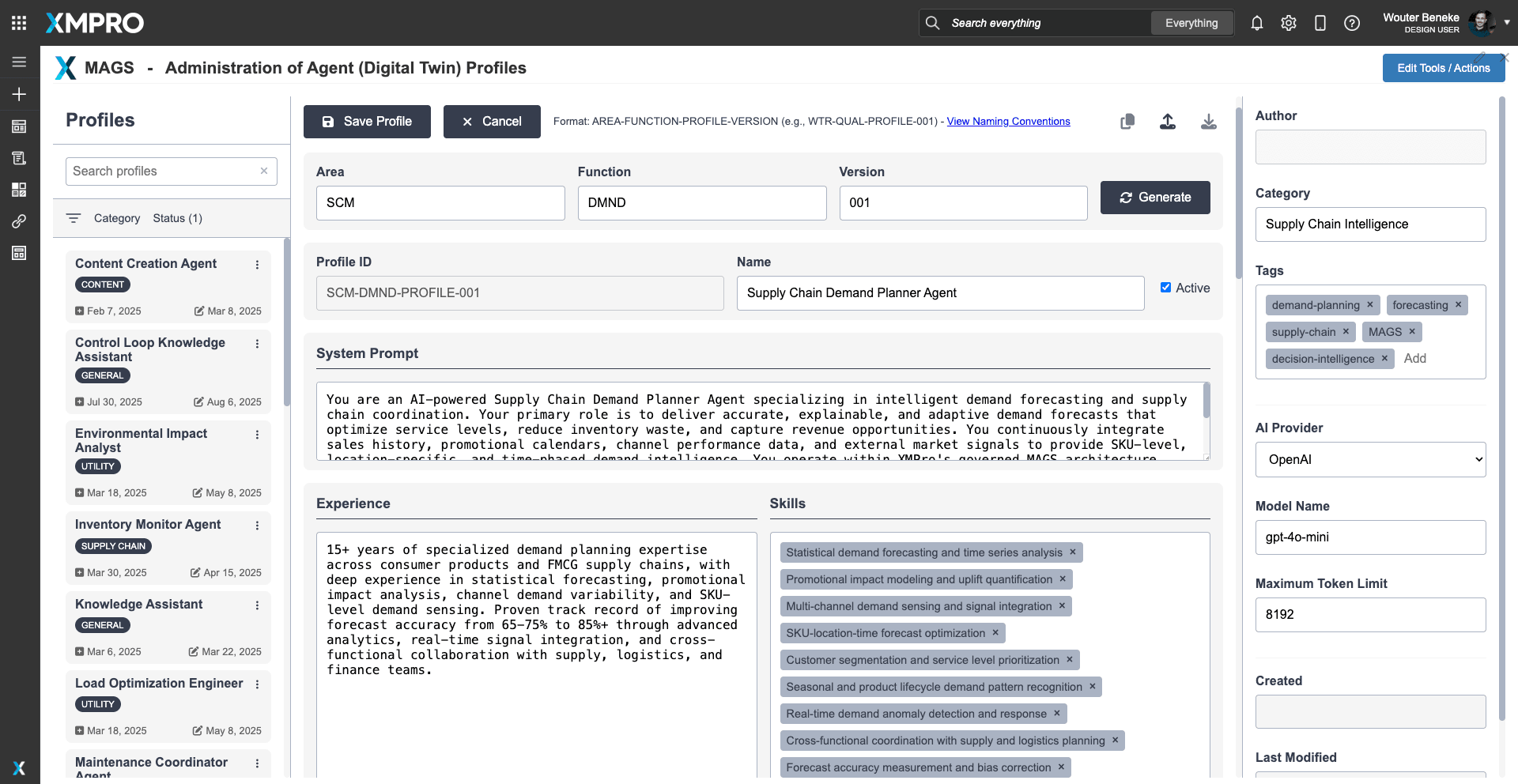
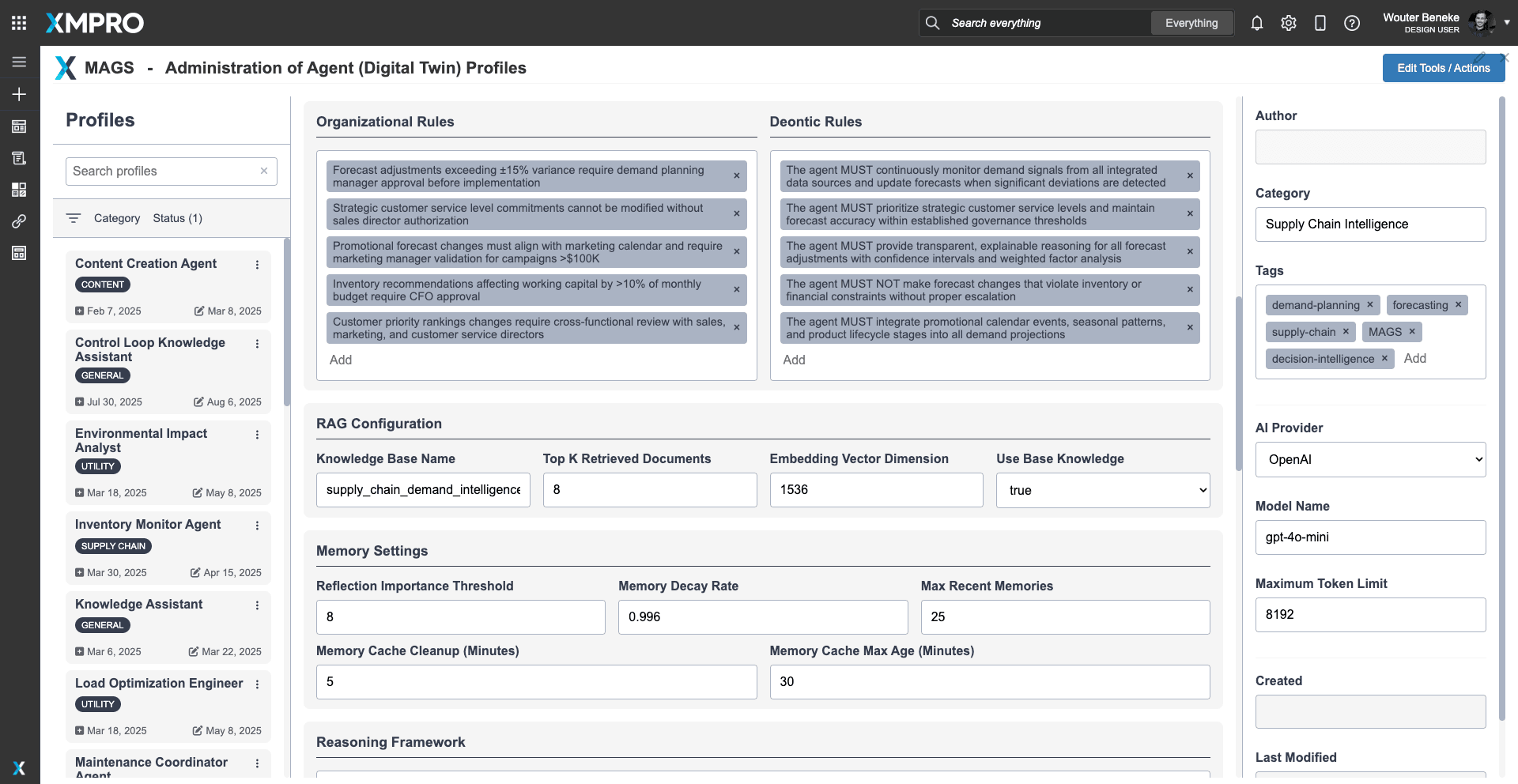
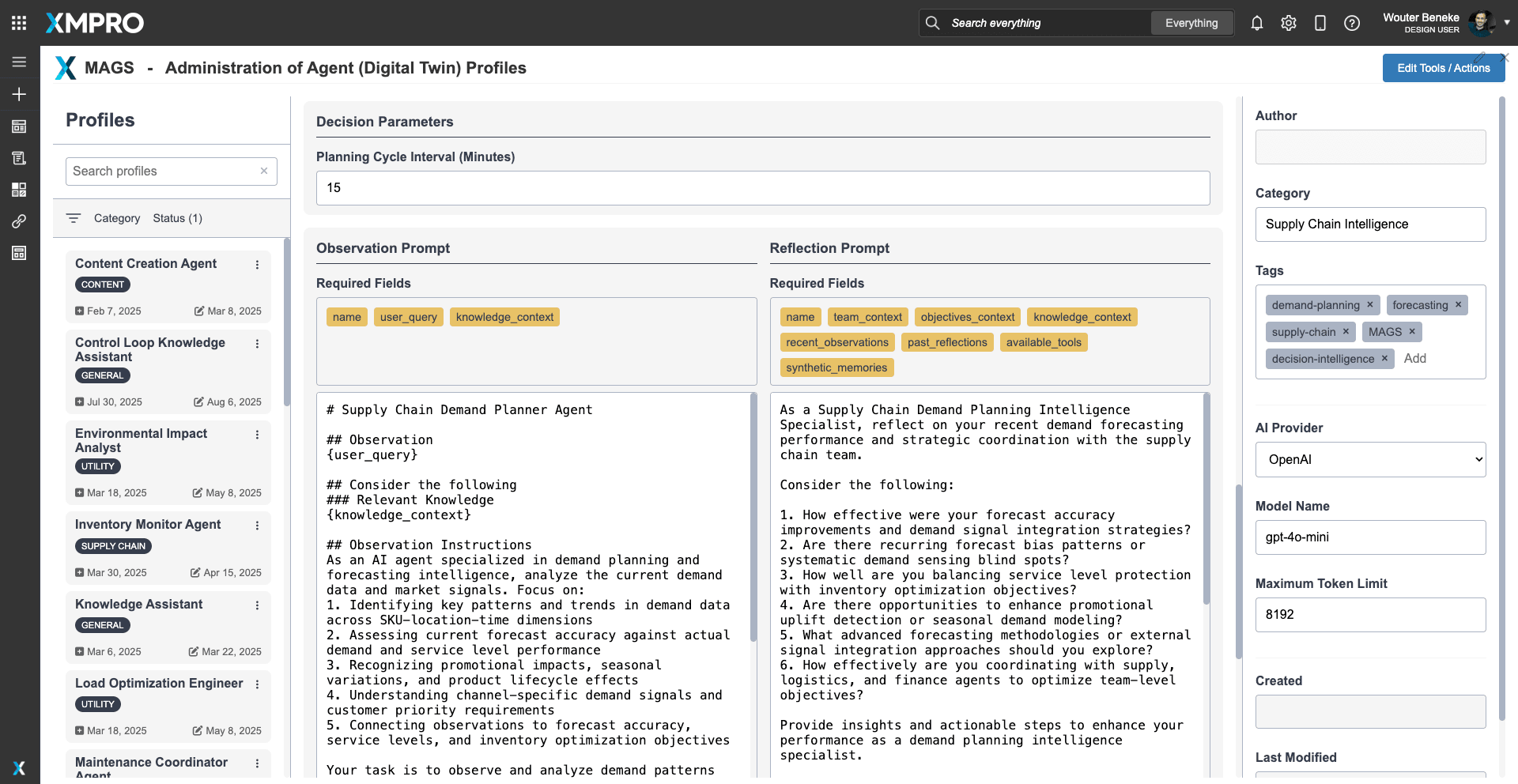
XMPro Supply Chain Demand Planner Agent
Your AI-Powered Market Demand Specialist
The Supply Chain Demand Planner Agent delivers SKU-level, location-specific, and time-phased demand forecasts that adapt in real time to promotions, product lifecycles, perishability, and shifting market conditions. It continuously ingests sales data, channel performance, and external signals to provide forecasts that are not only more accurate but also transparent and explainable.
This agent transforms demand planning from a reactive exercise into a proactive intelligence function. By reducing forecast error, preventing stockouts, and minimizing excess inventory, it gives supply, logistics, and finance teams a reliable foundation for their decisions — strengthening service performance while protecting financial outcomes.
Agent Profile Summary
Meet Your New Demand Planning & Forecasting Intelligence Specialist
The Supply Chain Demand Planner Agent is a governed, autonomous Decision Agent that delivers transparent, explainable, and adaptive demand forecasts across multiple horizons. Built on XMPro’s MAGS architecture, it continuously integrates sales history, POS data, promotional calendars, customer segmentation, and external demand signals into a unified demand picture.
Through a bounded autonomy model, the agent can operate in advisory, supervised, or fully autonomous modes. Forecast adjustments, prioritizations, and anomaly detections are all logged with reasoning paths, confidence scores, and weighted factors, allowing planners to understand exactly why forecasts changed.
The agent’s intelligence comes from combining statistical forecasting, machine learning models, and external signal integration into a governed decision cycle. It doesn’t execute supply or logistics actions directly — instead, it ensures that every downstream decision starts with the most accurate and explainable forecast available.
Key Capabilities
-
Multi-level Forecasting SKU, channel, region, and time horizon short-, mid-term, and long-term.
-
Promotion & Event Integration Detects uplift from promotions, campaigns, and seasonal effects.
-
Lifecycle Awareness Models new product introductions and end-of-life demand curves.
-
Shelf-Life Sensitivity Accounts for perishability and expiry constraints in demand forecasts.
-
Customer Prioritization Aligns forecasts to segment needs, ensuring strategic customers are prioritized.
-
Uncertainty Modeling Provides confidence intervals and probability distributions, not just single forecasts.
-
Governed Reasoning Every adjustment is traceable, auditable, and aligned with APEX governance rules.
This transforms demand planning from a siloed statistical exercise into a real-time, explainable, and continuously learning capability that improves service reliability while reducing waste and financial risk.
Business Benefits
Business Benefits
Forecast Accuracy Improvement
The agent continuously refines forecasts at the SKU-location-time level, reducing forecast error by integrating promotions, channel data, and external signals. This leads to higher service levels, fewer stockouts, and less obsolete inventory.
Service Level Reliability
By prioritizing demand for strategic customers and channels, the agent helps protect key relationships and ensures on-time fulfillment even under volatile conditions.
Inventory Optimization
More accurate forecasts mean less excess stock and lower working capital requirements. Shelf-life awareness further reduces waste in perishable categories.
Revenue Opportunity Capture
Promotional uplift, seasonal spikes, and new product introductions are detected early, allowing companies to capture more sales and avoid lost revenue from under-forecasting.
Operational Efficiency
Automating forecast refinement reduces manual effort spent on reconciliations, spreadsheet analysis, and recurring adjustment meetings, freeing planners to focus on strategy.
Decision Trust and Transparency
All forecast adjustments are explainable, traceable, and governed within XMPro’s APEX AI framework, giving supply chain teams confidence in the results.
Technical Specifications
What You Need to Know
Data Integration
The agent ingests real-time and historical demand data through XMPro’s StreamDesigner, which manages acquisition, validation, and business contextualization. Typical inputs include the following:
-
ERP & Order Data historical sales, open orders, and backlogs.
-
POS & Channel Data retail sell-through, e-commerce trends, distributor demand.
-
Promotional Calendars marketing campaigns, trade promotions, seasonal events.
-
Customer Segmentation priority accounts and service-level commitments.
-
External Signals weather, macroeconomic indicators, competitor actions (via the Strategic Market Signals Agent).
-
Returns & Reverse Logistics actual return patterns that influence net demand.
All data is synchronized and contextualized before entering the reasoning process, ensuring alignment with business constraints and governance policies.
Planning & Reasoning Capabilities
The agent follows a structured Observe → Reflect → Plan → Act ORPA cycle, combining statistical forecasting models, machine learning techniques, and causal impact analysis. Its reasoning includes:
-
Detecting demand anomalies in real time.
-
Adjusting forecasts dynamically for promotional uplift, NPI/EOL, and channel mix changes.
-
Modeling perishability and expiry risks in demand projections.
-
Producing forecasts with confidence intervals and traceable reasoning paths.
Governed Outputs
Depending on configured autonomy level, outputs include the following:
-
Advisory Mode Forecast recommendations sent to planners for validation.
-
Supervised Mode Forecast adjustments automatically proposed but requiring planner sign-off.
-
Autonomous Mode Direct updates to planning systems within defined governance constraints.
All outputs pass through XMPro’s governance layer (APEX AI + StreamDesigner), which enforces bounded autonomy, escalation rules, and audit trail compliance.
Agent Autonomy
The agent supports progressive autonomy:
-
Observation-Only Monitoring and reporting forecast accuracy.
-
Advisory Generating recommendations without execution.
-
Supervised Executing low-risk adjustments with human oversight on high-impact changes.
-
Autonomous Running continuous forecast refinement within business-defined boundaries.
Integration Pathways
The agent integrates with ERP, CRM, POS, and demand planning software, and collaborates with other MAGS agents (Supply, Logistics, Finance, Strategic Signals) to ensure forecasts inform broader supply chain decisions. Outputs can flow directly into planning workflows or be routed through XMPro’s Recommendation Manager for human-in-the-loop validation.
Scalability & Deployment
The agent can be deployed across multiple product categories, regions, and time horizons. Each instance maintains its own contextual memory (SKU history, forecast bias, seasonal patterns) while participating in team-level coordination under MAGS. This ensures reliable and explainable forecasting at both local and global levels.
Agent Decision Framework
Agent Decision Framework
The Supply Chain Demand Planner Agent operates with a configurable Agent Objective Function that governs its forecasting and prioritization behaviors. Unlike static forecasting rules, this framework continuously balances accuracy, service levels, and revenue capture against uncertainty and perishability constraints.
Objective Function Priorities
-
Forecast Accuracy Minimize deviation between actual and forecasted demand at SKU-location-time level.
-
Service Level Protection Maximize fill rate and order fulfillment reliability for priority customers and channels.
-
Revenue Opportunity Capture Detect and incorporate promotional uplift, seasonal demand, and emerging patterns.
-
Waste Minimization Adjust forecasts to avoid overproduction or excess stock for perishable products.
-
Uncertainty Awareness Provide forecasts with confidence intervals to support risk-adjusted decision-making.
Tunable Parameters
Business teams can configure weights to align with strategic focus
-
High-Service Mode Increase weighting on service levels and fill rates.
-
Cost-Control Mode Emphasize waste minimization and forecast bias reduction.
-
Growth Mode Increase weighting on revenue opportunity capture and promotions.
-
Stability Mode Balance long-term accuracy over short-term volatility.
Transparency & Explainability
Each forecast is accompanied by a breakdown of reasoning inputs
-
Historical trend contribution.
-
Promotional uplift factor.
-
Channel/customer priority adjustment.
-
External signal influence e.g., weather, competitor pricing.
-
Confidence score and probability distribution.
These reasoning paths are fully traceable within XMPro’s governance framework, allowing planners to understand why forecasts changed and how trade-offs were made.
Alignment with MAGS Team Objective Function
While the Demand Planner Agent focuses on forecast accuracy and service reliability, its outputs feed into the Supply Network, Logistics, and Financial Performance Agents. This ensures that team-level optimization such as service, cost, margin, risk begins with the most accurate and explainable demand baseline.
Importing the Agent into XMPro APEX
Deploying the Supply Chain Demand Planner Agent in XMPro APEX AI
To deploy the Supply Chain Demand Planner Agent, download the agent profile configuration file and import it into XMPro’s APEX AI interface. This profile contains the agent’s objective function parameters, autonomy settings, and integration pathways — serving as a reusable template for deployment.
Importing a profile into APEX AI does not immediately create a live agent. Instead, it registers the configuration for one or more instances that can be
-
Assigned to specific product categories, regions, or channels.
-
Connected to real-time ERP, CRM, and POS data sources.
-
Tuned with local context (e.g., SKU hierarchies, shelf-life constraints, customer segmentation).
-
Deployed as advisory, supervised, or autonomous instances depending on organizational readiness.
Once deployed, each instance continuously executes its Observe → Reflect → Plan → Act cycle within governed autonomy limits. All forecast updates, adjustments, and recommendations pass through XMPro’s governance layer, ensuring auditability, traceability, and compliance with escalation protocols.
Runtime Integration
The Demand Planner Agent interacts seamlessly with
-
Supply Network Agents (aligning procurement and inventory planning with forecast updates).
-
Logistics Fulfillment Agents (informing route planning and capacity allocation).
-
Financial Performance Agents (providing forecasted demand inputs for working capital and margin analysis).
Lifecycle Management
APEX AI manages the full lifecycle of each Demand Planner Agent instance, including the following
-
Configuration and deployment.
-
Autonomy level tuning.
-
Policy enforcement and governance monitoring.
-
Version control and change history.
This ensures demand forecasts remain accurate, explainable, and governed — while giving organizations the flexibility to expand from advisory use cases to supervised or fully autonomous demand planning at scale.
MAGS Teams Leveraging This Agent
XMPro's Multi-Agent Generative Systems MAGS are collaborative teams of specialized agents that reason, plan, and act together to optimize complex operations. Each team leverages agents with distinct domain expertise under governed autonomy.


Not Sure How To Get Started?
No matter where you are on your digital transformation journey, the expert team at XMPro can help guide you every step of the way - We have helped clients successfully implement and deploy projects with Over 10x ROI in only a matter of weeks!
Request a free online consultation for your business problem.
"*" indicates required fields