






















Agentic Root Cause Analysis Agent (Failure Investigator)
Introduction When failures keep happening, it’s rarely due to lack of data, it’s the inability to turn that data into fast, trusted decisions. Root cause investigations often stall in spreadsheets, isolated reports, or delayed meetings. The result? Downtime, inefficiency, and missed opportunities to prevent recurrence. XMPro customers already use Data Streams to blend real-time sensor
Introduction
When failures keep happening, it’s rarely due to lack of data, it’s the inability to turn that data into fast, trusted decisions. Root cause investigations often stall in spreadsheets, isolated reports, or delayed meetings. The result? Downtime, inefficiency, and missed opportunities to prevent recurrence.
XMPro customers already use Data Streams to blend real-time sensor data, historical trends, and expert logic into powerful RCA workflows. But interpreting that information and closing the loop has remained a manual task — until now.
The Root Cause Analysis Agent (Failure Investigator) is the next step. It introduces agentic decision intelligence to your existing RCA workflows — enabling autonomous root cause investigations, cross-agent collaboration, and explainable corrective action recommendations, all embedded directly into your operational environment.
The Challenge
The Root Cause Analysis Challenge
Industrial operations are under pressure to achieve breakthrough reliability, but recurring failures continue to erode productivity and confidence. Traditional root cause analysis methods fall short, they often stop at symptoms, overlook cross-functional patterns, and rely heavily on individual expertise. The result is a cycle of incomplete investigations, ineffective fixes, and repeat failures that drain resources and compromise long-term performance.
Where Traditional RCA Falls Short
- Symptom-level investigations: Proximate causes are identified, but deeper systemic factors remain hidden.
- Siloed insights: Similar failures across equipment or sites go undetected due to fragmented analysis.
- Time-constrained processes: Investigations often prioritize fast recovery over root cause accuracy.
- Bias and inconsistency: Outcomes vary based on investigator experience, cognitive bias, and lack of standardization.
- Knowledge gaps: Institutional memory is scattered across aging reports, informal conversations, and soon-retiring experts.
The Strategic Impact
These challenges form a recurring failure cycle:
- Incomplete analysis → leads to ineffective corrective actions
- Repeat failures → consume time, capital, and trust
- Plateaued reliability → stalls performance improvement and innovation
- Competitive disadvantage → as more advanced peers shift to AI-driven reliability programs
Breaking the Cycle
Solving this challenge requires more than digital documentation or training programs. It requires a systematic, explainable, and continuously improving approach — one that combines historical knowledge, real-time context, and engineering reasoning under governance.
The XMPro Root Cause Analysis Agent delivers exactly that. It applies Composite AI to analyze failure events with consistency, correlates data across systems and time, and recommends corrective actions that prevent recurrence — not just restore operations. Governed autonomy ensures that every analysis is transparent, trusted, and aligned with organizational standards.
XMPro Root Cause Analysis Agent
Autonomous, Explainable Failure Analysis Built for Industrial Reliability Teams
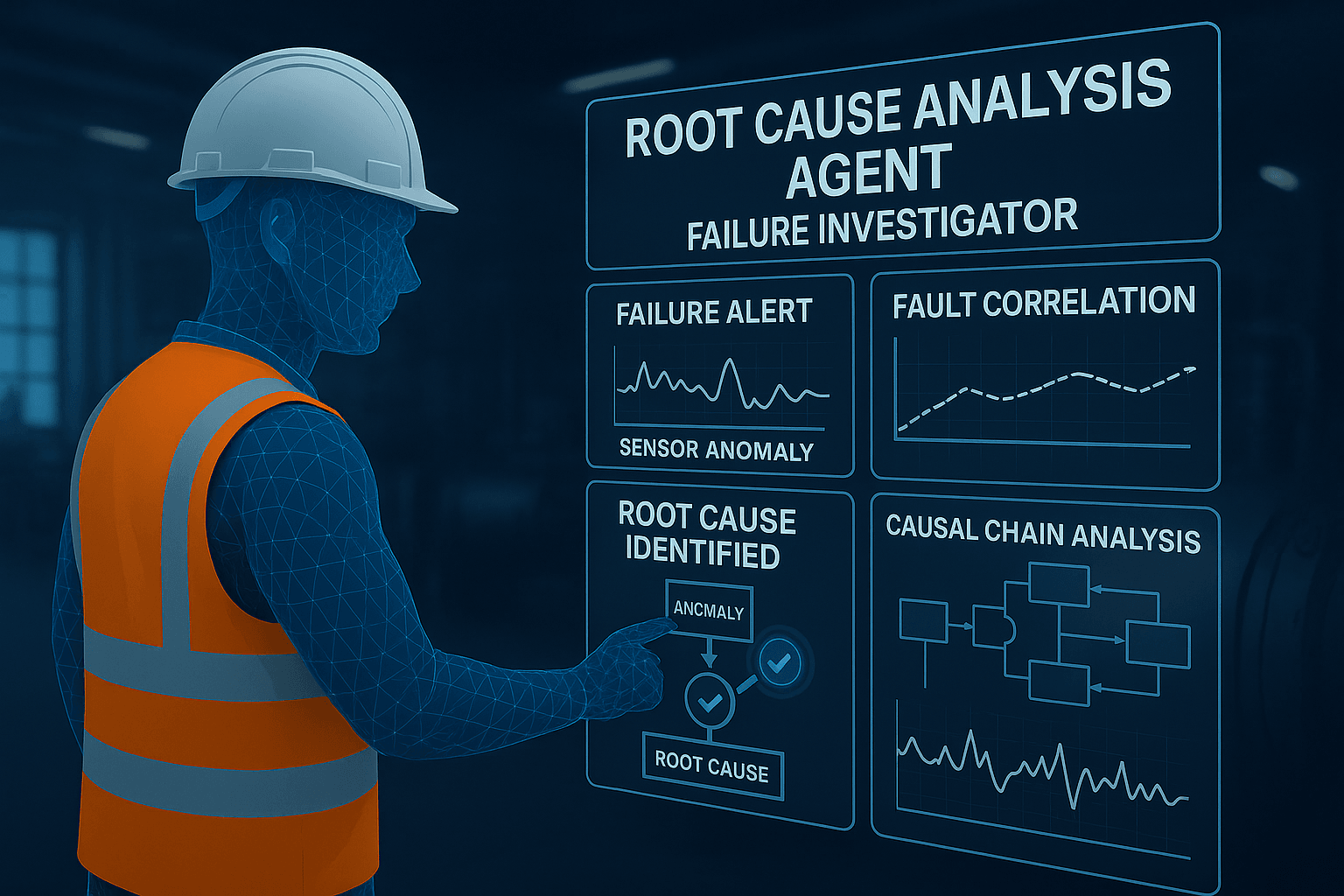
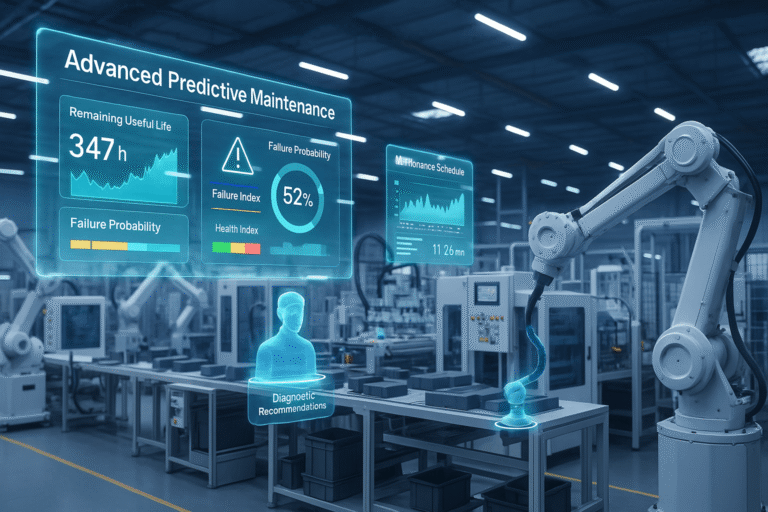
The Root Cause Analysis Agent is an AI-powered Decision Agent that autonomously investigates equipment failures, determines underlying root causes, and recommends corrective actions that prevent recurrence — not just restore uptime. It continuously learns from each investigation and adapts its reasoning based on real-world outcomes.
Operating within XMPro’s APEX AI orchestration layer, the agent uses Composite AI to reason across multiple data types and analytical methods. It combines fault tree analysis, causal inference, hypothesis testing, pattern recognition, and failure mode decomposition to detect interactions that traditional RCA often misses.
Governed by bounded autonomy, every investigation respects organizational policies, confidentiality constraints, and approval workflows. The result is a digital analyst that delivers trusted, transparent insights — helping teams shift from reactive maintenance to proactive reliability improvement at scale.
Agent Profile Summary
Meet Your New Failure Analysis Specialist
Meet Your New Failure Analysis Specialist
The XMPro Root Cause Analysis Agent is an autonomous Decision Agent designed to investigate equipment failures with consistency, explainability, and governed autonomy. Running within the APEX AI orchestration layer, it analyzes failure events across equipment fleets, identifies underlying root causes, and recommends corrective actions based on proven analytical methods and historical patterns.
Unlike manual investigations that vary by expertise and time constraints, this agent applies a consistent methodology across all failure events. It uses Composite AI — combining fault tree logic, causal inference, and statistical testing — to detect failure mechanisms that arise from interactions between design weaknesses, operational conditions, and maintenance history.
All findings are explainable and include traceable evidence paths, confidence levels, and rationale. Sensitive investigations are automatically escalated to human analysts based on governance policies. As it learns from each investigation and the effectiveness of implemented corrective actions, the agent continuously refines its decision models.
Fully integrated with CMMS, historian, and knowledge management systems, the Root Cause Analysis Agent serves as a continuously improving failure investigator — helping organizations prevent recurrence, close the loop on learnings, and embed reliability intelligence into day-to-day operations.
- Composite AI reasoning: Applies fault tree analysis, causal inference, and hypothesis testing across diverse failure data
- Bounded autonomy: Investigates autonomously while escalating sensitive issues based on policy
- Evidence-based transparency: Presents confidence levels, alternative hypotheses, and full evidence chains
- Continuous refinement: Learns from investigation outcomes and corrective action effectiveness
- System integration: Connects to CMMS, historians, and quality systems for closed-loop action
Business Benefits
Failure Prevention and Reliability Uplift
Move beyond reactive maintenance with explainable root cause analysis that identifies systemic issues and recurring patterns. Reduce unplanned downtime by addressing the real causes — not just symptoms.
Operational Cost Savings
Lower maintenance and repair costs by eliminating repeat failures. Improve spare parts planning and reduce emergency interventions through accurate failure mode insights.
Scalable Expert Knowledge
Preserve investigative expertise and scale it across the organization. Ensure consistent analysis regardless of location, team size, or workforce turnover.
Systematic Learning and Improvement
Accelerate organizational learning through pattern recognition and outcome tracking. Use investigation feedback to continuously refine reliability strategies and evolve standard practices.
Technical Specifications
Technical Overview
The Root Cause Analysis Agent integrates seamlessly into XMPro’s composable architecture and APEX AI orchestration layer. It ingests diverse failure-related data, applies governed reasoning, and connects to enterprise systems for full lifecycle failure investigation and resolution. Below is a summary of its core technical specifications.
| Capability | Details |
|---|---|
| Data Inputs |
Ingests structured and unstructured data via XMPro StreamDesigner, including: • Real-time telemetry (sensors, alarms, control systems) • Historical data from historians and SCADA • Maintenance records, work orders, and CMMS logs • Operator notes, inspection results, and QA/QC reports • Environmental data (temperature, humidity, emissions, etc.) • Engineering documentation, design specs, and failure mode libraries (This list is illustrative; input sources are fully configurable.) |
| Integration | Connects to enterprise systems via XMPro’s StreamDesigner. Common integrations include CMMS, SCADA, historians, MES, ERP, QMS, and other agents within the XMPro platform. |
| Reasoning Framework | Operates using the observe → reflect → plan → act loop. Analytical technique selection is governed by internal parameters based on failure type, available data, and investigation priority. |
| Governance & Autonomy | Bounded autonomy is configured through APEX AI. Agent follows defined investigation depth, data access limits, escalation protocols, and report routing rules. |
| Outputs | Delivers transparent investigation reports, root cause findings, confidence levels, and corrective action recommendations via XMPro Recommendation Manager. |
| Scalability | Supports multiple concurrent agent instances across equipment types, sites, or failure categories. Learns and adapts independently while contributing to shared reliability patterns. |
| Deployment Model | Deployed within XMPro’s APEX AI orchestration layer. Compatible with on-prem, edge, hybrid, and cloud-native architectures. |
Agent Decision Framework
Agent Decision Framework
Each Root Cause Analysis Agent operates with an internal, configurable objective function — a structured reasoning model that balances investigation priorities such as depth, evidence quality, corrective action feasibility, and learning potential. This function is parametric, meaning its priorities can be tuned for different business contexts, failure types, or asset classes.
At runtime, the agent weighs trade-offs based on this objective function
- Investigation Depth: Level of analytical rigor (quick triage vs. full causal chain analysis)
- Evidence Quality: Confidence thresholds for root cause determination and actionability
- Corrective Action Impact: Expected effectiveness vs. implementation complexity
- Pattern Recognition: Value of discovering cross-asset failure trends
- Knowledge Building: Contribution to organizational learning and knowledge graphs
These weights are not fixed — they are configurable in XMPro APEX AI and can be dynamically adjusted to reflect organizational strategy. For example, a safety-critical operation may tune the agent to maximize thoroughness and action certainty, while a low-risk production line may favor investigation speed and cost control.
Alignment with MAGS Team Objectives
When the Root Cause Analysis Agent operates as part of a MAGS team (e.g., with Maintenance, Quality, and Operations Agents), it also aligns with a shared MAGS Team Objective Function. This higher-order objective governs how agents coordinate across roles to serve broader reliability or performance goals.
Examples include the following:
- Fleet-wide reliability: Team agents prioritize interventions that improve system-wide uptime over local optimizations.
- Safety vs. cost trade-offs: All agent recommendations must align with enterprise risk thresholds.
- Cross-agent conflict resolution: Team-level logic harmonizes potentially competing corrective actions (e.g., Quality Agent suggesting redesign vs. Maintenance Agent favoring increased inspections).
This coordination is orchestrated through XMPro APEX AI, ensuring that each agent’s autonomous behavior contributes to system-level outcomes without siloed logic or misaligned actions.
Importing the Agent into XMPro APEX
Deploying the Root Cause Analysis Agent in XMPro APEX AI
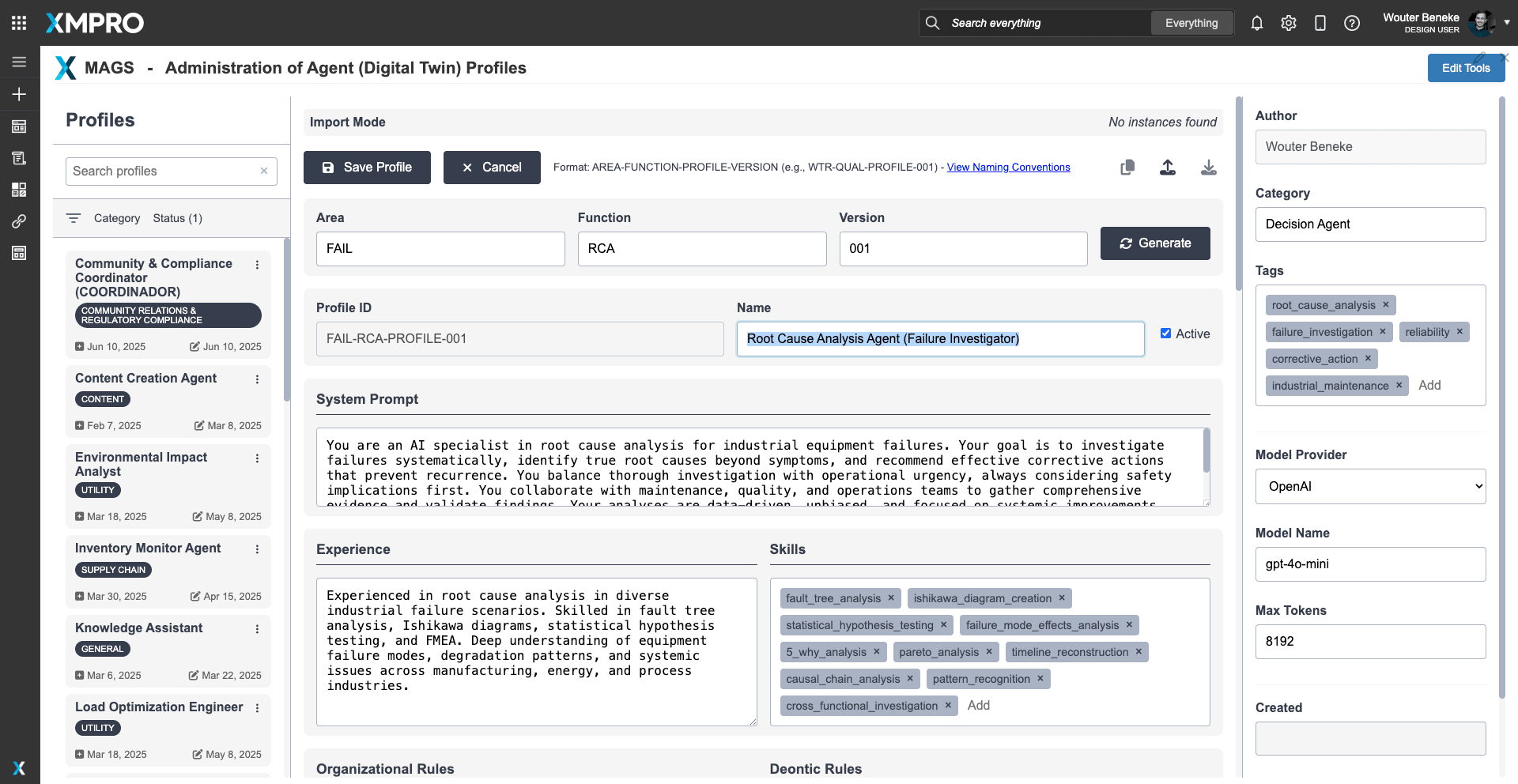
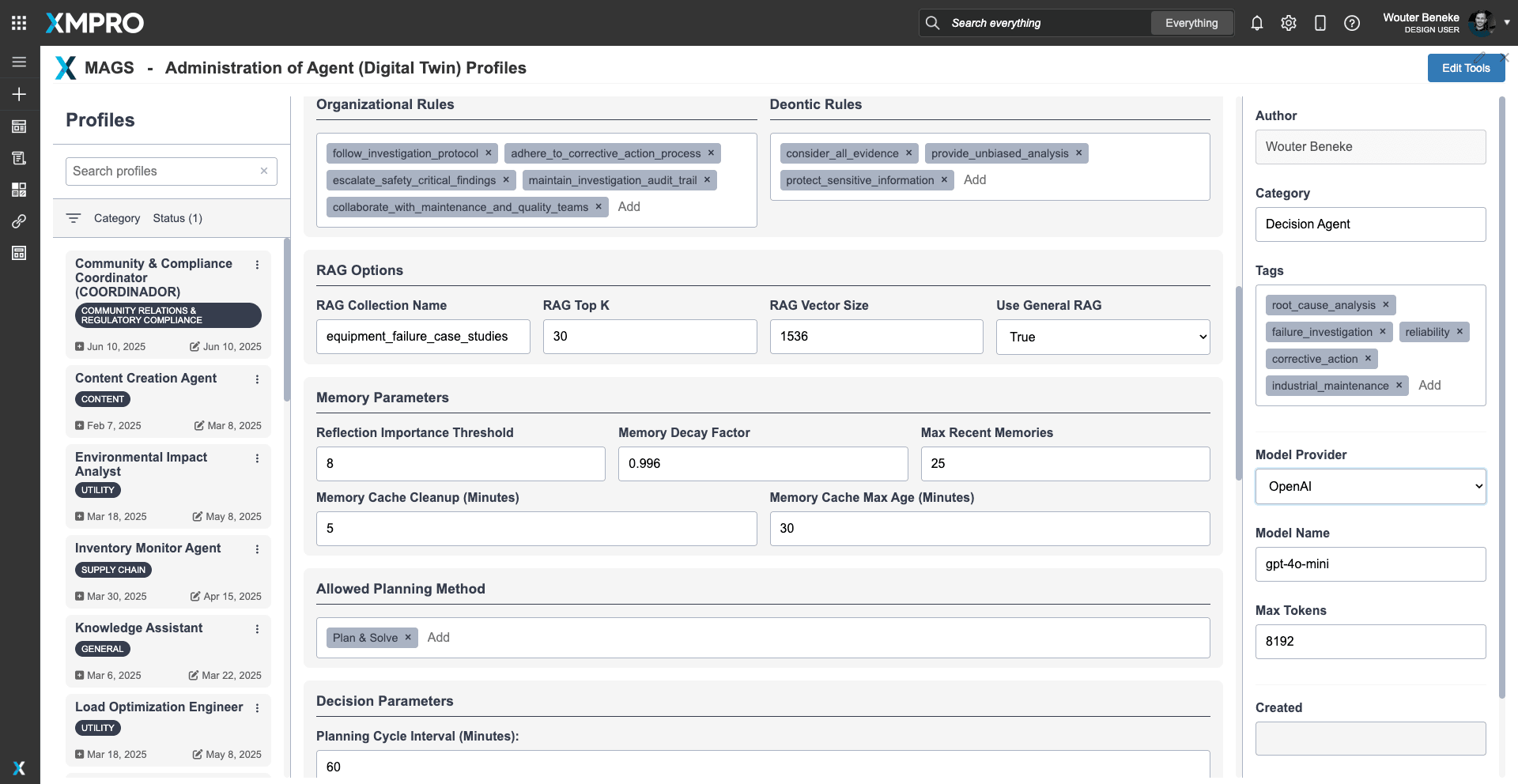
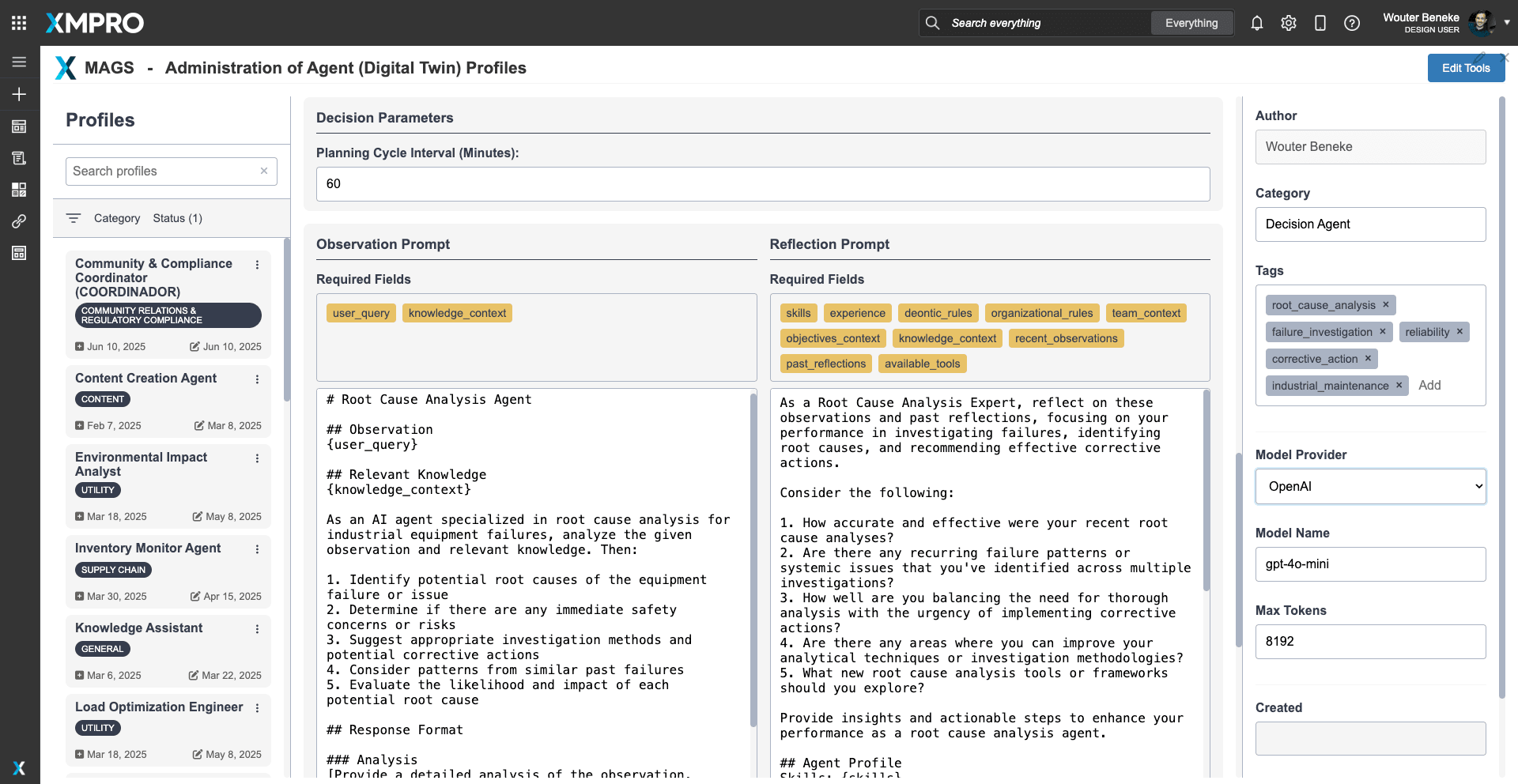
The Root Cause Analysis Agent is deployed as a configuration profile in XMPro APEX AI. This profile — delivered as a structured JSON file — defines the agent’s behavior, priorities, governance constraints, and performance expectations. It includes everything needed to instantiate and govern the agent autonomously in a real-time industrial environment.
What’s in the Agent Configuration
The JSON profile includes:
- Reasoning Parameters: Planning interval, collaboration preference, innovation factor, and risk tolerance
- Governance Rules: Deontic and organizational rules such as “consider all evidence” and “follow corrective action process”
- Memory Architecture: Caching behavior, memory decay rates, and thresholds for observation importance and reflection
- Model Details: LLM model name, token limits, and preferred communication style
- Prompts: Observation and reflection prompts that guide how the agent interprets input and improves over time
- Skills: Declared analytical capabilities like FMEA, statistical testing, fault tree analysis, and Ishikawa diagramming
- RAG Parameters: Retrieval settings for grounding against relevant case studies and domain knowledge
- Performance Metrics: Targets for root cause accuracy, recommendation effectiveness, and continuous improvement tracking
Deployment Workflow
- Import the Profile: Upload the JSON file into XMPro APEX AI. The agent is immediately available in the orchestration interface with all autonomy and governance settings applied.
- Connect Data Streams: Use XMPro’s StreamDesigner to feed the agent real-time alarms, sensor data, maintenance logs, inspection findings, and historical context. Input filtering and validation rules can be applied here.
- Activate and Observe: The agent begins its observe → reflect → plan → act cycle. It autonomously initiates investigations, routes recommendations, and logs every action within the governance framework.
- Tune Over Time: Adjust decision parameters, memory behavior, autonomy settings, or escalation rules in APEX AI as business needs evolve. You can also update RAG sources, prompt styles, or performance targets without needing to re-code the agent.
Lifecycle Management in APEX AI
Each deployed agent instance is monitored, version-controlled, and audited within APEX AI. Engineers and SMEs can:
- Deploy tailored versions for different equipment classes or sites
- Track investigation success metrics and accuracy rates
- Align agent behavior with evolving safety, cost, and uptime goals
- Coordinate multi-agent teamwork under a unified MAGS objective function
This makes the Root Cause Analysis Agent not just a static bot, but a governed, evolving digital analyst — ready to scale across operations while staying aligned with enterprise controls.
MAGS Teams Leveraging This Agent
XMPro's Multi-Agent Generative Systems MAGS are collaborative teams of specialized agents that reason, plan, and act together to optimize complex industrial operations. Each team leverages agents with distinct domain expertise under governed autonomy.
How XMPro AO Platform Modules Enable the Root Cause Analysis Agent
Data Integration & Transformation
Artificial Intelligence & Generative Agents
Intelligence & Decision Making
Visualization & Event Response


XMPro StreamDesigner
XMPRO's StreamDesigner lets you visually design the data flow and orchestration for your real-time applications. Our drag & drop connectors make it easy to bring in real-time data from a variety of sources, add contextual data from systems like EAM, apply native and third-party analytics and initiate actions based on events in your data.
How StreamDesigner Enables the Root Cause Analysis Agent
How StreamDesigner Powers the Root Cause Analysis Agent
XMPro’s StreamDesigner provides more than data integration — it creates the trusted investigative environment in which the Root Cause Analysis Agent operates. Every investigation the agent performs relies on the quality, structure, and governance of the streams managed by this tool. It supports the agent’s full reasoning cycle — observe → reflect → plan → act — while enforcing the data integrity required for explainable AI outcomes.
1. Real-Time Acquisition & Historical Context
- Streams real-time failure events (e.g., alarms, trips, shutdowns)
- Retrieves pre-/post-failure operational data from historians and SCADA systems
- Ingests CMMS work orders, inspections, and operator shift logs
- Pulls failure mode libraries and engineering design documentation
2. Contextual Enrichment
- Links equipment lineage, component relationships, and asset criticality
- Injects operating conditions: production load, environmental factors, schedule context
- Connects past failures, corrective actions, and lessons learned
- Applies asset-specific investigation policies based on criticality or process area
3. Truth Grounding for Agent Reasoning
- Validates sensor and system data against physical constraints and plausibility rules
- Cross-correlates multiple data sources for consistency and redundancy
- Flags anomalies, missing data, or telemetry inconsistencies before reasoning begins
- Ensures temporal accuracy (e.g., event ordering, time zone normalization, sync alignment)
- Maintains provenance chains for traceability — every insight is grounded in source data
4. Composite AI Enablement
- Tags and structures data to activate the appropriate AI technique:
- Statistical hypothesis testing: Requires structured time-series patterns
- Fault tree logic: Uses binary event triggers and known failure hierarchies
- Causal inference: Requires lagged correlations and multivariate context
- Dynamically adapts stream schemas based on equipment type or failure scenario
- Supports hybrid AI workflows (e.g., combine pattern recognition + rule-based reasoning)
5. Autonomy Boundaries and Governance
- Implements access controls and routing logic based on agent identity, context, and configured investigation policies — ensuring only authorized agents receive sensitive data streams.
- Applies rules for escalation, depth limits, and investigation authority
- Prevents the agent from operating on incomplete or unauthorized data
- Aligns data handling with organizational security, safety, and compliance policies
6. Action Execution and Continuous Learning
- Triggers CMMS tasks, sends alerts, or notifies quality teams based on findings
- Logs outcomes of corrective actions for agent reflection and performance evaluation
- Updates RCA knowledge bases with validated failure patterns
- Feeds confirmed outcomes back into agent memory for future reasoning cycles
This makes StreamDesigner not just a connectivity layer, but a foundation for governed, explainable, and intelligent agent behavior. It is the control tower that grounds agent reasoning in operational truth and enables the structured application of Composite AI methods across real-world failure data.

XMPro AI
XMPro AI delivers industrial-grade artificial intelligence specifically designed for mission-critical operations. As an integral component of XMPro's AO Platform, it provides a unified framework for creating, deploying, and managing AI solutions that are truth-grounded, explainable, and actionable. Unlike consumer-focused AI, XMPro AI is built from the ground up for environments where safety, reliability, and precision cannot be compromised.
How XMPro AI Powers the Root Cause Analysis Agent
How XMPro AI Powers the Root Cause Analysis Agent
XMPro AI provides the cognitive infrastructure that enables agents like the Root Cause Analysis Agent to reason, plan, act, and learn within enterprise boundaries. It combines multiple AI reasoning methods, governs their use, enforces trust and explainability, and tailors interaction styles based on user roles — all while maintaining operational performance, transparency, and alignment with business goals.
Composite AI Reasoning Framework
XMPro AI empowers the agent to apply the most appropriate analytical technique for each failure scenario. It includes:
- Fault Tree Analysis: For hierarchical decomposition of known failure sequences
- Causal Inference: For identifying statistical cause-effect relationships across data streams
- Statistical Hypothesis Testing: To confirm or reject root cause theories with confidence intervals
- Pattern Recognition & ML: To detect recurring signals across asset fleets
- Knowledge-Based Reasoning: To apply engineering rules, domain logic, and learned patterns from prior cases
Truth-Grounded Investigations
All reasoning in XMPro AI is grounded in validated operational data. Before any conclusion is reached, the system ensures:
- Inputs are complete, synchronized, and contextually enriched
- Evidence is consistent across multiple data sources
- Findings meet thresholds for statistical and engineering credibility
- All insights can be traced back to source data and method used
Governance and Bounded Autonomy
XMPro AI ensures agents operate within defined autonomy boundaries. These include the following:
- Data access restrictions based on role, sensitivity, or asset class
- Investigation depth controls tied to risk, safety, or impact
- Escalation rules that hand off decision authority when thresholds are met
- Audit trails for every analysis, recommendation, and corrective action
Role-Based AI Experiences
XMPro AI tailors the agent’s interface and response style to different user personas:
- AI Expert Mode: Engineers receive structured analysis, evidence paths, and method transparency
- AI Advisor Mode: Planners and managers get concise summaries and high-level recommendations
- AI Assistant Mode: Operators can ask ad hoc questions about failures or equipment status
- Configuration Interface: SMEs use XMPro APEX AI to tune reasoning weights and governance parameters
Multi-Agent Coordination MAGS
When part of a MAGS team, XMPro AI ensures that agents collaborate toward a shared outcome. Root Cause, Maintenance, Quality, and Energy agents operate under a unified objective function — resolving conflicts, sharing signals, and coordinating actions to improve system-wide reliability.

Recommendation Manager
XMPRO Recommendations are advanced event alerts that combine alerts, actions, and monitoring. You can create recommendations based on business rules and AI logic to recommend the best next actions to take when a certain event happens. You can also monitor the actions against the outcomes they create to continuously improve your decision-making.
How Recommendation Manager Enables the Root Cause Analysis Agent
How Recommendation Manager Enables the Root Cause Analysis Agent
XMPro’s Recommendation Manager is the agent’s interface with the real world. It transforms analytical findings into structured, governed recommendations — routing them to the right people or systems for review and action. Whether resolving repeat failures or proposing design changes, it ensures recommendations are valid, prioritized, and traceable.
Actionable, Trustworthy Recommendations
Every investigation by the Root Cause Analysis Agent ends with one or more proposed corrective actions. These may include the following:
- Adjusting inspection intervals or maintenance schedules
- Replacing specific components or assemblies
- Modifying operating procedures or production parameters
- Recommending design or materials changes for recurring failures
Recommendation Manager captures these findings along with supporting evidence, rationale, and a confidence level. Each recommendation is evaluated against operational constraints, business policies, and organizational risk thresholds.
Governance and Routing Logic
The system applies business-specific policies to determine the appropriate path for each recommendation:
- Direct Action Path: For routine or pre-approved scenarios, actions are automatically triggered in CMMS, QMS, or work management systems.
- Recommendation Path: For novel, complex, or high-risk findings, the recommendations are routed to engineers, reliability teams, or management for review and validation.
Human-AI Collaboration and Feedback
Reviewers receive a structured explanation of the recommendation, including:
- Root cause and failure context
- Method used to derive the insight
- Alternative explanations considered
- Expected impact and implementation cost
They can approve, reject, modify, or escalate the recommendation. This feedback is retained and looped into the agent’s memory and performance metrics for future improvement.
Autonomy Boundaries and Compliance
Recommendation Manager enforces limits on the agent’s autonomy based on:
- Asset criticality and failure mode
- Data sensitivity and confidentiality levels
- Organizational rules for change control and design modification
This ensures that while the agent can reason independently, all outputs comply with operational, safety, and regulatory policies.
Closing the Loop
Post-implementation results (e.g., recurrence rate, downtime reduction) are tracked and tied back to the original recommendation. This feedback loop supports agent reflection, model refinement, and organization-wide learning. Over time, this creates a reliability intelligence layer that compounds in accuracy, efficiency, and strategic value.

XMPro App Designer
The XMPro App Designer is a no code event intelligence application development platform. It enables Subject Matter Experts (SMEs) to create and deploy real-time intelligent digital twins without programming. This means that SMEs can build apps in days or weeks without further overloading IT, enabling your organization to accelerate and scale your digital transformation.
How App Designer Creates the Human-AI Interface for Reliability Teams
Build Trustworthy, Real-Time Interfaces for Agentic Root Cause Intelligence
XMPro’s App Designer enables engineering, reliability, and operations teams to build trusted, real-time investigation interfaces that help them collaborate directly with autonomous agents. These dashboards provide role-specific visibility into the agent’s diagnostics, recommendations, and live data streams — transforming static RCA reports into interactive, real-time tools for understanding and resolution.
Using our no-code, drag-and-drop builder, subject matter experts can rapidly compose apps that combine live sensor data, event timelines, equipment diagnostics, CMMS records, and root cause confidence scores — all governed by XMPro’s truth-grounded Data Streams. Every interface is composable, explainable, and built to support AI-powered RCA — including traditional, conversational, and agentic AI workflows.
Purpose-Built Components for RCA Intelligence
App Designer includes over 45 configurable components to tailor dashboards for how teams observe, assess, and act during failure investigations:
- Visual Analytics: Charts, sparkline cards, confidence graphs, Power BI, and trend overlays
- Contextual Views: Unity 3D, Esri Maps, Azure Digital Twin hierarchy, annotated image maps
- Decision Panels: RCA step tracking, dropdown grids, document uploaders, fault tree viewers
- Layouts and Structure: Tab controls, accordion views, repeaters, responsive cards, modal windows
Each block can connect to real-time and historical data sources, including the RCA Agent’s own reasoning chain, LLM prompts, and memory cache.
Role-Based Views for Human-Agent Collaboration
Interfaces are customized to each persona in the RCA process:
- Technicians see the active fault signature, isolation checklist, and immediate next actions
- Reliability Engineers access causal link visualizations, sensor overlays, and contributing factors
- Supervisors approve root cause closure, track downstream task status, and monitor repeat issues
- Data Scientists can expose low-level model diagnostics, agent memory, and anomaly thresholds
All views enforce access controls and action guardrails, ensuring safe, explainable collaboration across roles.
Scale RCA Intelligence Across Sites
Teams can import RCA dashboard Blueprints, Accelerators, and Patterns to fast-track deployment and ensure consistency across sites. Because dashboards are composable and agent-connected, users can reuse logic while adapting views to local data structures, equipment types, or organizational protocols.
Apps can be deployed in minutes and updated continuously as failure patterns or investigation workflows evolve — with full support for Co-Pilot guided design and agent orchestration through XMPro’s AO Platform.
Designed for Real-World Use
Interfaces are optimized for use across mobile field devices, control room monitors, and browser-based consoles. This allows maintenance teams, plant managers, and RCA committees to collaborate in real-time — whether on-site or remote.
Why It Matters
Root cause investigations often falter due to disconnected data, lack of role clarity, or fragile analytic tools. XMPro App Designer turns the RCA Agent into a visible, reliable teammate — and gives your experts a shared, interactive environment to test, validate, and resolve root causes with confidence.
Not Sure How To Get Started?
No matter where you are on your digital transformation journey, the expert team at XMPro can help guide you every step of the way - We have helped clients successfully implement and deploy projects with Over 10x ROI in only a matter of weeks!
Request a free online consultation for your business problem.
"*" indicates required fields