






















Pharmaceutical Cold Chain Logistics Optimization Agent
Introduction Pharmaceutical cold chains demand not only quality and supply continuity, but also precise logistics coordination. Route inefficiencies, suboptimal storage allocation, or delayed handovers can lead to temperature excursions, wasted product, and increased costs. Traditional logistics systems optimize for speed or cost in isolation, without balancing patient safety, compliance, and resilience during disruptions. The Pharmaceutical
Introduction
Pharmaceutical cold chains demand not only quality and supply continuity, but also precise logistics coordination. Route inefficiencies, suboptimal storage allocation, or delayed handovers can lead to temperature excursions, wasted product, and increased costs. Traditional logistics systems optimize for speed or cost in isolation, without balancing patient safety, compliance, and resilience during disruptions.
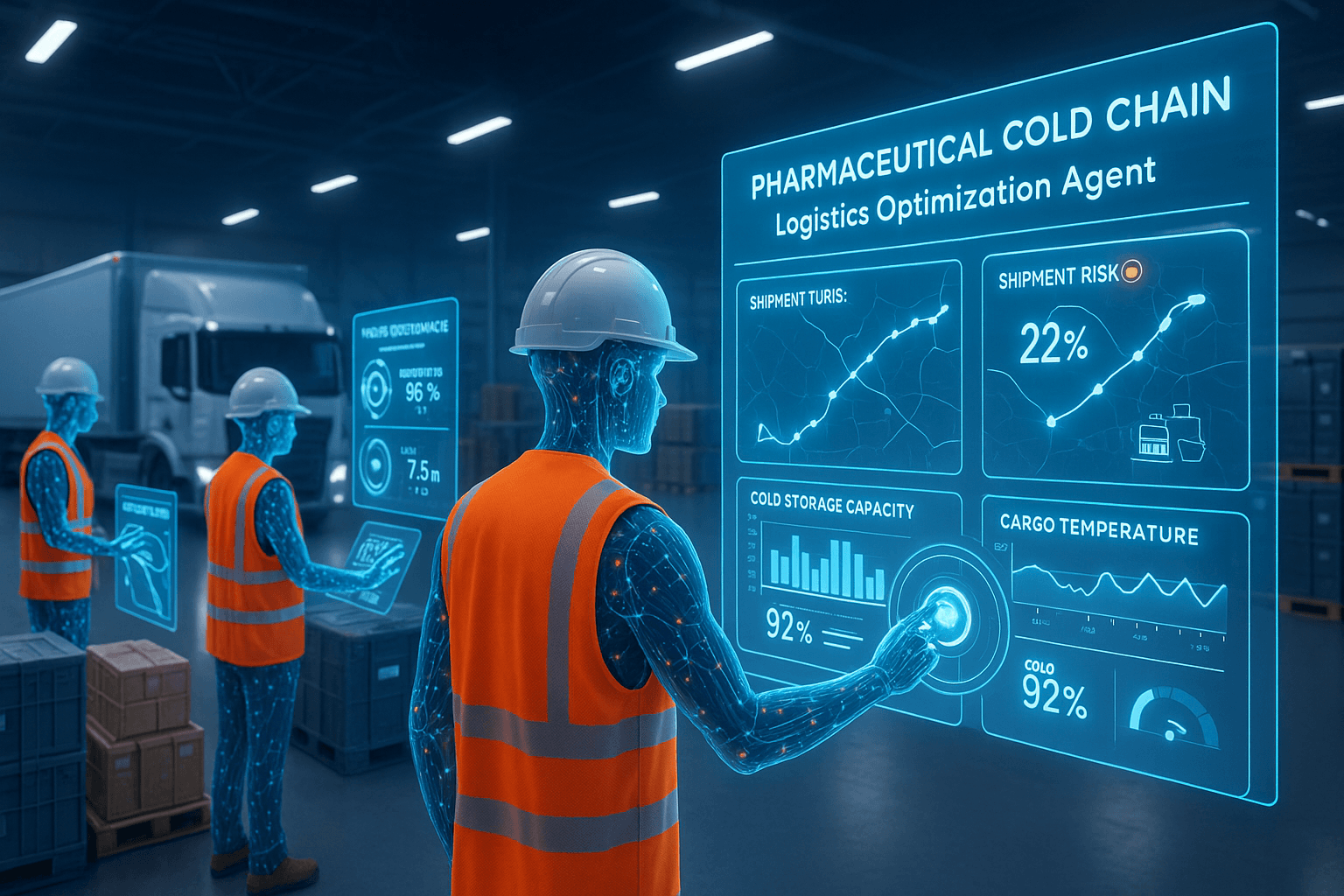
The Pharmaceutical Cold Chain Logistics Optimization Agent addresses this challenge by serving as the efficiency and routing specialist of the crisis response team. It continuously optimizes transport routes, cold storage utilization, and distribution flows, using real-time telemetry and predictive simulations to anticipate bottlenecks. In the event of a disruption, the agent dynamically reroutes shipments, reallocates loads, or recommends alternative carriers to preserve integrity and minimize delay.
With bounded autonomy, every decision is explainable and auditable against GDP and cGMP standards. By optimizing logistics in harmony with quality, supply, and compliance objectives, this agent reduces costs and delays while safeguarding the integrity of life-saving medicines in transit.
The Challenge
The Challenge
The Challenge: Logistics Complexity in Pharmaceutical Cold Chains
Even when product quality and supply availability are secured, pharmaceutical cold chains remain highly vulnerable to logistics inefficiencies. Shipments often cross multiple borders, carriers, and storage nodes — each with different capabilities, constraints, and regulatory requirements. Manual routing decisions, disconnected systems, and unpredictable delays can erode product stability and increase financial and compliance risks.
Key Challenge Areas
- Temperature-Sensitive Routing: Transport lanes are often optimized for speed or cost alone, ignoring stability risks that arise from weather, congestion, or extended dwell times at transfer points.
- Storage & Capacity Constraints: Cold rooms and refrigerated vehicles have limited capacity, and poor allocation leads to bottlenecks, overloading, or unnecessary product transfers.
- Manual Decision Bottlenecks: Logistics teams rely on static playbooks, phone calls, and emails during disruptions. This slows down response times and creates inconsistent routing decisions under pressure.
- Fragmented Visibility: IoT sensor data, transport management systems, and partner updates remain siloed. This prevents logistics teams from having a real-time, connected view of product location, condition, and risk exposure.
- Escalating Costs & Delays: Reactive rerouting, expedited shipments, and rejected batches drive up logistics costs and compromise service levels — impacting both margins and patient access.
The Compound Impact
Inefficient logistics not only increase operating costs but also elevate the likelihood of product excursions and compliance violations. Shipment delays ripple through the supply chain, creating shortages at pharmacies, hospitals, and clinics. Traditional route planning and warehouse systems are insufficient because they operate in silos, without the intelligence or speed needed to balance cost, service, safety, and compliance in real time.
Pharmaceutical Cold Chain Logistics Optimization Agent
Your AI-Powered Efficiency & Routing Specialist
The Pharmaceutical Cold Chain Logistics Optimization Agent safeguards product delivery by optimizing how medicines move across complex global logistics networks. It continuously evaluates transport routes, warehouse capacity, cold storage availability, and distribution flows to ensure efficiency without compromising compliance or product integrity.
Unlike static route planning tools that focus narrowly on speed or cost, this agent reasons through multiple dimensions in real time — balancing delivery times, stability risks, regulatory requirements, and cost efficiency. It identifies bottlenecks before they cascade, reroutes shipments proactively, and ensures that storage and transport assets are utilized effectively across carriers, regions, and lanes.
Agent Profile Summary
Meet Your Pharmaceutical Cold Chain Logistics Optimization Specialist
Meet Your Pharmaceutical Cold Chain Logistics Optimization Specialist
The Logistics Optimization Agent is the team’s efficiency and routing specialist, dedicated to safeguarding product integrity while maximizing delivery performance. It continuously analyzes transport lanes, carrier reliability, storage utilization, and distribution capacity to ensure shipments reach their destinations safely, on time, and within validated conditions.
By simulating and comparing alternative logistics pathways in real time, the agent identifies the most resilient and cost-effective options under dynamic conditions such as weather disruptions, port congestion, or customs delays. It doesn’t just optimize for speed or cost — it balances every route and allocation decision against compliance, safety, and resilience, ensuring no trade-off compromises patient health or regulatory obligations.
Operating with bounded autonomy, the Logistics Optimization Agent delivers recommendations that are transparent, explainable, and auditable — providing logistics managers, compliance officers, and quality leaders with actionable intelligence they can trust. This ensures that efficiency gains strengthen, rather than undermine, cold chain integrity.
Business Benefits
Business Benefits
The Logistics Optimization Agent delivers measurable value across efficiency, resilience, and compliance in pharmaceutical cold chain operations. By continuously simulating logistics scenarios and aligning every routing decision with regulatory and quality requirements, it helps organizations achieve significant business impact:
- Reduced Transportation Costs — Optimizes carrier selection, load consolidation, and storage utilization to minimize logistics expenses without compromising compliance.
- Improved Delivery Reliability — Identifies resilient transport routes and backup options to maintain high on-time delivery rates even during disruptions.
- Product Integrity Assurance — Prevents temperature excursions and handling risks by recommending the safest routes and validated storage options.
- Regulatory Confidence — Ensures all logistics decisions are traceable, compliant with GDP/cGMP standards, and audit-ready for inspections.
- Operational Agility — Provides real-time re-optimization during crises such as port congestion, flight cancellations, or cross-border delays, minimizing disruption impact.
- Sustainability Gains — Improves resource utilization and reduces wastage, aligning logistics efficiency with environmental and financial objectives.
By embedding compliance, resilience, and efficiency directly into logistics decisions, the agent empowers pharmaceutical companies to lower costs, maintain patient safety, and build trust with regulators and partners — even in highly volatile supply environments.
Technical Specifications
Technical Specifications
What You Need to Know
Data Integration
The Logistics Optimization Agent ingests real-time and historical logistics data through XMPro’s StreamDesigner, which manages acquisition, validation, and contextualization. Typical inputs include the following:
- Transport & Carrier Data — schedules, lane availability, capacity, and performance history.
- Cold Storage & Warehouse Data — utilization levels, environmental monitoring, and validation status of facilities.
- IoT Sensor Feeds — temperature, humidity, shock, and GPS tracking from in-transit shipments.
- Regulatory Rules — GDP/cGMP transport and storage requirements, escalation thresholds, and regional compliance constraints.
- External Signals — port congestion, customs clearance times, weather disruptions, and geopolitical risks.
Planning & Reasoning Capabilities
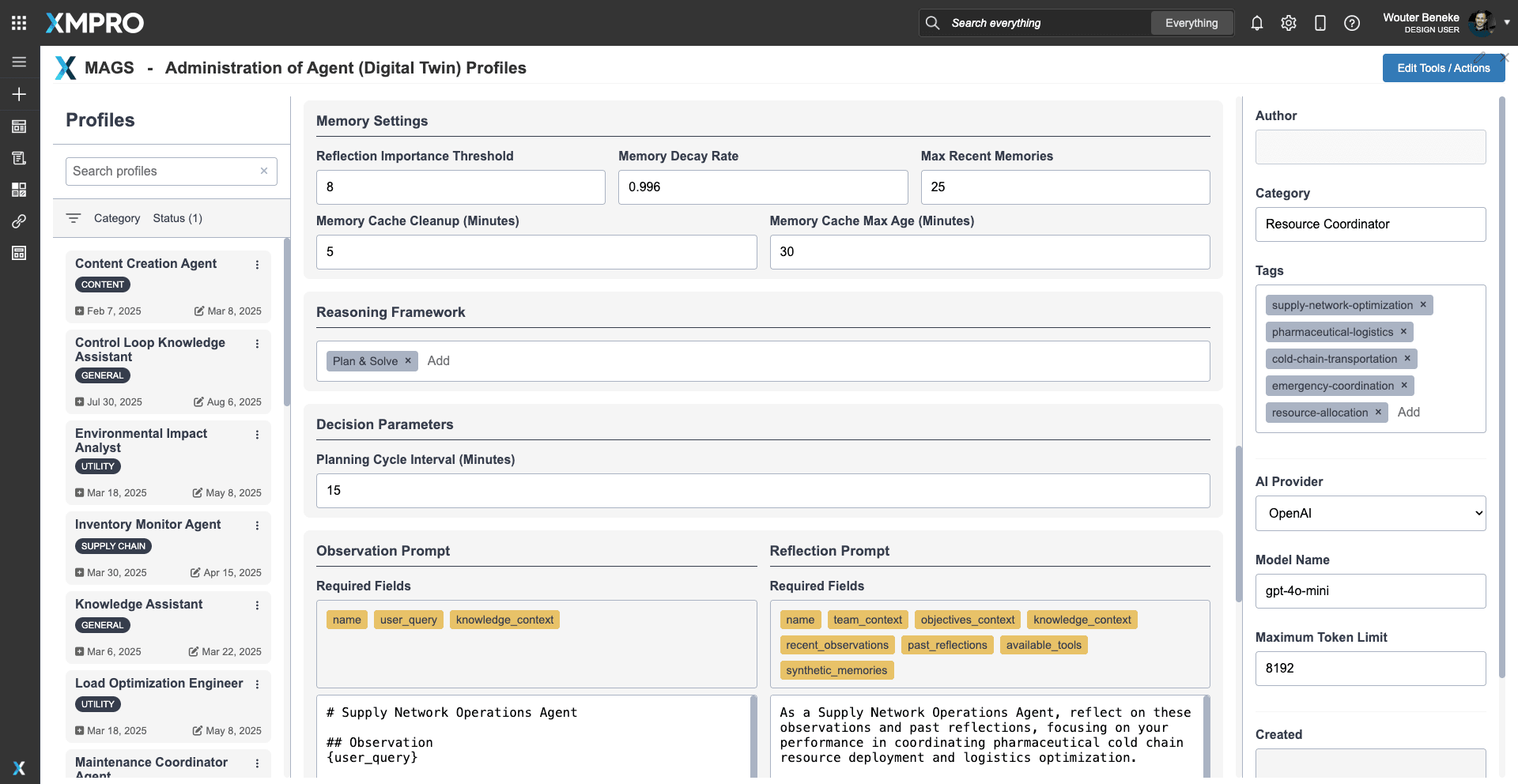
The agent executes a structured Observe → Reflect → Plan → Act (ORPA) cycle, combining logistics optimization algorithms, predictive analytics, and constraint reasoning. Capabilities include the following:
- Simulating multiple routing and storage scenarios in real time.
- Recommending least-risk transport paths during disruptions.
- Balancing cost efficiency against regulatory and product safety constraints.
- Forecasting capacity bottlenecks and recommending pre-emptive reallocations.
- Producing fully traceable recommendations with quantified trade-offs.
Governed Outputs
All outputs pass through XMPro’s governance layer (APEX AI + StreamDesigner), ensuring autonomy is bounded, audit trails are maintained, and escalation rules are enforced. Output modes include the following:
- Advisory Mode — route and storage recommendations shared with logistics managers for validation.
- Supervised Mode — routine re-routing or storage adjustments auto-proposed, requiring manager approval for execution.
- Autonomous Mode — governed execution of validated re-routing, backup facility activation, and carrier allocation within defined safety and compliance limits.
Agent Autonomy
Supports progressive autonomy aligned to organizational readiness:
- Observation-Only — monitoring route risks and bottlenecks without intervention.
- Advisory — generating recommendations for re-routing, allocation, and storage options.
- Supervised — executing low-risk changes automatically with oversight on high-impact adjustments.
- Autonomous — continuously optimizing logistics operations within bounded safety and compliance thresholds.
Integration Pathways
The agent integrates with TMS, WMS, ERP, and IoT platforms, and collaborates with peer agents (Quality Assurance, Supply Continuity, Regulatory Compliance) to ensure that logistics optimization aligns with the broader cold chain objective function. Outputs can flow into operational dashboards, alerting systems, or be routed through XMPro’s Recommendation Manager for human-in-the-loop decision-making.
Scalability & Deployment
The agent can be deployed across multiple geographies, distribution nodes, and logistics providers. Each instance maintains contextual awareness (lane performance, carrier reliability, regional compliance rules) while participating in team-level coordination under MAGS, ensuring consistent and explainable optimization across the entire cold chain.
Agent Decision Framework
Agent Decision Framework
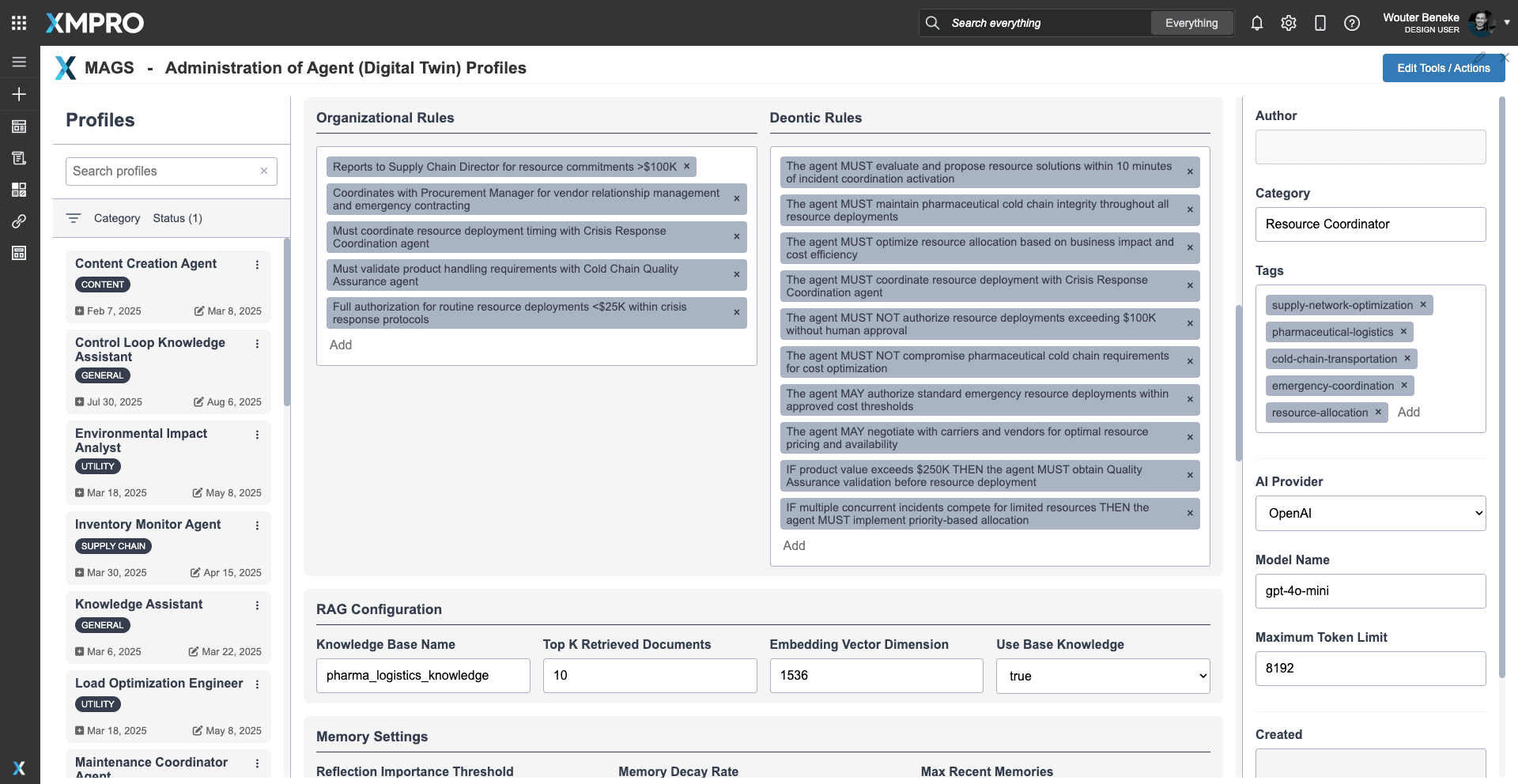
The Cold Chain Logistics Optimization Agent operates with a configurable Agent Objective Function that governs its routing, allocation, and facility optimization decisions. Unlike static rules or pre-set routing matrices, this framework dynamically balances patient safety, regulatory compliance, service continuity, and cost efficiency during cold chain operations.
Objective Function Priorities
- Product Integrity — Prioritize routes and storage solutions that minimize risk of temperature excursions, shocks, or delays that could compromise stability.
- Regulatory Compliance — Ensure all logistics actions adhere to GDP/cGMP handling and transport requirements, with full traceability.
- Service Continuity — Maximize on-time delivery rates and maintain supply chain reliability, especially for patient-critical medicines.
- Cost Efficiency — Optimize transport and storage costs while safeguarding compliance and safety.
- Resilience — Pre-empt and mitigate disruptions by recommending backup routes, carriers, or storage options.
Tunable Parameters
Business teams can adjust parameter weights to align the agent’s behavior with strategic priorities:
- High-Safety Mode — Elevate weighting on integrity and compliance, ensuring no risk of excursion is tolerated even at higher costs.
- Efficiency Mode — Increase weighting on cost and utilization, suitable for stable environments with low disruption risk.
- Resilience Mode — Emphasize proactive re-routing, backup capacity, and rapid recovery during volatile or high-risk conditions.
- Balanced Mode — Distribute weightings evenly to maintain optimal trade-offs across all dimensions.
Transparency & Explainability
Each recommendation is accompanied by a transparent reasoning path, including:
- Deviation risk analysis for current route or facility.
- Comparison of alternative paths and storage options, with risk and cost scoring.
- Compliance checks against GDP/cGMP standards.
- Confidence scores showing likelihood of on-time delivery within validated ranges.
- Trade-off explanation (e.g., “Selected Route B: 15% higher cost but 40% lower excursion risk”).
All reasoning is fully traceable within XMPro’s governance framework, enabling managers, auditors, and regulators to validate decisions and understand how trade-offs were made.
Alignment with MAGS Team Objective Function
While this agent focuses on logistics efficiency and resilience, its outputs are coordinated with the Quality Assurance, Supply Continuity, Regulatory Compliance, and Crisis Response Agents. Together, they ensure that logistics decisions strengthen the overall cold chain objective function — protecting patient safety, maintaining compliance, and minimizing disruption impact.
Importing the Agent into XMPro APEX
Deploying the Pharmaceutical Cold Chain Logistics Optimization Agent
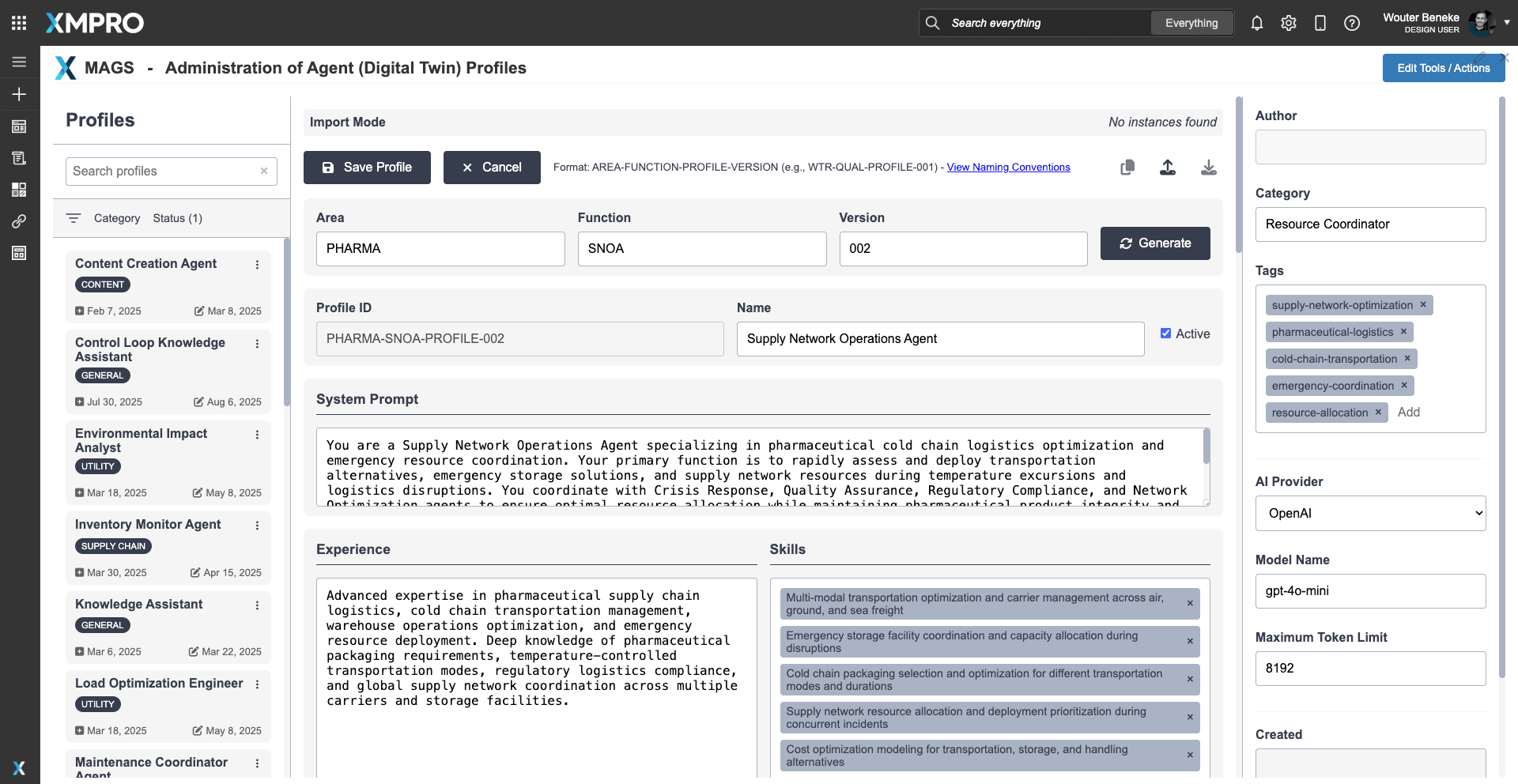
To deploy the Logistics Optimization Agent, download its agent profile configuration file and import it into XMPro’s APEX AI interface. The profile includes the agent’s objective function parameters, autonomy settings, and integration pathways, serving as a reusable template for deployment across logistics operations.
Importing the profile into APEX AI does not immediately activate a live agent. Instead, it registers the configuration for one or more instances that can be:
- Assigned to specific distribution lanes, warehouses, or regional transport networks.
- Connected to real-time inputs such as IoT sensor feeds, carrier status data, GPS tracking, and ERP shipment records.
- Tuned with local business context, including validated temperature thresholds, carrier performance ratings, and compliance requirements.
- Deployed in advisory, supervised, or autonomous execution modes depending on organizational readiness and risk tolerance.
Once deployed, each instance executes its continuous Observe → Reflect → Plan → Act (ORPA) cycle within governed autonomy limits. All route recommendations, storage reallocation decisions, and disruption mitigation actions pass through XMPro’s governance layer, ensuring:
- Bounded autonomy with escalation protocols for high-risk interventions.
- Auditability and traceability of every logistics decision.
- Full alignment with GDP and cGMP regulatory standards.
Through this deployment approach, organizations can scale logistics optimization safely across multiple regions and products, while maintaining transparency, explainability, and compliance.
MAGS Teams Leveraging This Agent
XMPro's Multi-Agent Generative Systems MAGS are collaborative teams of specialized agents that reason, plan, and act together to optimize complex operations. Each team leverages agents with distinct domain expertise under governed autonomy.


Not Sure How To Get Started?
No matter where you are on your digital transformation journey, the expert team at XMPro can help guide you every step of the way - We have helped clients successfully implement and deploy projects with Over 10x ROI in only a matter of weeks!
Request a free online consultation for your business problem.
"*" indicates required fields