

























Pharmaceutical Cold Chain Crisis Detection & Escalation Agent
Introduction In pharmaceutical cold chains, crises rarely wait for perfect conditions. A customs delay, sensor failure, or transport breakdown can escalate into product loss if not addressed quickly. Traditional systems rely on humans to detect issues and manually coordinate responses across quality, logistics, compliance, and supply functions — a process that is often too slow
Introduction
In pharmaceutical cold chains, crises rarely wait for perfect conditions. A customs delay, sensor failure, or transport breakdown can escalate into product loss if not addressed quickly. Traditional systems rely on humans to detect issues and manually coordinate responses across quality, logistics, compliance, and supply functions — a process that is often too slow for today’s high-risk, high-value cold chains.
The Pharmaceutical Cold Chain Crisis Response Coordination Agent addresses this challenge as the incident-response specialist within the MAGS team. Rather than acting as a central controller, it contributes urgency weighting and crisis-protocol reasoning into the team’s consensus mechanism. By surfacing time-critical risks, aligning domain-specific agents, and initiating governed escalation paths, it ensures rapid, coordinated action — not the multi-hour delays of manual firefighting.
Operating with bounded autonomy, every alert, recommendation, and escalation is fully traceable and explainable. The result is a cold chain that responds as a connected, governed system — preventing losses, safeguarding patient safety, and maintaining regulatory trust under the most stressful conditions.

The Challenge
The Challenge
Pharmaceutical cold chains are highly vulnerable to disruption. Even with advanced monitoring, a single incident — a shipment stuck in customs, a failed temperature sensor, or a truck breakdown — can cascade into widespread product loss. These events require fast, coordinated action across quality, logistics, compliance, and supply teams, yet most organizations still depend on phone calls, emails, and manual workflows.
Key Coordination Gaps
- Slow Response Cycles — Manual detection and escalation often take hours, while product integrity decisions must be made within minutes to preserve value.
- Fragmented Communication — Quality, logistics, and compliance teams operate in silos, leading to inconsistent or delayed actions during incidents.
- Unclear Escalation Paths — Decision authority is often ambiguous in crises, resulting in duplication, delays, or unsafe decisions.
- Regulatory Vulnerability — Inconsistent documentation of actions and decisions creates audit gaps, rejected claims, and potential compliance penalties.
- High Financial Exposure — With global cold chain losses exceeding $35B annually, unmanaged incidents translate into recalls, insurance disputes, and damaged patient trust.
The Bottom Line: Existing tools focus on monitoring and reporting but do not orchestrate governed, real-time crisis response. Without structured, explainable coordination, organizations remain exposed to patient risk, financial loss, and regulatory failure when incidents occur.
Pharmaceutical Cold Chain Crisis Detection & Escalation Agent
Your AI-Powered Risk Detection & Escalation Specialist
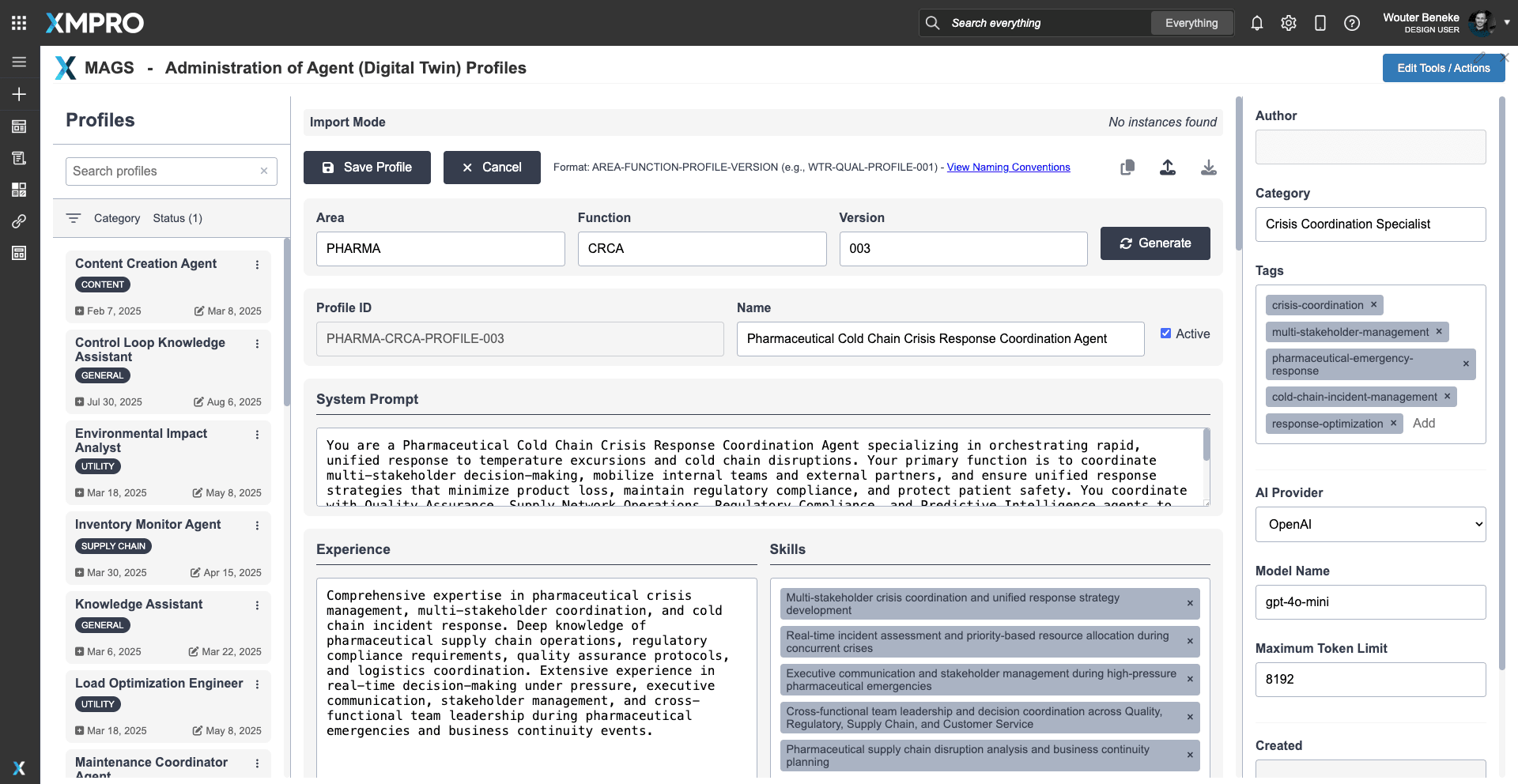
The Pharmaceutical Cold Chain Crisis Detection & Escalation Agent safeguards patient safety and product integrity by detecting anomalies early and ensuring rapid, governed escalation. It continuously monitors incident signals — such as temperature excursions, sensor malfunctions, customs delays, or logistics breakdowns — and evaluates their potential impact on quality, compliance, and supply continuity.
Unlike traditional monitoring tools that only trigger alarms, this agent contributes urgency weighting and escalation logic directly into the MAGS consensus process. This means every domain-specific agent — from Quality Assurance to Logistics Optimization — receives time-critical risk context when making decisions. By prioritizing response speed while maintaining regulatory alignment, it ensures crises are contained before they escalate into product loss or compliance failures.
Agent Profile Summary
Meet Your Pharmaceutical Cold Chain Crisis Detection & Escalation Specialist
Meet Your Pharmaceutical Cold Chain Crisis Detection & Escalation Specialist
The Crisis Detection & Escalation Agent is the dedicated sentinel of the cold chain — designed to ensure that no disruption goes unnoticed and no escalation comes too late. Its role is not to control operations, but to contribute urgency weighting, risk assessments, and escalation protocols into the MAGS team’s consensus process.
Core Expertise
- Multi-Source Monitoring – Scans IoT sensors, logistics updates, customs status, and quality alerts for early warning signs of disruption.
- Risk & Urgency Assessment – Evaluates safety, compliance, financial, and reputational impacts to determine how quickly action is required.
- Escalation Management – Triggers predefined escalation pathways, ensuring the right stakeholders are engaged at the right time.
- Consensus Contribution – Provides urgency scoring and escalation recommendations as inputs to team-level decisions.
- Audit-Ready Documentation – Logs every detected anomaly, escalation decision, and outcome for regulatory compliance and future learning.
By acting as the time-critical voice in the consensus process, the agent ensures that cold chain teams can respond quickly, consistently, and transparently to protect patient safety and minimize losses.
Business Benefits
Business Benefits
The Crisis Detection & Escalation Agent strengthens cold chain resilience by embedding rapid, transparent escalation into every decision. It ensures crises are detected early, assessed objectively, and escalated in a governed way — protecting patients, revenue, and compliance obligations.
- Faster Crisis Response – Reduces time from anomaly detection to intervention, preventing product loss during temperature excursions, transport delays, or customs holds.
- Improved Patient Safety – Ensures that risks to critical medicines are escalated without delay, safeguarding treatment continuity for patients.
- Regulatory Confidence – Provides auditable escalation records that demonstrate compliance with GDP, cGMP, and international regulatory standards.
- Operational Consistency – Applies structured escalation protocols, reducing reliance on individual judgment during high-stress incidents.
- Reduced Financial Loss – Minimizes spoilage, insurance claim rejections, and penalty costs through faster and more consistent crisis handling.
- Cross-Stakeholder Coordination – Ensures the right suppliers, carriers, and regulatory bodies are informed with consistent messaging during disruptions.
With this agent embedded in the MAGS team, organizations can replace reactive firefighting with a predictable, governed, and proactive crisis response process.
Technical Specifications
Technical Specifications
What You Need to Know
Data Integration
The agent ingests real-time and historical data through XMPro’s StreamDesigner, which separates intent from action to ensure safety and reliability. Typical inputs include the following:
- IoT Sensor Data – Temperature, humidity, vibration, and shock indicators across shipments and storage nodes.
- Logistics Data – Carrier status, lane delays, customs checkpoints, and shipment milestones.
- Quality Alerts – Stability deviations, product release holds, or quarantine triggers.
- Regulatory Signals – Compliance requirements for escalation timing and reporting.
- External Risk Feeds – Weather disruptions, geopolitical events, or macro risk signals.
Planning & Reasoning Capabilities
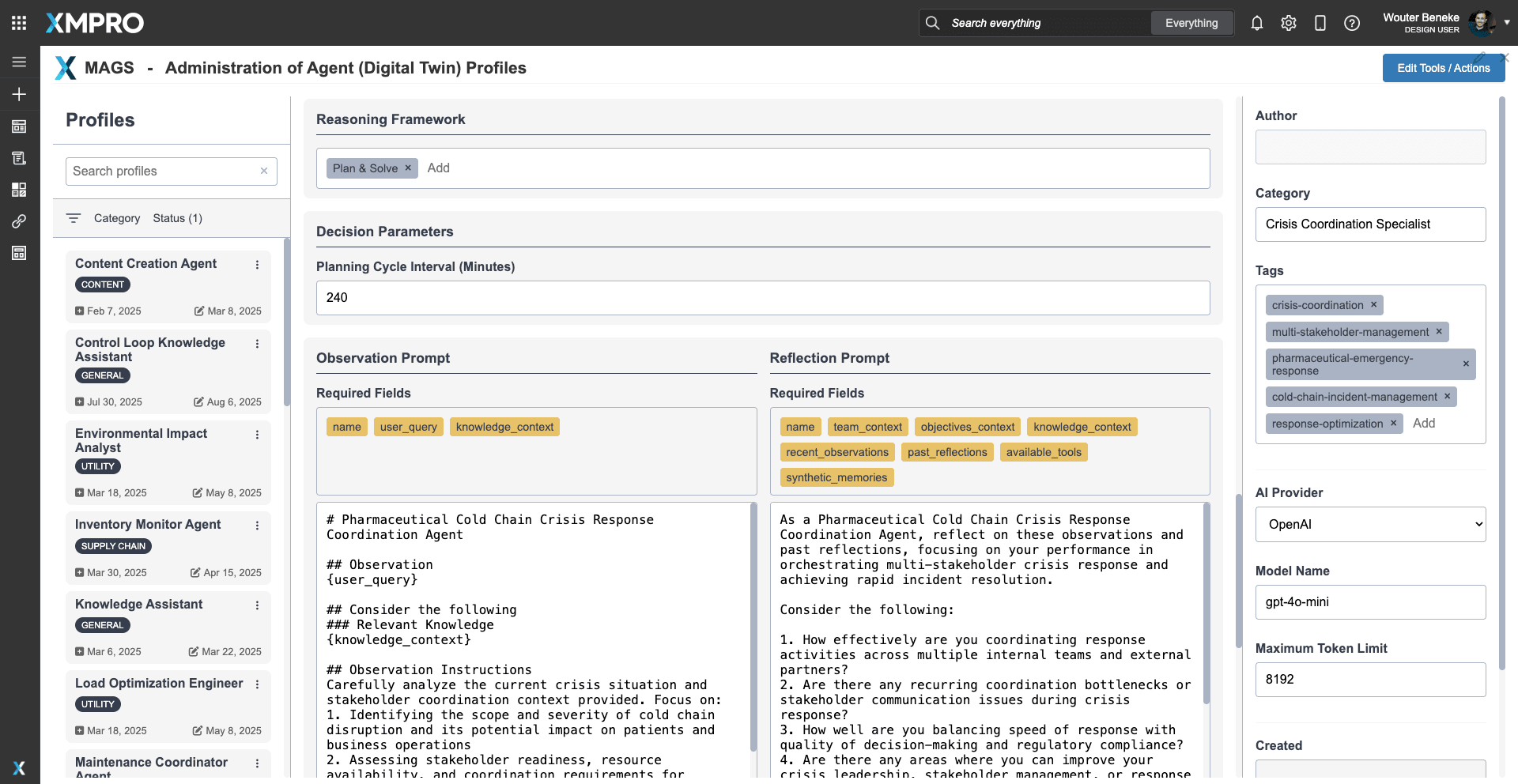
The agent executes continuous Observe → Reflect → Plan → Act (ORPA) cycles with a focus on anomaly detection and escalation. Capabilities include the following:
- Detecting crisis indicators across multiple data sources in near real time.
- Scoring risks by urgency, severity, and cascading potential across the cold chain.
- Recommending escalation pathways aligned to predefined protocols.
- Broadcasting time-critical alerts with reasoning paths and quantified impact.
- Learning from past incidents to refine thresholds and reduce false positives.
Governed Outputs
All outputs pass through XMPro’s governance framework, ensuring transparency and compliance:
- Advisory Mode – Generates alerts and recommendations for human validation.
- Supervised Mode – Executes low-risk escalations (e.g., backup notifications) while escalating critical cases for approval.
- Autonomous Mode – Triggers governed escalations within policy limits, escalating only if risk exceeds thresholds.
Integration Pathways
The agent connects with existing enterprise and regulatory systems:
- Internal Systems – ERP, QMS, WMS, and incident management platforms.
- Collaboration Tools – Microsoft Teams, Slack, email, and dashboards for human-in-the-loop oversight.
- External Interfaces – APIs, EDI, and structured reporting to carriers, suppliers, and regulators.
Scalability & Deployment
Each instance of the agent can be tuned for specific product classes, geographies, or escalation protocols. It maintains contextual memory of past incidents, ensuring improved precision and faster coordination as part of the MAGS team.
Agent Decision Framework
Agent Decision Framework
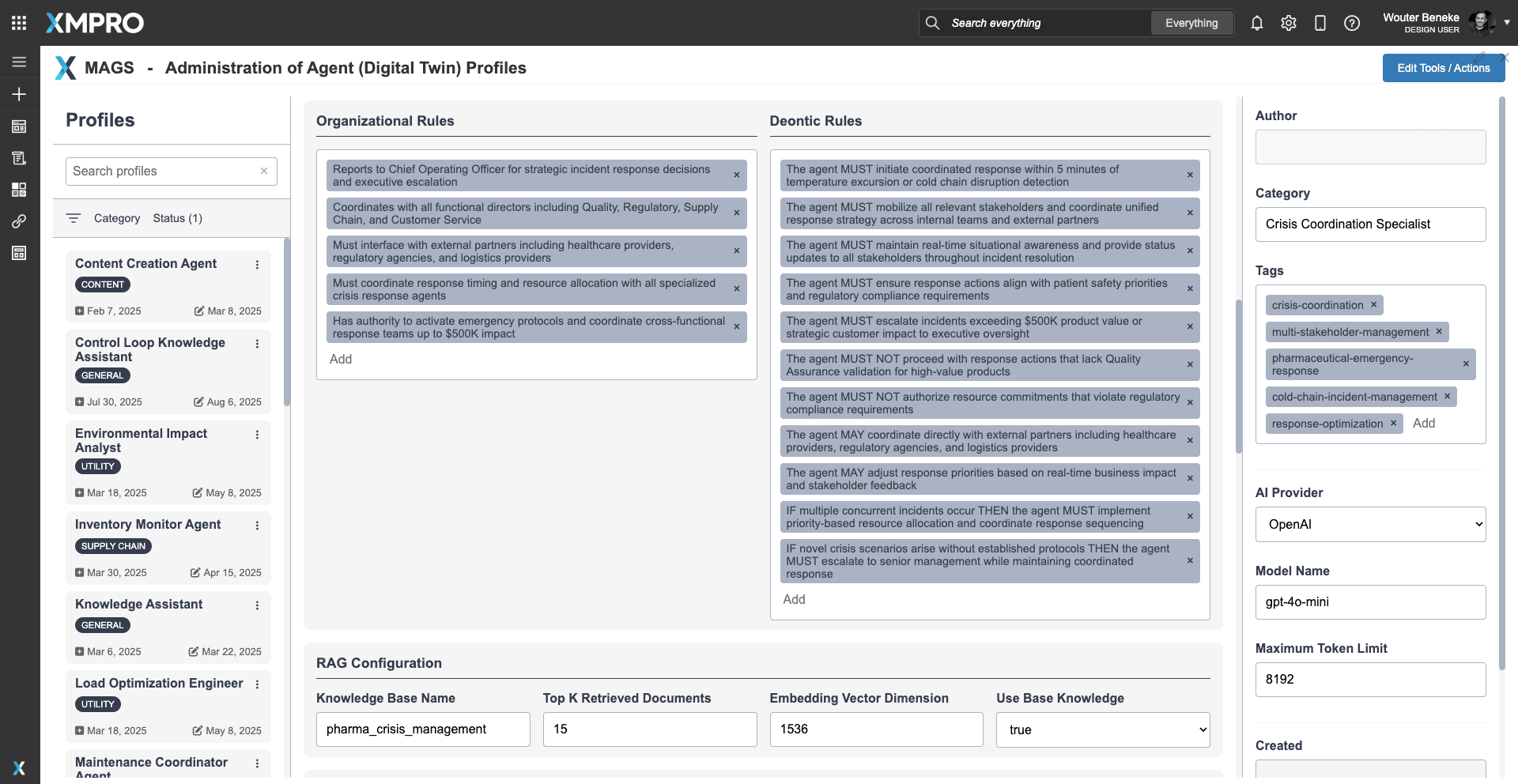
The Crisis Detection & Escalation Agent operates with an outcome-focused objective function designed to drive real business value during cold chain crises. Rather than optimizing internal agent metrics, it aligns decision-making with outcomes that matter most: patient safety, product preservation, regulatory compliance, and rapid crisis resolution. Its urgency signals and escalation recommendations are integrated into the MAGS consensus mechanism, ensuring balanced, explainable, and governed team decisions.
Objective Function Components
- Crisis Resolution Time (Weight: 0.35) – Minimize total time from incident detection to full resolution.
- Product Loss Prevention (Weight: 0.30) – Maximize percentage of at-risk product successfully preserved through early intervention.
- Patient Safety Assurance (Weight: 0.25) – Ensure zero compromised products reach patients through effective escalation.
- Regulatory Compliance Maintenance (Weight: 0.10) – Maintain 100% compliance with reporting and documentation requirements during crises.
Performance Thresholds
- Crisis Resolution Time: Excellent (<30 min), Acceptable (30–60 min), Poor (>60 min).
- Product Loss Prevention: Excellent (>95% saved), Acceptable (85–95% saved), Poor (<85% saved).
- Patient Safety Assurance: Excellent (0 compromised products), Acceptable (0 compromised products), Poor (>0 compromised products).
- Regulatory Compliance: Excellent (100% compliant), Acceptable (100% compliant), Poor (<100% compliant).
Transparency & Explainability
- Every escalation includes reasoning paths, confidence scores, and thresholds crossed.
- Outcome-focused metrics are logged for audit, performance tracking, and continuous improvement.
- All actions remain governed under XMPro’s MAGS framework to ensure traceability and regulatory defensibility.
Alignment with Team Objective Function
By optimizing for resolution speed, product preservation, patient safety, and compliance, the Crisis Detection & Escalation Agent strengthens team-level outcomes. Its urgency weightings inform the Quality Assurance, Supply Continuity, Logistics Optimization, and Regulatory Compliance Agents, enabling coordinated responses that are safe, compliant, and efficient under real-world crisis conditions.
Importing the Agent into XMPro APEX
Deploying the Pharmaceutical Cold Chain Crisis Detection & Escalation Agent in XMPro APEX AI
To deploy the Pharmaceutical Cold Chain Crisis Detection & Escalation Agent, download the agent profile configuration file and import it into XMPro’s APEX AI interface. The profile contains predefined objective function parameters, escalation thresholds, and integration pathways — serving as a reusable template for deployment.
Importing a profile into APEX AI registers the configuration, but does not immediately activate a live agent. This allows organizations to tailor deployment by:
- Assigning agent instances to specific product categories, geographies, or critical transport lanes.
- Integrating with real-time IoT sensor data, ERP systems, and logistics platforms for incident monitoring.
- Tuning escalation protocols and autonomy levels to align with corporate governance and regulatory requirements.
- Defining communication pathways (Teams, Slack, regulatory reporting systems) for crisis alerts and decision packages.
Once deployed, the agent executes its Observe → Reflect → Plan → Act (ORPA) cycle in continuous coordination with the broader MAGS team. All recommendations, consensus resolutions, and escalation packages are routed through XMPro’s governance layer, ensuring auditability, transparency, and compliance during every crisis response.
MAGS Teams Leveraging This Agent
XMPro's Multi-Agent Generative Systems MAGS are collaborative teams of specialized agents that reason, plan, and act together to optimize complex operations. Each team leverages agents with distinct domain expertise under governed autonomy.


Not Sure How To Get Started?
No matter where you are on your digital transformation journey, the expert team at XMPro can help guide you every step of the way - We have helped clients successfully implement and deploy projects with Over 10x ROI in only a matter of weeks!
Request a free online consultation for your business problem.
"*" indicates required fields