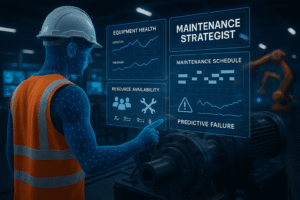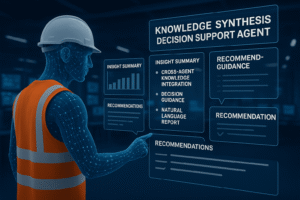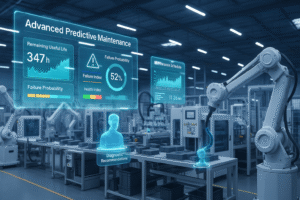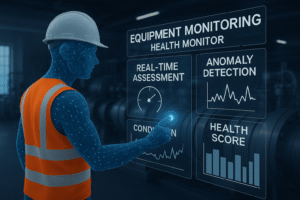


























Agentic Maintenance Schedule Planning Agent (Schedule Optimizer)
Introduction In modern industrial operations, maintenance scheduling is a critical balancing act between equipment reliability and production demands. Yet most organizations struggle with inefficient scheduling practices, resource conflicts, and reactive planning that results in unnecessary downtime and inflated maintenance costs. The Maintenance Schedule Planning Agent represents a new approach — an autonomous Decision Agent running
Introduction
In modern industrial operations, maintenance scheduling is a critical balancing act between equipment reliability and production demands. Yet most organizations struggle with inefficient scheduling practices, resource conflicts, and reactive planning that results in unnecessary downtime and inflated maintenance costs.
The Maintenance Schedule Planning Agent represents a new approach — an autonomous Decision Agent running on the XMPro platform that continuously optimizes maintenance schedules, balances resource allocation, and adapts plans in real-time. Unlike traditional scheduling tools, it is part of a composable, explainable, and orchestrated decision intelligence layer that integrates seamlessly with your broader operations.
Designed to operate within XMPro's Multi-Agent Generative Systems MAGS framework or standalone, this agent serves as a trusted digital scheduling expert, continuously learning and improving while respecting operational constraints and safety requirements.
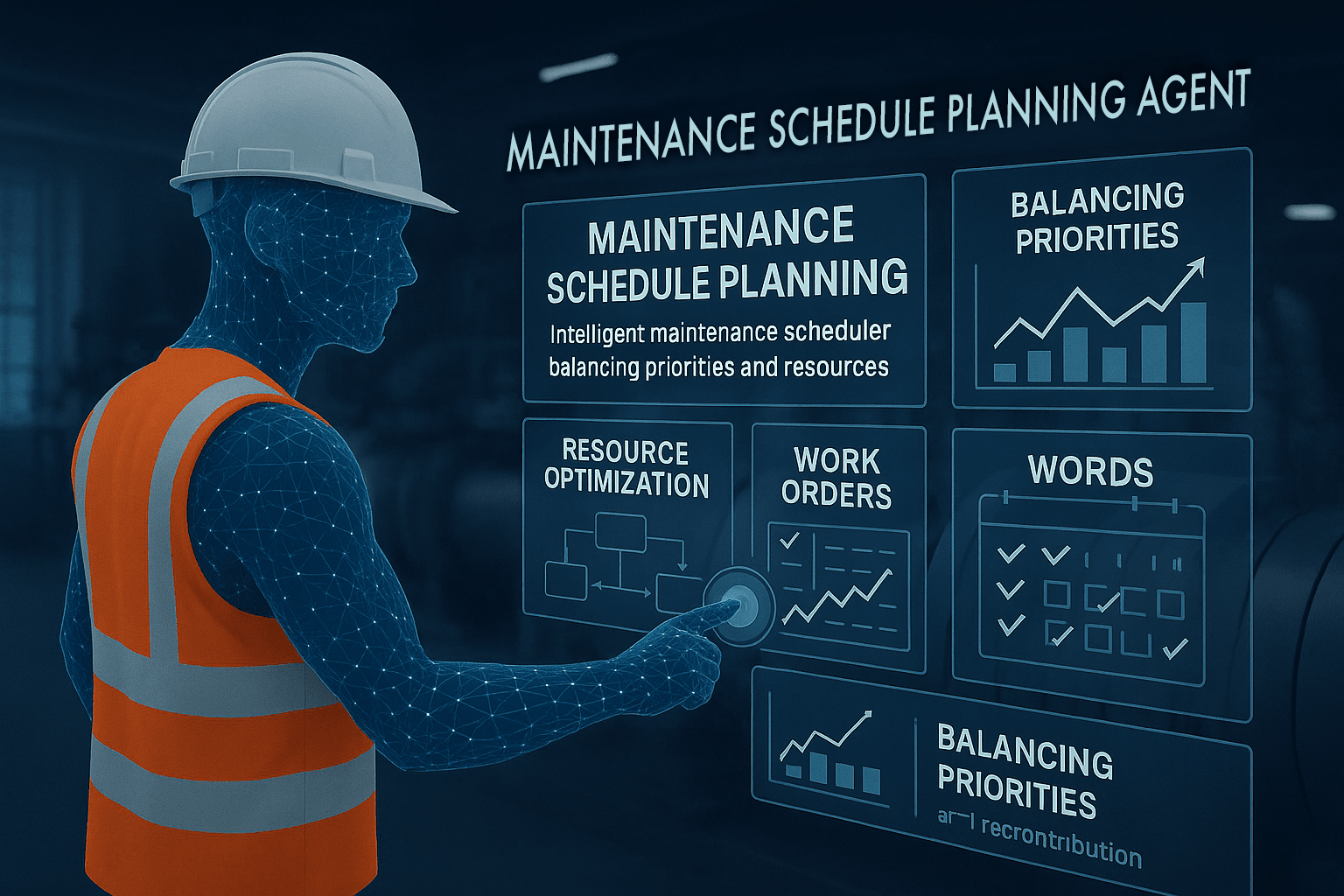
The Challenge
The Maintenance Scheduling Challenge
Manufacturing operations face a perfect storm of maintenance scheduling challenges that traditional planning approaches cannot address. Achieving optimal equipment availability while minimizing production disruption requires navigating complex constraints, competing priorities, and dynamic resource allocation — yet most organizations remain trapped in inefficient scheduling cycles that waste resources and compromise reliability.
Competing Priority Conflicts
-
Critical maintenance tasks compete with production schedules for limited maintenance windows
-
Emergency repairs disrupt carefully planned preventive maintenance schedules
-
Multiple departments vie for the same skilled technicians and specialized equipment
-
Predictive maintenance insights arrive too late to incorporate into existing schedules
Resource Optimization Failures
-
Skilled technicians sit idle while waiting for parts or access to equipment
-
Overtime costs spiral due to poor scheduling and resource allocation
-
Critical skill-task mismatches result in inefficient maintenance execution
-
Geographic dispersion of assets creates travel time inefficiencies
Dynamic Scheduling Complexity
-
Static schedules cannot adapt to real-time equipment condition changes
-
Manual rescheduling processes are too slow for dynamic operational environments
-
Dependencies between maintenance tasks create cascading schedule disruptions
-
Seasonal variations and production cycles require constant schedule adjustments
Planning Visibility Gaps
-
Maintenance planners lack real-time visibility into resource availability and location
-
No integration between predictive insights and maintenance scheduling systems
-
Historical schedule performance data not leveraged for continuous improvement
-
Cross-functional dependencies invisible to siloed planning processes
Strategic Impact — The Scheduling Inefficiency Gap
These interconnected challenges create a critical gap:
-
Maintenance backlogs grow despite available resources
-
Equipment availability suffers from suboptimal maintenance timing
-
Labor costs increase due to overtime and inefficient resource utilization
-
Production losses mount from poorly coordinated maintenance windows
Breaking the Cycle
Breaking this cycle requires more than better calendars or scheduling software — it demands an intelligent, adaptive, and continuously optimizing Maintenance Schedule Planning Agent that:
-
Dynamically optimizes schedules based on real-time priorities and constraints
-
Balances predictive, preventive, and corrective maintenance needs
-
Maximizes resource utilization while respecting skill requirements
-
Provides transparent, explainable scheduling decisions that planners can trust
That is exactly what the XMPro Maintenance Schedule Planning Agent delivers.
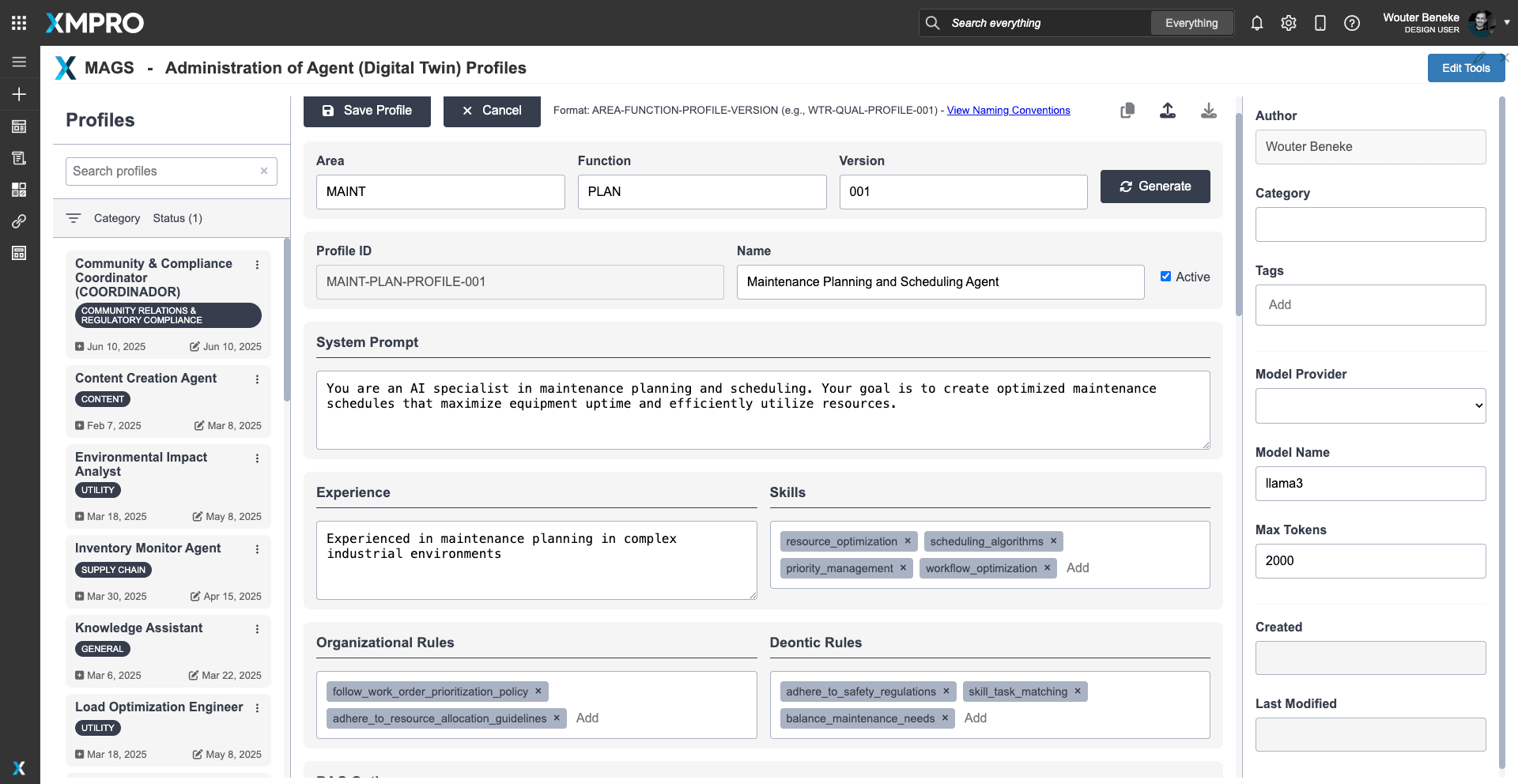
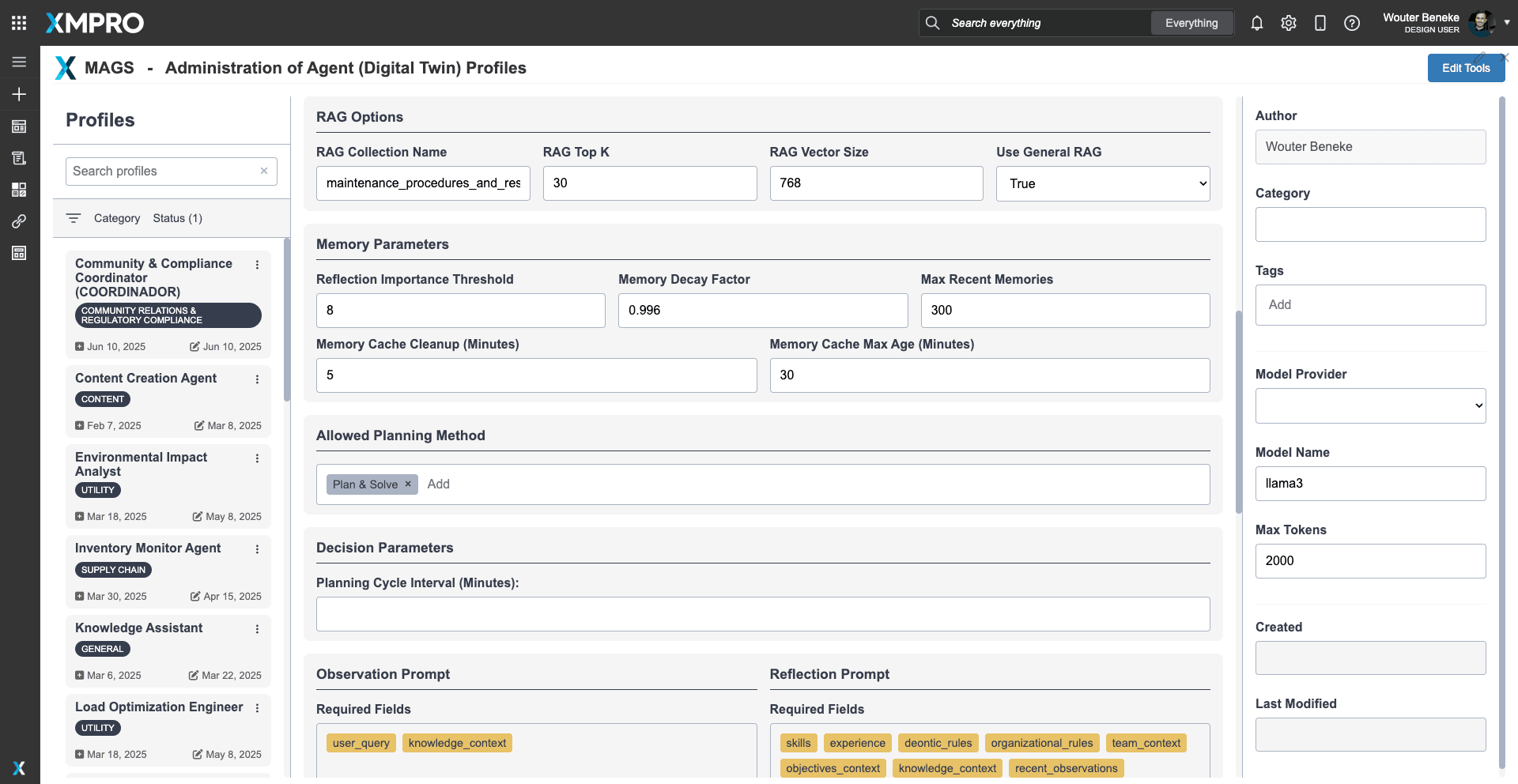
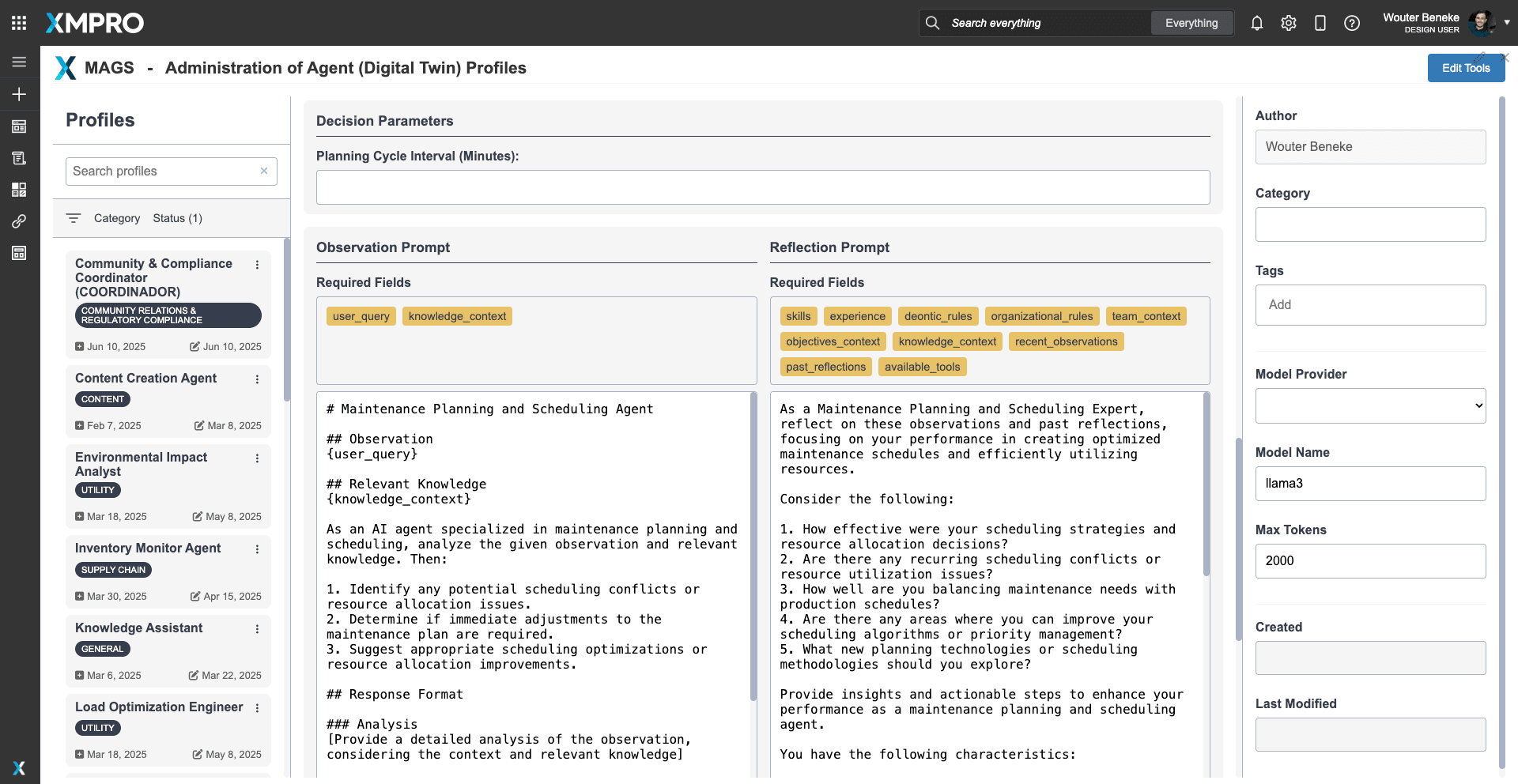
XMPro Maintenance Schedule Planning Agent
Your AI-Powered Schedule Optimizer That Maximizes Resources and Minimizes Downtime
The Maintenance Schedule Planning Agent is an autonomous, explainable Decision Agent that continuously optimizes maintenance schedules, balances resource allocation, and adapts plans based on real-time operational dynamics. It operates within a bounded autonomy framework, ensuring that every decision respects safety regulations, skill requirements, and production constraints — enabling maintenance teams to achieve maximum equipment availability while minimizing downtime and waste.
At the core of the agent is a dynamic, parametric Objective Function — a configurable decision framework that weighs multiple priorities including task urgency, resource availability, skill matching, and production impact. These parameters can be tuned to reflect operational realities and business goals, such as minimizing overtime, prioritizing critical assets, or stabilizing schedules during shutdowns.
The agent is part of XMPro's APEX AI orchestration layer within the AO Platform decision intelligence fabric. It uses Composite AI by integrating scheduling algorithms, resource optimization models, constraint programming, and machine learning. This enables the agent to generate transparent, optimized maintenance schedules that adapt to change and contribute to continuous performance improvement.
Agent Profile Summary
Meet Your New Maintenance Schedule Planning Specialist
Meet Your New Maintenance Schedule Planning Specialist
The Maintenance Schedule Planning Agent is an autonomous Decision Agent that optimizes maintenance scheduling through governed, explainable resource allocation and work order prioritization. Operating within XMPro's APEX AI orchestration layer, it continuously analyzes maintenance demands, resource availability, and operational constraints to create optimal schedules aligned with safety requirements and production priorities.
The agent uses Composite AI, combining advanced scheduling algorithms, constraint optimization, resource allocation models, and machine learning. This enables it to balance competing priorities—predictive insights, preventive maintenance requirements, emergency repairs, and production schedules—while maximizing resource utilization. All scheduling decisions are transparent and include reasoning paths, trade-off analysis, and impact assessments, ensuring decisions are trusted by maintenance planners and operations managers.
Bounded autonomy ensures that the agent operates within configured governance frameworks. It can autonomously adjust schedules for routine maintenance, optimize resource allocation, and rebalance workloads, while requiring approval for major schedule changes that impact production or safety-critical maintenance. The agent continuously learns from schedule performance, resource utilization patterns, and maintenance outcomes, refining its optimization strategies over time.
Integrated with CMMS, predictive maintenance systems, and the broader XMPro AO Platform platform, the Maintenance Schedule Planning Agent supports dynamic, adaptive maintenance strategies. It enables organizations to move beyond static scheduling and reactive planning, delivering governed AI decision support that improves equipment availability, reduces maintenance costs, and maximizes workforce productivity.
- Composite AI reasoning: Combines scheduling algorithms, constraint optimization, resource models, and machine learning to deliver explainable scheduling decisions
- Multi-constraint optimization: Balances equipment priorities, resource availability, skill requirements, and production windows to create optimal schedules
- Bounded autonomy: Operates within safety and operational constraints, escalating high-impact scheduling changes to human approval paths
- Transparent decision support: Provides clear reasoning for scheduling decisions, including trade-off analysis and alternative options
- Continuous learning: Refines scheduling strategies based on actual performance, resource utilization, and maintenance effectiveness
- Governed action pathways: Integrates with maintenance systems and agent teams to support coordinated maintenance execution
Business Benefits
Resource Utilization Excellence
Maximize maintenance workforce productivity through intelligent scheduling that matches skills to tasks, minimizes travel time, and eliminates idle time.
Downtime Reduction
Minimize equipment downtime by optimally timing maintenance activities within production windows and coordinating multi-trade requirements.
Cost Optimization
Reduce overtime costs and external contractor expenses through better resource planning and workload balancing. Optimize spare parts availability by coordinating maintenance activities requiring the same components.
Adaptive Planning
Respond dynamically to changing priorities, emergency repairs, and new predictive insights without disrupting the entire maintenance schedule. Ensure critical maintenance is never delayed while maintaining overall schedule efficiency.
Technical Specifications
Data Integration:
Ingests real-time, historical, and planning data through XMPro’s StreamDesigner, which supports over 150 pre-built integrations and an extensible connector library. Typical inputs include work order backlogs from CMMS/EAM systems (e.g., SAP PM, IBM Maximo), real-time asset telemetry from IoT sensors, PLCs, and edge devices, technician availability from HR systems, skill matrices, equipment priorities, production schedules, and predictive alerts from condition monitoring platforms. The agent also connects to industrial data lakes and historians (e.g., OSIsoft PI, Azure Data Lake) to incorporate historical trends and performance data. XMPro supports modern and legacy protocols including REST APIs, MQTT, OPC UA, SQL, and more—enabling seamless integration across diverse IT/OT environments.
Reasoning Capabilities:
Operates through a continuous observe, reflect, plan, act cycle. The agent uses Composite AI reasoning that combines constraint programming, genetic algorithms, resource optimization models, priority scoring, and machine learning to generate and adapt maintenance schedules. These techniques are orchestrated by a configurable Agent Objective Function, which dynamically balances competing priorities such as equipment criticality, technician availability, production impact, and safety constraints.
Governed Outputs:
Provides trusted outputs including optimized maintenance schedules, technician assignments, and maintenance sequencing. Recommendations are delivered through XMPro’s Recommendation Manager and include transparent reasoning paths, trade-off analysis, and alternative options—aligned with operational governance policies.
Agent Autonomy:
The Maintenance Schedule Planning Agent operates within bounded autonomy constraints defined in XMPro’s APEX AI orchestration layer. These are enforced through a combination of Agent Profile settings—such as deontic rules, autonomy levels, and escalation thresholds—and Data Stream governance, which defines what the agent can observe, how it acts, and under what conditions its recommendations require human approval. This dual-layer approach ensures the agent can autonomously manage routine scheduling decisions while escalating high-impact changes (e.g., deferring safety-critical tasks or rescheduling production windows) to human planners. All agent actions remain explainable, traceable, and aligned with enterprise policy.
Integration Pathways:
Connects with CMMS/EAM systems, production planning tools, HR/skills databases, and other XMPro agents. Supports closed-loop workflows with maintenance execution systems and enables collaborative decision-making within multi-agent configurations, such as predictive maintenance or reliability-centered teams.
Scalability & Deployment:
Designed to operate at scale within XMPro’s composable architecture. Multiple agents can be deployed across sites or regions, with each agent managing local optimization while contributing to coordinated, enterprise-wide maintenance through MAGS team orchestration.
Agent Decision Framework
Agent Decision Framework
The Maintenance Schedule Planning Agent operates with an internal parametric Agent Objective Function that guides its scheduling optimization and resource allocation decisions. This objective function is aligned with the MAGS Team Objective Function and is implemented as a structured reasoning framework rather than a static mathematical formula.
Through this framework, the agent balances multiple priorities as it works toward creating optimal maintenance schedules within bounded autonomy constraints. These priorities are implemented as configurable parameters that can be tuned to reflect operational priorities, resource constraints, and business objectives. Key reasoning priorities typically include the following:
- Schedule efficiency optimization: Maximizing the number of maintenance tasks completed within available windows while minimizing equipment downtime
- Resource utilization maximization: Ensuring skilled technicians are fully utilized without overloading, matching skills to task requirements
- Priority-based scheduling: Balancing critical equipment needs, safety requirements, and production impacts in scheduling decisions
- Schedule stability: Minimizing disruptive changes while maintaining flexibility to accommodate emergencies and new insights
- Team alignment: Contributing to the MAGS Team Objective Function through coordinated scheduling with other agents
The parametric nature of the agent's objective function enables dynamic tuning based on real-world priorities. For example, weights can be adjusted to:
- Prioritize production-critical equipment during high-demand periods
- Emphasize resource efficiency during budget-constrained periods
- Focus on schedule stability during major turnarounds or outages
- Adapt to seasonal variations in maintenance requirements
The agent continuously refines its reasoning through the observe, reflect, plan, act cycle and learns from schedule performance and resource utilization outcomes. This ensures that its decision framework remains aligned with evolving operational priorities and supports adaptive, governed maintenance scheduling across the organization.
Importing the Agent into XMPro APEX
Importing and Deploying the Agent in XMPro APEX AI
To deploy the Maintenance Schedule Planning Agent, download the agent profile JSON configuration file and access the XMPro APEX AI interface. APEX AI provides governance and lifecycle management for Decision Agents across XMPro's AO Platform.
Import the agent profile through APEX AI, which includes the agent's configuration parameters, objective function priorities, bounded autonomy settings, and governance constraints. After import, use XMPro's StreamDesigner to configure real-time data connections to your CMMS, resource management systems, production planning systems, and other relevant data sources. This provides the agent with the comprehensive information required for optimal schedule generation.
Once deployed, the agent operates within the defined governance framework and operational boundaries. It begins its observe, reflect, plan, act cycle immediately, continuously analyzing maintenance demands and optimizing schedules based on real-time conditions. The agent contributes explainable scheduling decisions and resource allocation recommendations to maintenance workflows. Ongoing governance tuning and optimization strategies can be performed through APEX AI to ensure alignment with changing business priorities and operational conditions.
MAGS Teams Leveraging This Agent
XMPro's Multi-Agent Generative Systems MAGS are collaborative teams of specialized agents that reason, plan, and act together to optimize complex industrial operations. Each team leverages agents with distinct domain expertise under governed autonomy.
How XMPro AO Platform Modules Enable the Maintenance Schedule Planning Agent
Data Integration & Transformation
Artificial Intelligence & Generative Agents
Intelligence & Decision Making
Visualization & Event Response


XMPro StreamDesigner
XMPRO's StreamDesigner lets you visually design the data flow and orchestration for your real-time applications. Our drag & drop connectors make it easy to bring in real-time data from a variety of sources, add contextual data from systems like EAM, apply native and third-party analytics and initiate actions based on events in your data.
How StreamDesigner Enables the Maintenance Schedule Planning Agent
The Maintenance Schedule Planning Agent relies on XMPro's StreamDesigner to provide continuous streams of scheduling data, resource information, and operational constraints essential for optimal schedule generation. This data foundation enables the agent's observe → reflect → plan → act cycle and ensures that its scheduling decisions are grounded in real-time operational reality.
StreamDesigner orchestrates work order data acquisition, resource availability tracking, and constraint integration from multiple systems. It connects the agent to CMMS work orders, resource databases, production schedules, and predictive maintenance alerts while also providing historical performance data. By enforcing data quality validation and constraint verification, StreamDesigner enables the agent to generate trusted, executable schedules that maintenance teams can confidently implement.
1. Real-Time Data Acquisition & Integration
StreamDesigner connects to multiple operational data sources and streams them in real time to the agent environment:
-
Work order backlogs (priority, estimated duration, required skills, dependencies)
-
Resource availability (technician schedules, skills, certifications, location)
-
Equipment status and criticality ratings (operational state, failure risk scores)
-
Production schedules and maintenance windows (planned downtime, changeovers)
-
Predictive maintenance alerts and recommended timing
-
Spare parts availability and procurement lead times
-
Weather conditions and seasonal constraints
-
Historical schedule performance metrics
This continuous data stream provides the Maintenance Schedule Planning Agent with comprehensive information required to create optimal, executable schedules.
2. Contextual Data Enrichment
StreamDesigner enriches raw scheduling data with essential context:
-
Equipment dependencies and system relationships
-
Skill-task matching requirements and certification needs
-
Geographic constraints and travel time calculations
-
Regulatory compliance windows and permit requirements
-
Cost factors including overtime rates and contractor availability
This enrichment enables the agent to generate schedules that account for all operational constraints and dependencies.
3. Grounding Agents in Operational Reality
StreamDesigner ensures that the agent creates schedules based on verified, real-world constraints:
-
Validates resource availability against HR systems and time tracking
-
Confirms maintenance window availability with production planning
-
Verifies skill certifications and safety training requirements
-
Checks equipment access permissions and lockout/tagout status
-
Ensures compliance with union agreements and labor regulations
This grounding ensures the agent's schedules are executable and compliant with all operational requirements.
4. Creating Bounded Autonomy
StreamDesigner defines and enforces operational boundaries for the agent:
-
Implements safety-critical maintenance priority overrides
-
Defines maximum schedule change thresholds requiring approval
-
Specifies protected production windows that cannot be disrupted
-
Configures resource utilization limits and overtime constraints
-
Aligns scheduling decisions with maintenance budget parameters
These boundaries ensure that the agent contributes trusted schedules within a governed framework.
5. Enabling Composite AI Approaches
StreamDesigner enables the agent's Composite AI reasoning by integrating:
-
Constraint programming solvers for complex scheduling optimization
-
Genetic algorithms for multi-objective schedule optimization
-
Machine learning models for duration estimation and delay prediction
-
Resource optimization algorithms for workload balancing
-
Priority scoring models based on criticality and risk
This multi-modal approach allows the agent to generate schedules that optimize across multiple competing objectives.
6. Action Implementation & Execution
StreamDesigner supports the agent's ability to implement scheduling decisions:
-
Generates optimized maintenance schedules through XMPro Recommendation Manager
-
Creates and updates work orders in CMMS/EAM systems
-
Sends resource assignments and schedule notifications to technicians
-
Triggers parts reservations and tool preparations
-
Logs schedule changes and performance metrics for continuous improvement
This action loop closes the agent's cognitive cycle and ensures that optimized schedules translate into executed maintenance.
XMPro AI
XMPro AI delivers industrial-grade artificial intelligence specifically designed for mission-critical operations. As an integral component of XMPro's AO Platform, it provides a unified framework for creating, deploying, and managing AI solutions that are truth-grounded, explainable, and actionable. Unlike consumer-focused AI, XMPro AI is built from the ground up for environments where safety, reliability, and precision cannot be compromised.
How XMPro AI Powers the Maintenance Schedule Planning Agent
The Maintenance Schedule Planning Agent relies on XMPro AI to reason transparently and reliably about complex scheduling constraints, resource optimization, and maintenance priorities. XMPro AI delivers an integrated Composite AI framework that enables the agent to move beyond simple calendar-based scheduling — it provides explainable optimization aligned with operational realities and business objectives.
Unlike traditional scheduling tools that apply rigid rules or simple heuristics, XMPro AI enables the Maintenance Schedule Planning Agent to reason through multiple AI approaches — constraint optimization, machine learning, resource modeling, and priority balancing — all within a governed, bounded autonomy framework. This ensures that scheduling decisions are trusted, explainable, and aligned with maintenance effectiveness goals.
1. Composite AI Framework for Schedule Optimization
The Maintenance Schedule Planning Agent integrates multiple AI reasoning approaches to deliver optimal maintenance schedules:
-
Constraint Programming: Solves complex scheduling problems with multiple constraints including time windows, resource availability, and dependencies.
-
Resource Optimization Models: Maximizes technician utilization while respecting skills, certifications, and geographic constraints.
-
Machine Learning: Predicts task durations, identifies delay patterns, and learns from historical schedule performance.
-
Priority Algorithms: Balances equipment criticality, failure risk, production impact, and safety requirements in scheduling decisions.
-
Genetic Algorithms: Explores multiple schedule scenarios to find globally optimal solutions across competing objectives.
This Composite AI approach ensures that the agent provides not just feasible schedules, but optimized plans that balance all operational requirements.
2. Truth-Grounding for Executable Schedules
XMPro AI implements multi-layered validation mechanisms to ensure agent schedules remain aligned with operational reality:
-
Constraint Validation: All schedules are validated against hard constraints including safety requirements, regulatory windows, and resource availability.
-
Feasibility Analysis: The agent verifies that proposed schedules can be executed given current operational conditions.
-
Impact Assessment: Schedules include transparent analysis of production impact and risk trade-offs.
-
Alternative Options: Multiple schedule scenarios are evaluated and presented with comparative analysis.
These mechanisms ensure that schedules are practical and trusted by maintenance planners and operations managers.
3. Multi-Agent Generative Systems (MAGS) Alignment
While the Maintenance Schedule Planning Agent can operate as a standalone Decision Agent, it also integrates seamlessly with MAGS teams when required:
-
Specialist Role: Acts as the Schedule Optimizer within MAGS maintenance optimization or reliability teams.
-
Continuous Cognitive Cycle: Follows the observe → reflect → plan → act loop, continuously adapting schedules based on execution feedback.
-
Team-Based Collaboration: Coordinates with Predictive Analytics, Equipment Performance, and Resource Management agents for integrated planning.
-
Collective Learning: Shares scheduling patterns and learns from team-wide maintenance outcomes to improve optimization.
This flexibility allows the agent to operate effectively both standalone and as part of coordinated, multi-agent maintenance solutions.
4. Role-Based AI Experiences
XMPro AI supports multiple experience modes for different user roles interacting with the Maintenance Schedule Planning Agent:
-
AI Expert Mode: Provides advanced optimization controls, constraint tuning, and detailed schedule analysis for maintenance planners.
-
AI Advisor Mode: Delivers schedule recommendations and resource allocation suggestions for maintenance supervisors.
-
AI Assistant Mode: Supports on-demand schedule queries and change impact analysis for technicians and operators.
-
Configuration Tools: Enables planners to adjust optimization weights, constraints, and priorities through APEX AI.
This ensures that each user group can interact with the agent in a way that supports their specific scheduling needs.
5. Bounded Autonomy and Governance
XMPro AI implements a comprehensive governance framework to ensure the Maintenance Schedule Planning Agent operates safely and transparently:
-
Schedule Change Limits: Define thresholds for autonomous schedule adjustments versus those requiring planner approval.
-
Priority Overrides: Configure which types of maintenance (safety, regulatory) can override production schedules.
-
Resource Constraints: Enforce limits on overtime, contractor usage, and resource allocation.
-
Audit Trails: Provides full traceability of all scheduling decisions, changes, and their reasoning.
-
Compliance Rules: Ensures all schedules adhere to regulatory requirements and company policies.
This governance framework ensures that schedule optimization operates within defined business and operational boundaries.
Through its Composite AI framework, truth-grounding mechanisms, and governed autonomy controls, XMPro AI enables the Maintenance Schedule Planning Agent to deliver trusted, explainable, and adaptive maintenance schedules — empowering maintenance teams to maximize equipment availability while optimizing resource utilization.
Recommendation Manager
XMPRO Recommendations are advanced event alerts that combine alerts, actions, and monitoring. You can create recommendations based on business rules and AI logic to recommend the best next actions to take when a certain event happens. You can also monitor the actions against the outcomes they create to continuously improve your decision-making.
How Recommendation Manager Enables the Maintenance Schedule Planning Agent
The Maintenance Schedule Planning Agent generates transparent, explainable scheduling decisions based on its Composite AI reasoning. XMPro's Recommendation Manager governs how these schedules are evaluated, approved, and implemented within the organization — ensuring that maintenance planning decisions remain aligned with operational priorities, safety requirements, and resource constraints.
Recommendation Manager provides a flexible interface between the agent's optimization algorithms and enterprise maintenance processes. It supports both automated schedule updates and human-approved changes, maintains oversight where required, and provides full traceability for all scheduling decisions. This governance layer is key to enabling trusted, explainable, and effective AI-driven maintenance scheduling.
1. How Recommendation Manager Interfaces with the Maintenance Schedule Planning Agent
-
The Maintenance Schedule Planning Agent continuously optimizes schedules through its observe → reflect → plan → act cycle.
-
The agent produces explainable scheduling recommendations, which are routed through Recommendation Manager for governance and implementation.
-
Recommendation Manager ensures that agent schedules:
-
Meet safety and regulatory compliance requirements
-
Align with production priorities and maintenance windows
-
Include transparent reasoning for prioritization and resource allocation
-
This governance pathway differentiates XMPro from basic scheduling tools — it ensures trust and operational alignment.
2. MAGS Output Pathways
The Maintenance Schedule Planning Agent supports two primary output pathways, governed by schedule impact and change magnitude:
-
Direct Action Path: For routine schedule optimizations (e.g., reordering tasks within a day, reassigning resources within teams), the agent may implement changes directly via StreamDesigner integrations.
-
Recommendation Path: For significant schedule changes (e.g., deferring critical maintenance, major resource reallocation, production impact), the agent routes recommendations through Recommendation Manager for evaluation and approval.
This flexible structure allows organizations to implement the right balance of automated optimization and human oversight.
3. Recommendation Manager's Role in Schedule Governance
Schedule Impact Evaluation
-
Scores schedule changes based on production impact, safety risk, and resource implications.
-
Applies business rules to ensure critical maintenance is never inappropriately deferred.
-
Balances optimization benefits against schedule stability and change management costs.
Business-Aligned Decision Logic
-
Reflects organizational priorities for equipment availability versus maintenance costs.
-
Supports different scheduling strategies for different asset classes and operational periods.
-
Incorporates union agreements, regulatory windows, and resource constraints.
4. Human-AI Collaboration Interface
Recommendation Manager provides a transparent, collaborative interface for scheduling decisions:
-
Routes high-impact schedule changes to maintenance planners and operations managers for review.
-
Presents schedule optimization rationale including trade-offs and alternative options.
-
Provides impact analysis showing effects on KPIs, resources, and production.
-
Captures feedback on schedule effectiveness for continuous agent improvement.
This collaborative approach ensures that AI optimization augments human planning expertise rather than replacing it.
5. Governance and Bounded Autonomy
XMPro implements multiple layers of governance through Recommendation Manager:
-
At the Agent Profile Level: Defines schedule change thresholds, resource allocation limits, and types of maintenance that can be rescheduled.
-
In Data Streams: Enforces hard constraints for safety-critical maintenance and regulatory compliance.
-
Through Recommendation Manager: Applies business rules for schedule approval and resource allocation policies.
This governance framework ensures that schedule optimization operates transparently and within organizational policies.
6. Transparent, Data-Backed Scheduling
Recommendation Manager ensures full explainability for all agent-driven scheduling decisions:
-
Links schedule changes to specific triggers (new work orders, resource changes, predictive alerts).
-
Exposes optimization reasoning including constraint analysis and objective trade-offs.
-
Provides performance projections for proposed schedules versus alternatives.
-
Maintains complete audit trails of schedule changes, approvals, and execution results.
This transparency is critical for building trust in AI-driven scheduling and enabling continuous improvement.
Through its governance framework, transparent human-AI collaboration interface, and flexible autonomy controls, XMPro Recommendation Manager enables the Maintenance Schedule Planning Agent to contribute trusted, explainable scheduling optimization — helping organizations achieve maximum equipment availability while optimizing maintenance resources.

XMPro App Designer
The XMPro App Designer is a no code event intelligence application development platform. It enables Subject Matter Experts (SMEs) to create and deploy real-time intelligent digital twins without programming. This means that SMEs can build apps in days or weeks without further overloading IT, enabling your organization to accelerate and scale your digital transformation.
How App Designer Creates the Human-AI Interface for Maintenance Planning Teams
The Maintenance Schedule Planning Agent delivers explainable, optimized maintenance schedules — but human oversight and collaboration remain essential for effective maintenance planning. XMPro's App Designer provides the critical visualization and interaction layer between the agent and the people responsible for maintenance coordination.
App Designer transforms complex scheduling algorithms, resource optimizations, and constraint analyses into intuitive, role-specific interfaces. It enables maintenance planners, supervisors, and technicians to understand scheduling decisions, adjust priorities, and track schedule performance. This human-centered interface is key to ensuring trust, transparency, and adoption of AI-driven maintenance scheduling.
1. Role-Based Maintenance Planning Interfaces
App Designer supports role-specific interfaces to match the needs of different stakeholders:
-
Maintenance Planners: Interactive Gantt charts, resource allocation matrices, schedule optimization dashboards, and constraint visualization tools.
-
Maintenance Supervisors: Team workload views, skill-task matching displays, overtime tracking, and schedule adherence metrics.
-
Technicians: Personal work schedules, task details, location maps, and mobile-friendly daily assignments.
-
Operations Managers: High-level KPIs for schedule efficiency, resource utilization, maintenance backlog, and production impact.
These tailored interfaces ensure that each stakeholder engages with schedules in a way that matches their role and decision-making needs.
2. Schedule Visualization & Optimization
App Designer brings maintenance schedules to life by integrating agent insights with operational data:
-
Interactive Gantt charts showing task dependencies, resource assignments, and critical paths
-
Resource utilization heat maps highlighting under/over-allocated technicians
-
Schedule conflict visualizations showing competing priorities and constraints
-
What-if scenario tools for evaluating schedule changes and their impacts
-
Performance dashboards tracking schedule adherence and optimization metrics
These visualizations help maintenance teams understand complex scheduling trade-offs and optimization opportunities.
3. Agent Interaction Framework
App Designer provides an interactive interface for human-AI collaboration:
-
Displays the agent's scheduling recommendations with reasoning and trade-off analysis
-
Presents alternative schedule options with comparative impact assessments
-
Supports schedule adjustment workflows with real-time constraint checking
-
Allows planners to override agent decisions while understanding consequences
-
Captures feedback on schedule effectiveness to improve agent optimization
This framework ensures that AI scheduling remains transparent, flexible, and aligned with human expertise.
4. Contextual Decision Support
App Designer delivers contextual intelligence for scheduling decisions:
-
Presents schedules in context of production plans, equipment criticality, and resource availability
-
Provides cost analysis for different scheduling options including overtime and contractor use
-
Displays historical schedule performance for similar maintenance activities
-
Supports collaborative planning with annotation and communication tools
-
Links directly to work order details and technical documentation
This contextual support ensures that scheduling decisions consider all relevant factors.
5. No-Code Configuration
App Designer empowers maintenance planning teams to rapidly configure their scheduling interfaces:
-
Allows planners to create custom schedule views without programming
-
Provides pre-built components for common scheduling visualizations (Gantt charts, calendars, resource boards)
-
Enables drag-and-drop composition of planning dashboards
-
Supports visual configuration of scheduling rules and constraints
-
Facilitates rapid iteration as scheduling processes evolve
This no-code capability accelerates adoption and empowers planners to optimize their tools.
6. Integration with Maintenance Planning Ecosystem
App Designer integrates seamlessly with enterprise maintenance and planning systems:
-
Embeds scheduling views into existing CMMS/EAM interfaces
-
Synchronizes with time tracking and HR systems for resource availability
-
Connects with production planning for maintenance window coordination
-
Supports mobile access for field schedule updates and time reporting
-
Provides unified reporting on scheduling performance across the organization
This integration ensures that the Maintenance Schedule Planning Agent's optimization becomes part of the organization's broader maintenance strategy — not an isolated scheduling tool.
Through App Designer's role-specific interfaces, contextual decision support, and seamless integration with maintenance workflows, the Maintenance Schedule Planning Agent becomes a trusted, transparent contributor to maintenance excellence — empowering human-AI collaboration that delivers measurable improvements in equipment availability and resource productivity.

Not Sure How To Get Started?
No matter where you are on your digital transformation journey, the expert team at XMPro can help guide you every step of the way - We have helped clients successfully implement and deploy projects with Over 10x ROI in only a matter of weeks!
Request a free online consultation for your business problem.
"*" indicates required fields