


























CSTR Resource Planning & Scheduling Agent
Introduction In pharmaceutical manufacturing, production efficiency depends on intelligent coordination of batch sequences, resource allocation, and capacity utilization while maintaining cGMP compliance and regulatory requirements. Yet most CSTR facilities struggle with equipment utilization rates of 75-80%, inefficient changeovers lasting 6-8 hours, and inventory levels exceeding 45-60 days due to suboptimal production planning and resource coordination.
Introduction
In pharmaceutical manufacturing, production efficiency depends on intelligent coordination of batch sequences, resource allocation, and capacity utilization while maintaining cGMP compliance and regulatory requirements. Yet most CSTR facilities struggle with equipment utilization rates of 75-80%, inefficient changeovers lasting 6-8 hours, and inventory levels exceeding 45-60 days due to suboptimal production planning and resource coordination.
The CSTR Resource Planning & Scheduling Agent represents a breakthrough approach to pharmaceutical manufacturing optimization - an AI-powered production planning specialist that continuously optimizes batch sequences, coordinates resource allocation, and maximizes facility utilization while ensuring regulatory compliance. Unlike traditional static scheduling systems that operate independently, this agent understands how production planning, equipment availability, material flow, and maintenance requirements interact in complex pharmaceutical environments.

The Challenge
The Pharmaceutical Production Planning Challenge
Pharmaceutical CSTR operations face a critical production planning challenge that traditional scheduling approaches cannot adequately address. Achieving optimal facility utilization requires simultaneous coordination of batch sequences, resource allocation, equipment availability, and regulatory compliance constraints while adapting to changing production demands and equipment conditions in real-time.
Where Traditional Production Planning Falls Short
- Static scheduling approaches: Fixed production schedules that cannot adapt to equipment conditions, material delays, or changing priorities, resulting in suboptimal resource utilization.
- Manual resource coordination: Excel-based planning systems that struggle to optimize complex interactions between equipment availability, material flow, utilities, and personnel.
- Inefficient changeovers: 6-8 hour changeover times due to inadequate planning of cleaning validation, equipment setup, and material staging.
- Equipment utilization gaps: 75-80% utilization rates with significant downtime between batches due to poor sequence optimization and resource conflicts.
- Inventory inefficiencies: 45-60 day inventory levels due to poor demand planning, batch size optimization, and material coordination.
- Maintenance coordination failures: Production disruptions from uncoordinated maintenance activities and resource conflicts.
Resource Allocation Complexity
- Multi-resource coordination: Simultaneous optimization of materials, utilities (steam, cooling water, compressed air), personnel, and equipment capacity across multiple production lines.
- Campaign planning challenges: Coordinating multi-product campaigns while minimizing changeover time and maintaining product quality segregation.
- Capacity constraint management: Balancing production demand against available reactor capacity, downstream processing capability, and quality control resources.
- Utility load balancing: Optimizing steam, cooling water, and electrical loads across multiple reactors to prevent system overload and reduce energy costs.
- Personnel scheduling complexity: Ensuring adequate operator coverage across shifts while managing specialized skills for different products and processes.
Regulatory Compliance Integration Challenges
- Batch genealogy requirements: Maintaining complete traceability through complex production sequences while optimizing efficiency and resource utilization.
- Change control coordination: Integrating regulatory change implementations with production planning to minimize operational disruption.
- Validation protocol scheduling: Coordinating cleaning validation, process validation, and equipment qualification activities with production requirements.
- Documentation completeness: Ensuring all production planning decisions support cGMP documentation requirements and audit trail integrity.
- Quality system integration: Coordinating production planning with quality control testing schedules and laboratory capacity constraints.
The Strategic Impact
These planning challenges create a reactive operational cycle where production facilities operate below optimal capacity, changeovers consume excessive time and resources, and inventory levels remain high due to poor demand coordination. Traditional planning approaches become less effective as production complexity increases and fail to adapt to changing operational conditions or equipment health status.
Breaking the Inefficiency Cycle
Solving this challenge requires more than better scheduling software or resource tracking systems — it demands an intelligent, explainable, and continuously learning production planning system that combines operations research optimization with real-time operational awareness, equipment condition monitoring, and regulatory compliance requirements for unified production intelligence.
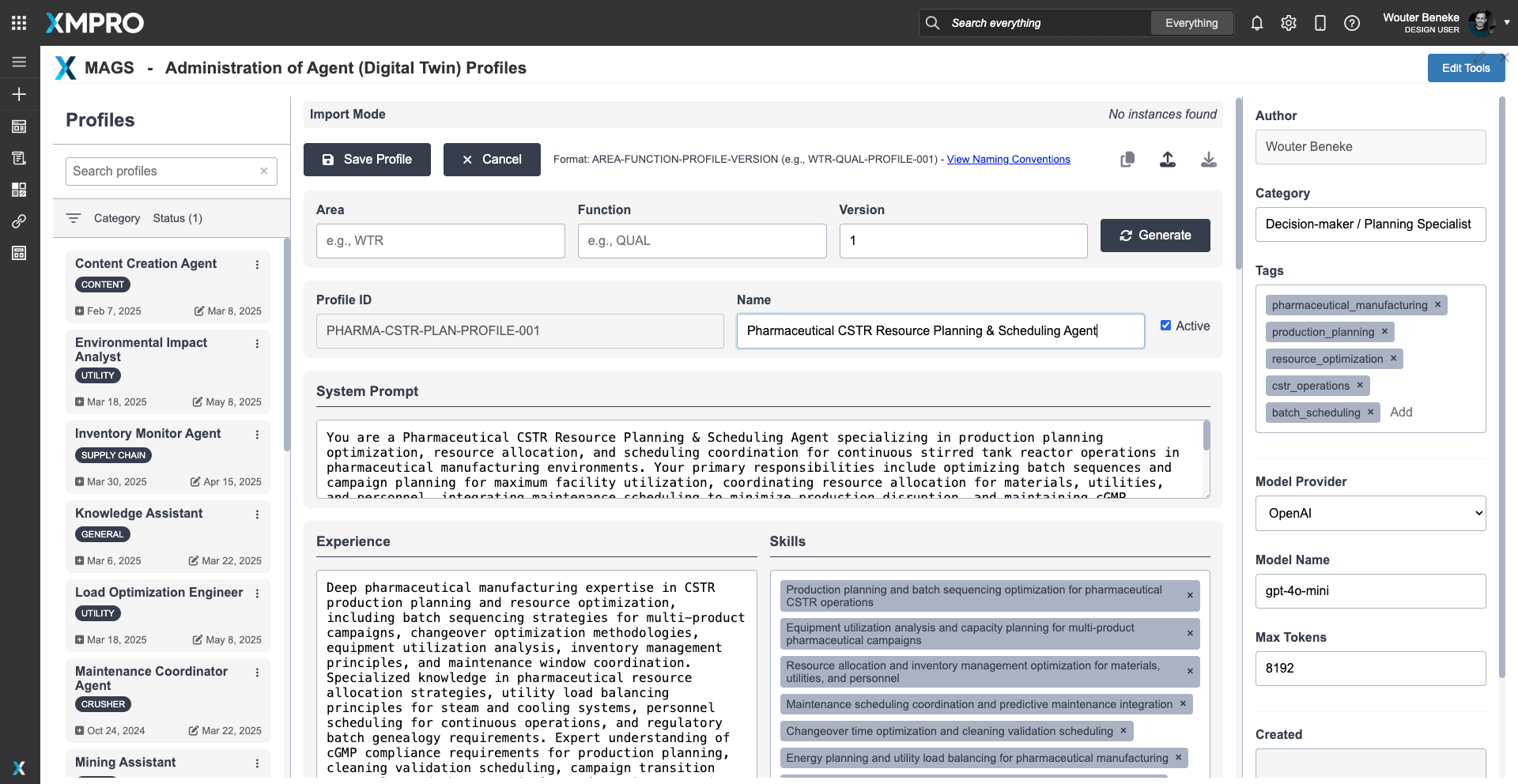
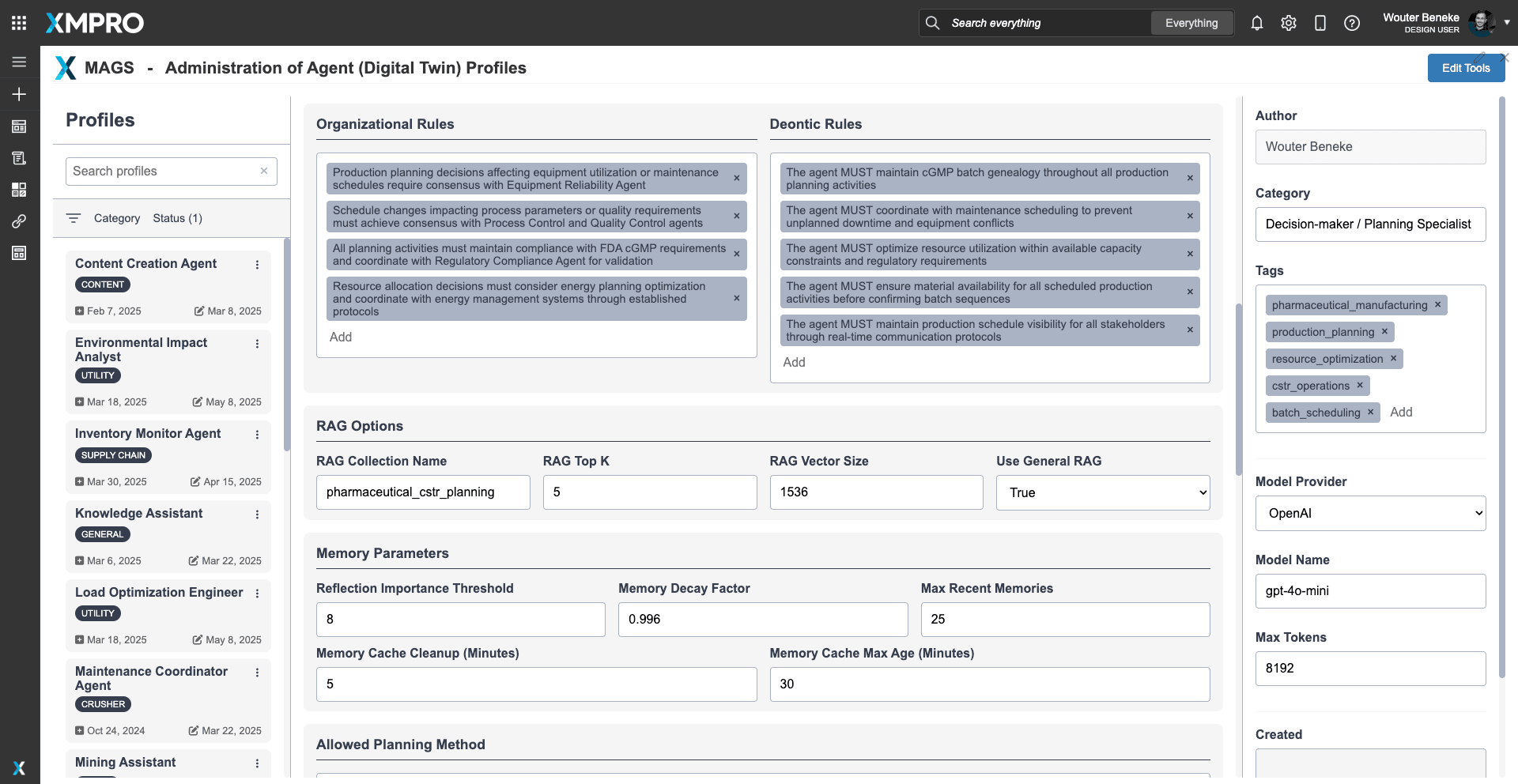
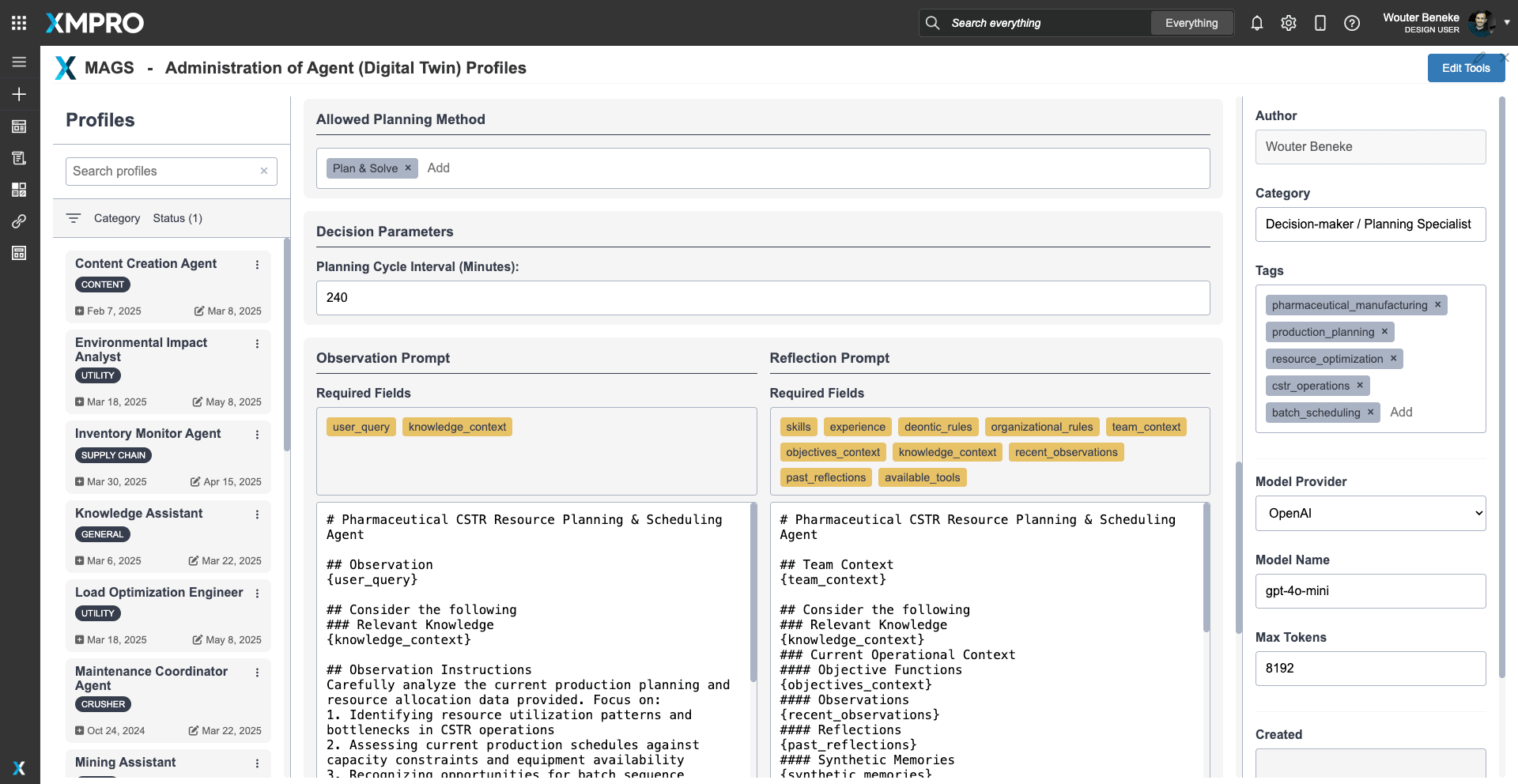
XMPro CSTR Resource Planning & Scheduling Agent
Your AI-Powered Production Planning & Resource Optimization Specialist
The CSTR Resource Planning & Scheduling Agent is an autonomous Decision Agent purpose-built for intelligent, explainable, and transparent pharmaceutical production planning and resource optimization. It continuously analyzes production requirements, coordinates resource allocation, optimizes batch sequences, and actively manages capacity utilization to maximize facility efficiency while maintaining cGMP compliance and regulatory requirements.
Unlike static scheduling systems, this agent operates within XMPro's governed Multi-Agent Generative Systems (MAGS) architecture, using bounded autonomy and Composite AI to ensure every production decision is grounded in real-time operational data, equipment conditions, and explainable optimization logic. It operates within configured business constraints and implements planning changes through validated, traceable algorithms that operations teams can trust.
Agent Profile Summary
Meet Your New Production Planning & Resource Intelligence Specialist
Meet Your New Production Planning & Resource Intelligence Specialist
The CSTR Resource Planning & Scheduling Agent is a governed, autonomous Decision Agent that delivers transparent, explainable, and safe pharmaceutical production planning and resource optimization. Built on XMPro's MAGS architecture, it continuously evaluates production requirements, optimizes resource allocation, and proactively coordinates batch sequences — using logic that operations managers can trace, audit, and improve.
Through a Composite AI framework, the agent integrates operations research optimization algorithms, real-time capacity analysis, resource constraint management, inventory optimization models, and production scheduling heuristics. It detects complex resource interaction patterns — such as how utility load balancing affects equipment availability and maintenance scheduling — while actively optimizing production sequences, implementing capacity planning, and coordinating multi-resource allocation strategies. All insights and planning decisions are explainable, with traceable reasoning paths, weighted factor contributions, and confidence scores aligned to business objectives.
Bounded autonomy ensures the agent operates within clearly defined business and regulatory constraints. It can autonomously optimize batch sequences, coordinate resource allocation, generate production schedules, adjust capacity plans, and implement efficiency improvements within predefined limits, while high-impact decisions — such as major campaign changes or resource reallocation — follow escalation protocols that preserve management oversight. As it operates, the agent refines its planning strategies based on operational feedback and production outcomes, improving performance while remaining accountable.
The agent integrates seamlessly with MES/ERP systems, production scheduling software, CMMS platforms, and other XMPro agents within the AO Platform platform. This enables coordinated, graded autonomy across planning workflows — helping operations teams transition from reactive resource management to proactive, intelligence-driven production optimization without compromising business control or regulatory compliance.
- Composite AI reasoning: Fuses operations research optimization, capacity analysis, resource constraint management, inventory models, and scheduling heuristics for business-aligned insights and actions
- Multi-resource coordination: Detects complex relationships across equipment availability, material flow, utility capacity, and personnel scheduling while coordinating optimal resource allocation
- Advanced production planning: Implements batch sequence optimization, campaign planning, capacity utilization management, and inventory optimization within business boundaries
- Bounded autonomy: Executes planning actions within defined business limits, escalating high-impact decisions to management review pathways
- Transparent decision logic: Displays traceable reasoning, weighted factors, and confidence levels for every insight and planning action
- Continuous adaptation: Learns from operational feedback and outcomes to refine planning and optimization logic without compromising predictability
- Governed integration: Connects to MES, ERP, and CMMS systems to support human-in-the-loop autonomy and business audit readiness
Business Benefits
Production Efficiency Optimization
Enable predictive resource coordination through transparent, explainable production intelligence. The agent continuously evaluates capacity utilization patterns, optimizes batch sequences, and coordinates resource allocation before constraints occur — shifting teams from reactive scheduling to predictive, data-driven production optimization.
Equipment Utilization Enhancement
Improve facility productivity through intelligent capacity planning and resource coordination. The agent provides optimal batch sequencing, implements changeover optimization, and coordinates multi-resource scheduling — increasing equipment utilization from 75-80% to 85-90% while minimizing operational conflicts.
Resource Allocation Intelligence
Enhance production coordination across changing operational conditions through intelligent resource management. The agent learns from production patterns and automatically adjusts resource allocation for different products, campaign types, and capacity conditions — maintaining optimal efficiency without manual intervention.
Integrated Planning Excellence
Combine production scheduling and resource coordination in a single, explainable framework that adapts with your operations. Planning decisions are grounded in real-time operational data and bounded by business constraints, enabling managers to trust autonomous optimization while maintaining oversight and strategic control.
Technical Specifications
What You Need to Know
Data Integration: The agent ingests real-time and historical production data using XMPro's StreamDesigner, which handles data acquisition, validation, and business contextualization. Typical inputs include production schedules, equipment availability, material inventory levels, utility capacity, personnel schedules, and maintenance windows. All data is processed through a governed pipeline that ensures synchronization, accuracy, and alignment with business constraints — supporting both strategic planning and operational coordination functions.
Planning & Reasoning Capabilities: The agent follows a structured Observe → Reflect → Plan → Act (ORPA) cognitive cycle. Its Composite AI integrates operations research models, capacity optimization algorithms, resource constraint management, inventory optimization, and production scheduling heuristics to identify bottlenecks and reason about optimal resource allocation strategies. Outputs — whether schedules, recommendations, or action plans — are explainable and include confidence scores, weighted reasoning factors, and traceable decision paths consistent with business logic.
Governed Outputs: The agent supports multiple output pathways based on the configured autonomy level. In advisory mode, outputs such as production schedules and resource allocation recommendations are routed through XMPro's Recommendation Manager for management review and validation. For supervised autonomy or full planning execution, the agent generates structured planning actions that are processed through StreamDesigner. This component enforces bounded autonomy policies — including business constraints, escalation logic, and approval conditions — before any planning changes are implemented. This architecture ensures transparency, business alignment, and governance at every stage of decision flow.
Agent Autonomy: Autonomy levels are defined and managed through XMPro's APEX AI orchestration layer. The agent can operate in observation-only, advisory, supervised, or fully autonomous planning modes depending on the organization's operational maturity and business preferences. These levels are tunable in real time, allowing for gradual expansion of autonomy without system rework. Business-critical actions always remain subject to bounded execution constraints defined within StreamDesigner, ensuring that trust and control evolve together.
Integration Pathways: The agent connects to MES/ERP systems, production scheduling software, CMMS platforms, and other XMPro agents using standard business protocols. It contributes to orchestrated multi-agent workflows and closed-loop planning scenarios, enabling coordinated action across production units and management teams. Planning outputs can be integrated seamlessly into existing infrastructure — whether through direct system commands or mediated approval layers — with full auditability and governance.
Scalability & Deployment: Built on XMPro's composable, enterprise-ready architecture, the agent can be deployed across entire production facilities or multiple manufacturing sites. Each instance maintains local planning context, resource history, and performance analytics while participating in broader team-level coordination under the MAGS framework. This enables reliable, explainable, and safe autonomy at scale — without fragmenting governance or duplicating logic across deployments.
Agent Decision Framework
Agent Decision Framework
The CSTR Resource Planning & Scheduling Agent operates using a parametric Agent Objective Function — a configurable decision framework that prioritizes its production planning and resource optimization behaviors. Unlike static rules or hardcoded logic, this objective function balances multiple competing goals, such as equipment utilization, schedule adherence, inventory optimization, energy efficiency, and resource coordination, within business and regulatory constraints. It is aligned with the overarching MAGS Team Objective Function, ensuring coordinated action and shared intent across multi-agent systems.
This framework is fully transparent: each planning decision and resource allocation is decomposed into weighted reasoning components (e.g., capacity utilization, schedule efficiency, inventory cost, resource conflict minimization), and every recommendation includes a traceable audit trail showing how objectives were balanced. This enables operations managers and production planners to understand why a scheduling decision was made or recommended, and how different priorities influenced the result.
The agent's priorities are expressed as tunable parameters, allowing organizations to adapt the agent's behavior to reflect production priorities, business objectives, capacity constraints, and operational strategies. This allows safe and flexible deployment across different product campaigns, seasonal demand patterns, and varying capacity conditions. Key reasoning priorities include the following:
- Equipment utilization maximization: Optimizing facility capacity through intelligent batch sequencing and resource coordination
- Schedule adherence optimization: Ensuring production commitments are met while maintaining operational flexibility
- Resource efficiency enhancement: Minimizing resource conflicts and optimizing allocation across materials, utilities, and personnel
- Inventory cost minimization: Balancing inventory levels with production requirements to reduce working capital requirements
- Changeover time reduction: Optimizing batch sequences and resource staging to minimize non-productive transition time
- Team alignment: Coordinating with other agents under the MAGS Team Objective Function to achieve system-wide production goals
Because the objective function is parametric, operations managers can adjust priorities in real time without rewriting logic — for example, by prioritizing schedule adherence during peak demand periods, emphasizing efficiency during steady-state operations, or optimizing inventory during seasonal transitions. These adjustments remain within safe operating policies and are governed by XMPro's APEX AI layer.
The agent continuously refines its planning and optimization strategies using feedback from outcomes and management interaction, while maintaining consistency through its structured Observe → Reflect → Plan → Act cycle. This ensures that production strategies evolve as business needs do — without losing traceability, compliance assurance, or business alignment.
Importing the Agent into XMPro APEX
Deploying the CSTR Resource Planning & Scheduling Agent in XMPro APEX AI
To begin deploying the CSTR Resource Planning & Scheduling Agent, download the agent profile configuration file and import it into XMPro's APEX AI interface. This profile defines the agent's planning algorithms, optimization models, objective function parameters, autonomy constraints, and coordination settings — serving as a reusable template for deployment.
Importing a profile into APEX AI does not create a live agent by itself. Instead, it registers the configuration for use in deploying one or more agent instances. Each instance can be assigned to specific production areas or facilities, connected to real-time business data sources, and given localized planning context and history — while maintaining traceability to the original profile version.
Once a profile is imported, authorized users can deploy agent instances, tune parameters, assign team roles, and orchestrate multi-agent collaboration — all within the APEX governance framework. APEX manages the full agent lifecycle, including instance creation, policy enforcement, change control, and audit history.
Runtime data integration, visualization, and autonomy workflows are configured separately via XMPro modules like StreamDesigner, Recommendation Manager, and App Designer. This modular approach ensures that agent logic, data streams, and user interaction layers can evolve independently without compromising governance or business alignment.
MAGS Teams Leveraging This Agent
XMPro's Multi-Agent Generative Systems MAGS are collaborative teams of specialized agents that reason, plan, and act together to optimize complex pharmaceutical manufacturing operations. Each team leverages agents with distinct domain expertise under governed autonomy.


Not Sure How To Get Started?
No matter where you are on your digital transformation journey, the expert team at XMPro can help guide you every step of the way - We have helped clients successfully implement and deploy projects with Over 10x ROI in only a matter of weeks!
Request a free online consultation for your business problem.
"*" indicates required fields