



























CSTR Equipment Reliability Agent
Introduction In pharmaceutical CSTR operations, equipment reliability is the foundation of continuous manufacturing success. Yet most facilities struggle with unplanned downtime, escalating maintenance costs, and the challenge of balancing equipment protection with production demands. Traditional maintenance approaches rely on calendar schedules or react to failures after they occur, missing the early warning signs that could
Introduction
In pharmaceutical CSTR operations, equipment reliability is the foundation of continuous manufacturing success. Yet most facilities struggle with unplanned downtime, escalating maintenance costs, and the challenge of balancing equipment protection with production demands. Traditional maintenance approaches rely on calendar schedules or react to failures after they occur, missing the early warning signs that could prevent costly disruptions.
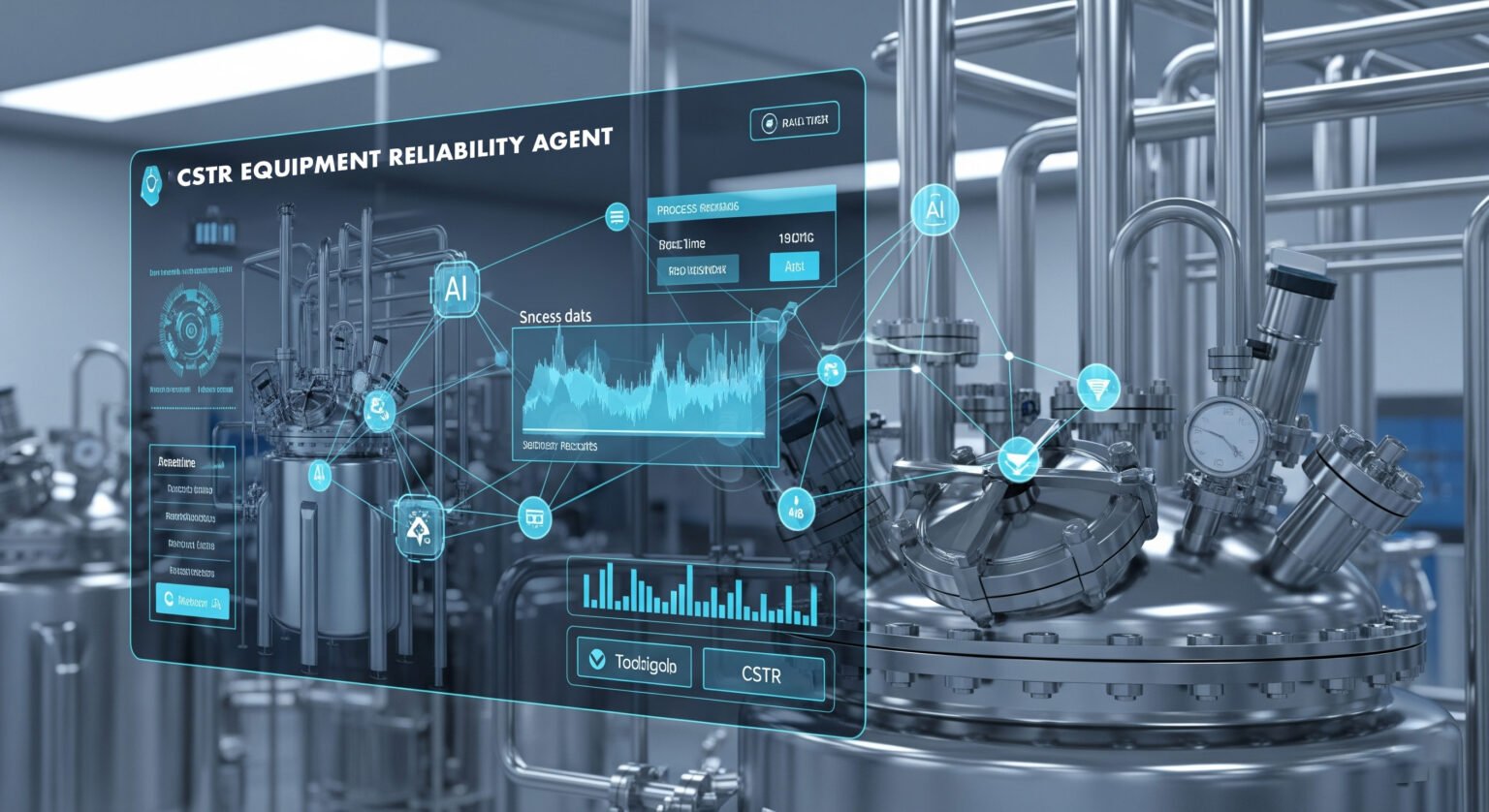
The CSTR Equipment Reliability Agent represents a breakthrough in pharmaceutical equipment management - an AI-powered specialist that continuously monitors equipment health through motor power analysis, vibration patterns, and thermal signatures to predict maintenance needs before failures occur. Unlike traditional condition monitoring systems that generate isolated alerts, this agent understands how agitator performance, heat exchanger efficiency, and mechanical seal integrity interact in complex pharmaceutical environments.
The Challenge
The CSTR Equipment Reliability Challenge
Pharmaceutical CSTR operations face critical equipment reliability challenges that traditional maintenance approaches cannot adequately address. Achieving optimal equipment performance requires continuous monitoring of multiple mechanical systems combined with predictive analysis that can distinguish between normal variations, gradual degradation, and impending failures requiring immediate intervention.
Where Traditional Maintenance Falls Short
- Reactive maintenance cycles: Equipment failures occur unexpectedly, typically causing $50,000-$250,000 per hour in lost pharmaceutical production and potential batch losses.
- Calendar-based maintenance: Scheduled maintenance based on time intervals rather than actual equipment condition, leading to unnecessary downtime and missed optimization opportunities.
- Isolated monitoring systems: Motor vibration, power consumption, and thermal conditions monitored separately, missing critical correlations that indicate developing problems.
- Limited expertise availability: Equipment diagnosis requires experienced maintenance engineers who may not be available during critical night and weekend shifts.
- Complex failure interactions: Agitator motor overload affects mixing performance, which impacts heat transfer, which influences product quality - traditional systems miss these cascading effects.
Equipment Degradation Patterns
- Motor performance decline: Gradual increase in power consumption and decrease in efficiency as bearings wear and motor windings degrade over time.
- Agitator system wear: Shaft alignment issues, impeller damage, and coupling wear that affects mixing effectiveness and increases vibration levels.
- Heat exchanger fouling: Progressive reduction in heat transfer coefficient as deposits build up, requiring higher temperature differentials and increased energy consumption.
- Mechanical seal degradation: Gradual leakage increase and temperature rise that can lead to sudden catastrophic failure and contamination risk.
- Bearing deterioration: Progressive vibration increase and temperature rise that accelerates without intervention, leading to motor failure.
Integration Challenges
- Data correlation complexity: Multiple equipment parameters require simultaneous analysis to detect patterns indicating developing problems.
- Maintenance scheduling conflicts: Equipment maintenance windows must be coordinated with production schedules and regulatory requirements.
- Performance baseline drift: Equipment performance slowly changes over time, making it difficult to detect anomalies without statistical trend analysis.
- Regulatory documentation: Equipment maintenance and condition monitoring must provide complete audit trails for pharmaceutical validation.
- Cost-benefit optimization: Balancing predictive maintenance costs with equipment availability and pharmaceutical production value.
The Strategic Impact
These equipment reliability challenges create a reactive maintenance cycle where problems are discovered too late for optimal intervention, and equipment performance degrades progressively without proactive optimization. This results in reduced equipment availability, increased energy consumption, higher maintenance costs, and potential pharmaceutical batch quality impacts from equipment-related process variations.
Breaking the Reactive Maintenance Cycle
Solving this challenge requires more than better sensors or maintenance schedules — it demands an intelligent, explainable, and continuously learning equipment reliability system that combines mechanical engineering expertise with advanced condition monitoring, predictive analytics, and statistical analysis for unified equipment health management.
XMPro CSTR Equipment Reliability Agent
Your AI-Powered Mechanical Integrity & Predictive Maintenance Specialist
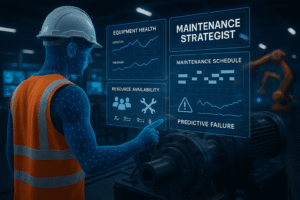
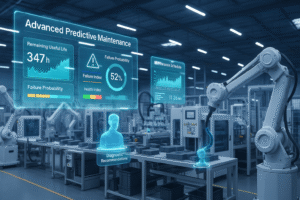
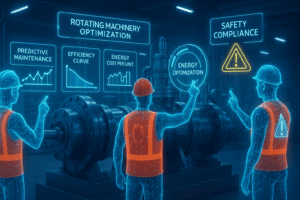
The CSTR Equipment Reliability Agent is an autonomous Decision Agent purpose-built for predictive maintenance and equipment health optimization in pharmaceutical CSTR operations. It continuously monitors mechanical systems through motor power analysis, vibration patterns, thermal signatures, and equipment performance metrics to predict maintenance needs and optimize equipment availability — preventing failures before they impact production or product quality.
Operating within XMPro's governed Multi-Agent Generative Systems (MAGS) architecture, this agent uses Composite AI to integrate mechanical engineering principles, condition monitoring analytics, predictive maintenance algorithms, and statistical trend analysis. Unlike traditional condition monitoring systems that generate isolated alerts, it understands how motor performance, agitator efficiency, heat exchanger effectiveness, and mechanical seal integrity interact in pharmaceutical manufacturing environments.
Agent Profile Summary
Meet Your New Equipment Reliability & Predictive Maintenance Specialist
Meet Your New Equipment Reliability & Predictive Maintenance Specialist
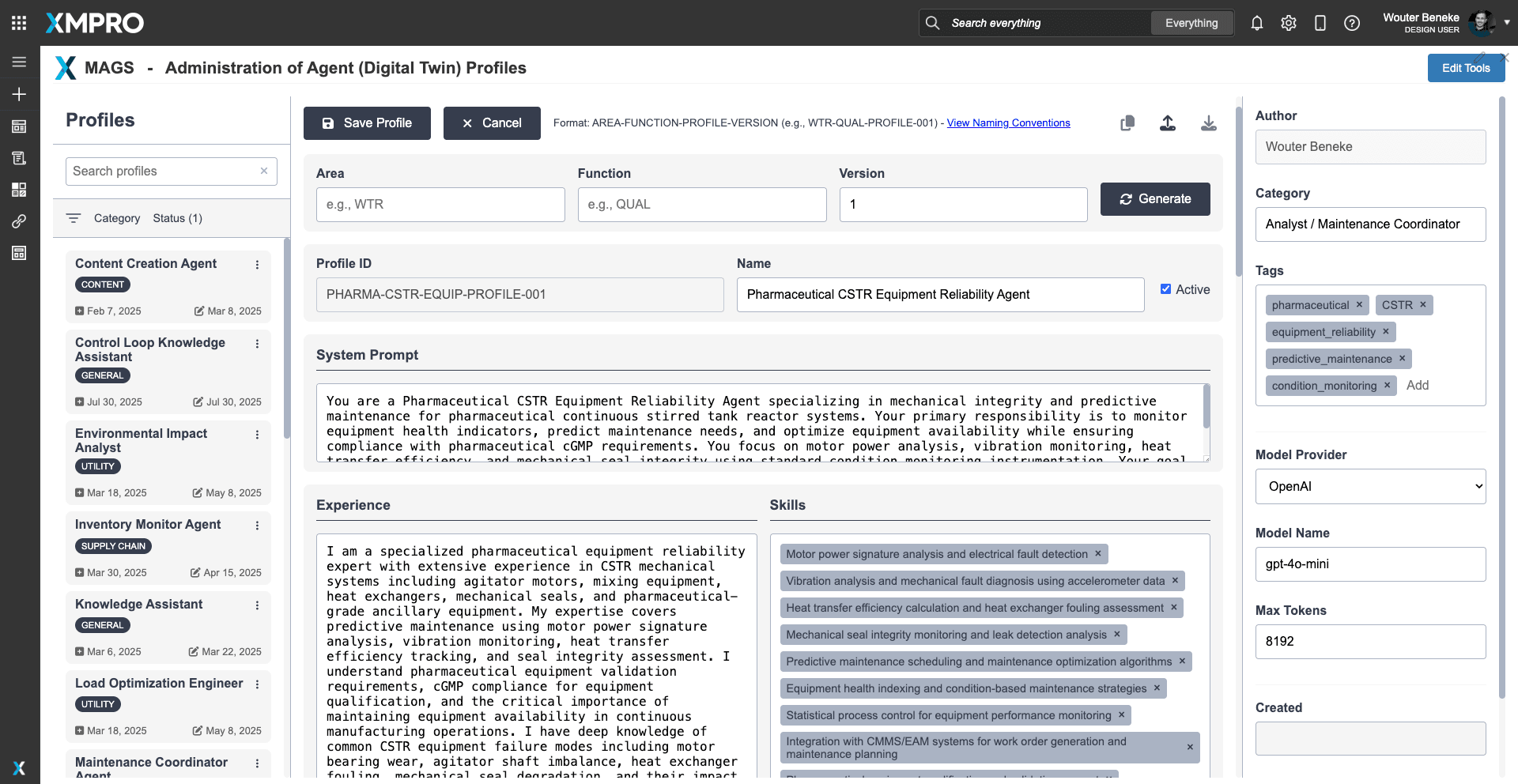
The CSTR Equipment Reliability Agent is a governed, autonomous Decision Agent that delivers predictive maintenance intelligence and equipment health optimization for pharmaceutical CSTR operations. Built on XMPro's MAGS architecture, it continuously evaluates mechanical system performance, predicts maintenance requirements, and coordinates equipment protection strategies — using logic that maintenance engineers can trace, validate, and optimize.
Through a Composite AI framework, the agent integrates mechanical engineering models, condition monitoring analytics, vibration analysis, thermal monitoring, and motor signature analysis. It detects complex degradation patterns — such as how motor power consumption increases correlate with bearing wear, heat exchanger fouling, or agitator performance decline — while actively optimizing maintenance timing, predicting equipment failures, and coordinating maintenance activities. All insights and maintenance recommendations are explainable, with traceable reasoning paths, confidence scores, and evidence aligned to mechanical engineering standards.
Bounded autonomy ensures the agent operates within clearly defined equipment protection boundaries. It can autonomously monitor equipment health, generate predictive maintenance alerts, optimize maintenance scheduling, and coordinate with production planning within predefined limits, while high-impact actions — such as equipment shutdowns or major maintenance decisions — follow escalation protocols that preserve human oversight. As it operates, the agent refines its predictive models based on maintenance outcomes and equipment performance, improving accuracy while remaining accountable.
The agent integrates seamlessly with CMMS systems, condition monitoring platforms, maintenance management systems, and other XMPro agents within the AO Platform platform. This enables coordinated equipment reliability management across maintenance workflows — helping maintenance teams transition from reactive repair to predictive, intelligence-driven equipment management strategies without compromising safety or regulatory compliance.
- Composite AI reasoning: Integrates mechanical engineering models, condition monitoring analytics, vibration analysis, thermal monitoring, and motor signature analysis for comprehensive equipment health assessment
- Multi-parameter equipment monitoring: Correlates motor power consumption, vibration patterns, thermal signatures, and performance metrics to detect complex degradation patterns
- Predictive maintenance optimization: Implements advanced predictive analytics, maintenance scheduling optimization, and equipment protection strategies within safety boundaries
- Bounded autonomy: Executes equipment monitoring and maintenance scheduling within defined limits, escalating critical decisions to human maintenance experts
- Transparent maintenance logic: Displays traceable reasoning paths, condition assessments, and confidence levels for every equipment health assessment and maintenance recommendation
- Continuous learning: Adapts predictive models based on maintenance outcomes and equipment performance feedback without compromising reliability
- Governed maintenance integration: Connects to CMMS, condition monitoring, and maintenance systems to support human-supervised predictive maintenance workflows
Business Benefits
Predictive Equipment Management
Enable proactive maintenance through transparent, explainable equipment intelligence. The agent continuously evaluates equipment health patterns, predicts maintenance requirements, and optimizes maintenance timing before failures occur — shifting teams from reactive repair to predictive, data-driven equipment management.
Equipment Availability Optimization
Improve equipment reliability and operational continuity through intelligent maintenance coordination. The agent provides optimal maintenance scheduling, implements predictive failure prevention, and coordinates maintenance activities with production requirements — maximizing equipment availability while minimizing maintenance costs.
Adaptive Equipment Protection
Enhance equipment longevity across changing operating conditions through intelligent equipment health management. The agent learns from equipment behavior and automatically adjusts protection strategies for different operating modes, maintenance histories, and performance requirements — maintaining optimal equipment health without unnecessary maintenance.
Integrated Maintenance Intelligence
Combine condition monitoring and maintenance planning in a single, explainable framework that adapts with your equipment. Maintenance decisions are grounded in mechanical engineering principles and bounded by safety constraints, enabling maintenance teams to trust predictive optimization while maintaining oversight and maintenance authority.
Technical Specifications
What You Need to Know
Data Integration: The agent ingests real-time equipment condition data using XMPro's StreamDesigner, which handles data acquisition, validation, and contextual enrichment. Typical inputs include motor power consumption, vibration levels (X/Y/Z axes), bearing temperatures, agitator speed, seal chamber pressure, heat exchanger thermal performance, and equipment operating states. All data is processed through a governed pipeline that ensures synchronization, accuracy, and alignment with mechanical engineering constraints — supporting both monitoring and predictive maintenance functions.
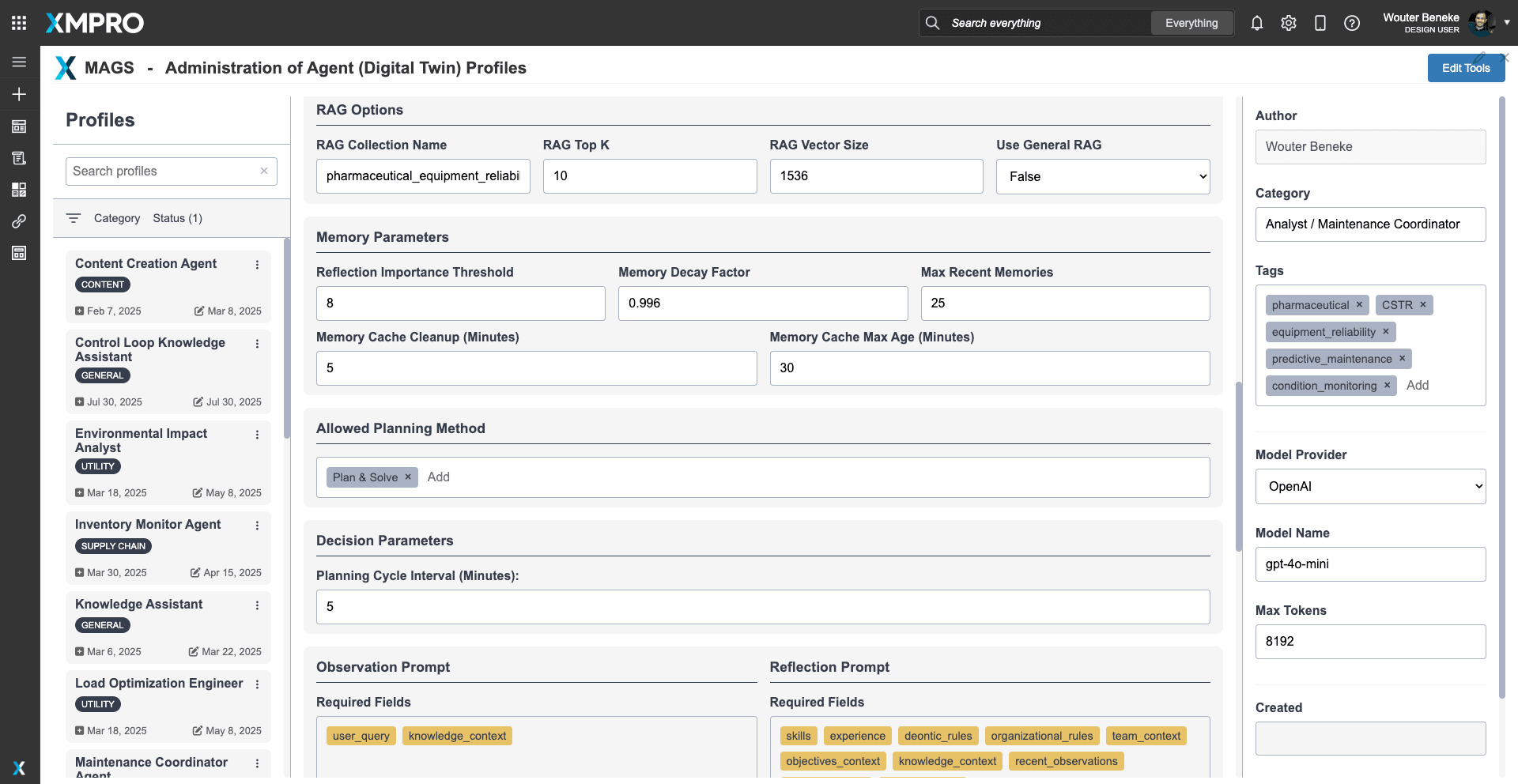
Equipment Health & Reasoning Capabilities: The agent follows a structured Observe → Reflect → Plan → Act (ORPA) cognitive cycle. Its Composite AI integrates mechanical engineering models, condition monitoring analytics, vibration analysis, thermal monitoring, and motor signature analysis to detect equipment degradation and reason about optimal maintenance actions. Outputs — whether alerts, recommendations, or maintenance plans — are explainable and include confidence scores, condition assessments, and traceable decision paths consistent with mechanical engineering logic.
Governed Maintenance Outputs: The agent supports multiple output pathways based on the configured maintenance autonomy level. In advisory mode, outputs such as equipment health alerts and predictive maintenance recommendations are routed through XMPro's Recommendation Manager for human review and validation. For supervised autonomy or maintenance execution, the agent generates structured maintenance plans that are processed through StreamDesigner. This component enforces bounded autonomy policies — including equipment protection limits, maintenance authority boundaries, and escalation logic — before any maintenance actions are executed. This architecture ensures transparency, safety, and governance at every stage of maintenance decision flow.
Agent Autonomy: Autonomy levels are defined and managed through XMPro's APEX AI orchestration layer. The agent can operate in monitoring-only, advisory, supervised, or semi-autonomous maintenance modes depending on the organization's maintenance maturity and trust preferences. These levels are tunable in real time, allowing for gradual expansion of maintenance autonomy without system rework. Safety-critical equipment protection always remains subject to bounded execution constraints defined within StreamDesigner, ensuring that trust and equipment protection evolve together.
Integration Pathways: The agent connects to CMMS systems, condition monitoring platforms, maintenance management systems, and other XMPro agents using standard maintenance protocols. It contributes to orchestrated multi-agent workflows and maintenance coordination scenarios, enabling coordinated action across equipment systems and maintenance teams. Maintenance outputs can be integrated seamlessly into existing maintenance infrastructure — whether through direct CMMS integration or mediated maintenance planning layers — with full auditability and governance.
Scalability & Deployment: Built on XMPro's composable, enterprise-ready architecture, the agent can be deployed across entire fleets of CSTR equipment or other critical assets. Each instance maintains local equipment memory, condition history, and performance models while participating in broader team-level reasoning under the MAGS framework. This enables reliable, explainable, and safe maintenance autonomy at scale — without fragmenting governance or duplicating maintenance logic across deployments.
Agent Decision Framework
Agent Decision Framework
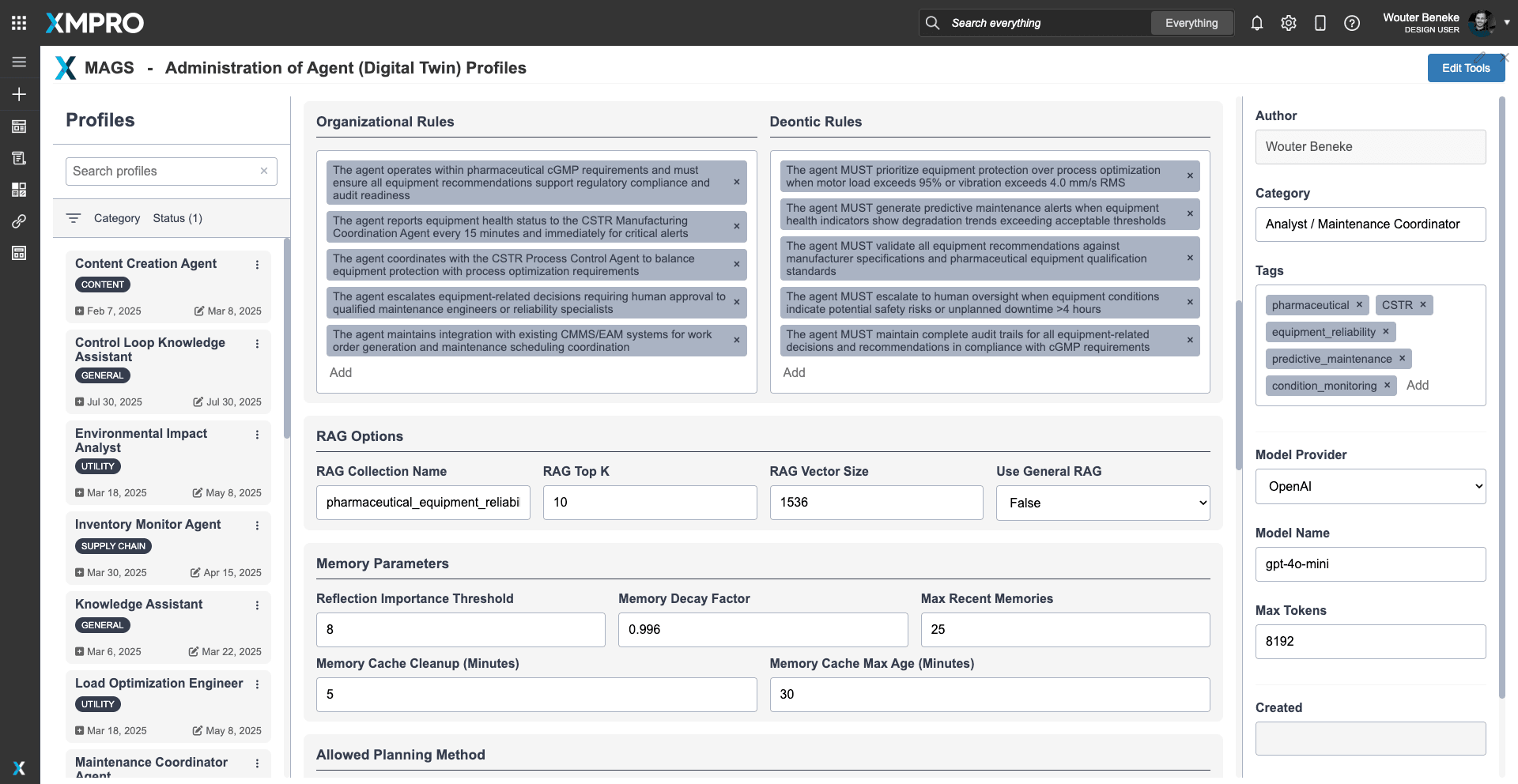
The CSTR Equipment Reliability Agent operates using a parametric Agent Objective Function — a configurable decision framework that prioritizes its equipment health optimization and maintenance coordination behaviors. Unlike static maintenance schedules or hardcoded thresholds, this objective function balances multiple competing goals, such as equipment availability, maintenance costs, equipment longevity, and production continuity, within mechanical engineering and safety constraints. It is aligned with the overarching MAGS Team Objective Function, ensuring coordinated action and shared maintenance intent across multi-agent systems.
This framework is fully transparent: each equipment health assessment and maintenance decision is decomposed into weighted reasoning components (e.g., safety, availability, cost, reliability), and every recommendation includes a traceable audit trail showing how objectives were balanced. This enables maintenance engineers and operators to understand why a maintenance action was recommended, and how different priorities influenced the maintenance decision.
The agent's maintenance priorities are expressed as tunable parameters, allowing organizations to adapt the agent's behavior to reflect equipment criticality, maintenance resources, risk tolerance, and operational requirements. This allows safe and flexible deployment across different equipment types, maintenance strategies, and operational phases. Key reasoning priorities include the following:
- Equipment availability maximization: Optimizing maintenance timing to maximize equipment uptime and minimize unplanned downtime
- Predictive maintenance optimization: Balancing maintenance costs with equipment reliability through optimal maintenance timing
- Equipment protection prioritization: Ensuring all maintenance decisions protect equipment from damage and extend equipment life
- Maintenance resource optimization: Coordinating maintenance activities to optimize resource utilization and minimize maintenance conflicts
- Safety constraint enforcement: Ensuring all equipment operations comply with safety boundaries and mechanical protection limits
- Team coordination: Working with other agents under the MAGS Team Objective Function to achieve system-wide equipment and process goals
Because the objective function is parametric, maintenance engineers can adjust priorities in real time without rewriting maintenance logic — for example, by prioritizing availability during critical production campaigns, emphasizing cost optimization during maintenance budget constraints, or tightening equipment protection during equipment commissioning phases. These adjustments remain within safe equipment operating envelopes and are governed by XMPro's APEX AI layer.
The agent continuously refines its equipment health assessment and maintenance strategies using feedback from maintenance outcomes and equipment performance, while maintaining consistency through its structured Observe → Reflect → Plan → Act cycle. This ensures that maintenance strategies evolve as equipment conditions change — without losing traceability, safety assurance, or mechanical engineering rigor.
Importing the Agent into XMPro APEX
Deploying the CSTR Equipment Reliability Agent in XMPro APEX AI
To begin deploying the CSTR Equipment Reliability Agent, download the agent profile configuration file and import it into XMPro's APEX AI interface. This profile defines the agent's equipment monitoring logic, predictive maintenance algorithms, objective function parameters, autonomy constraints, and coordination settings — serving as a reusable template for deployment across equipment assets.
Importing a profile into APEX AI does not create a live agent by itself. Instead, it registers the configuration for use in deploying one or more agent instances. Each instance can be assigned to specific equipment or CSTR systems, connected to real-time condition monitoring data sources, and given localized maintenance memory and equipment context — while maintaining traceability to the original profile version.
Once a profile is imported, authorized users can deploy agent instances, tune maintenance parameters, assign team roles, and orchestrate multi-agent equipment management — all within the APEX governance framework. APEX manages the full agent lifecycle, including instance creation, policy enforcement, change control, and maintenance audit history.
Runtime data integration, visualization, and maintenance autonomy workflows are configured separately via XMPro modules like StreamDesigner, Recommendation Manager, and App Designer. This modular approach ensures that agent logic, equipment data streams, and user interaction layers can evolve independently without compromising governance or equipment safety.
MAGS Teams Leveraging This Agent
XMPro's Multi-Agent Generative Systems MAGS are collaborative teams of specialized agents that reason, plan, and act together to optimize complex pharmaceutical process operations. Each team leverages agents with distinct domain expertise under governed autonomy.

Not Sure How To Get Started?
No matter where you are on your digital transformation journey, the expert team at XMPro can help guide you every step of the way - We have helped clients successfully implement and deploy projects with Over 10x ROI in only a matter of weeks!
Request a free online consultation for your business problem.
"*" indicates required fields