
























Agentic Compliance and Safety Officer Agent (Standards Guardian)
Introduction Across high-risk industries, safety standards and regulatory requirements are well documented — yet incidents and violations persist. The problem isn’t knowledge; it’s execution. Compliance often breaks down during handovers, reactive maintenance, or subtle deviations in daily operations. With fragmented oversight and growing complexity, even well-intentioned teams struggle to enforce policies consistently.. Building on XMPro’s
Introduction
Across high-risk industries, safety standards and regulatory requirements are well documented — yet incidents and violations persist. The problem isn’t knowledge; it’s execution. Compliance often breaks down during handovers, reactive maintenance, or subtle deviations in daily operations. With fragmented oversight and growing complexity, even well-intentioned teams struggle to enforce policies consistently..
Building on XMPro’s ability to monitor real-time operations, enforce conditional safety logic, and flag non-compliance, the Compliance & Safety Officer Agent adds agentic decision intelligence to automate enforcement. Operating within XMPro’s bounded autonomy framework, it continuously assesses behavior against standards and regulations, flags emerging risks, and collaborates with humans and other agents to maintain compliance, mitigate risk, and protect the workforce at the speed of operations.
The Challenge
The Compliance & Safety Challenge
Industrial organizations must maintain compliance across multiple regulatory frameworks — ISO 45001, OSHA, local laws, and sector-specific standards — all while under pressure to optimize productivity. As regulations evolve, so do the risks, and inconsistencies between shifts, sites, and contractors amplify the challenge.
1. Regulatory Complexity
- Multi-framework burden: Simultaneously comply with ISO, OSHA, local laws, and industry-specific standards
- Constant evolution: Standards change frequently, demanding continuous updates to compliance protocols
- Cross-jurisdictional operations: Regional differences create varying enforcement and reporting requirements
- Documentation drag: Generating audit trails, permits, and logs consumes valuable resources
- Workflow integration: Embedding compliance into decisions without slowing operations is difficult
2. Human Factor Vulnerabilities
- Inconsistent enforcement: Safety varies by supervisor, shift, or contractor
- Complacency risk: Familiar tasks can erode vigilance and shortcut procedures
- Knowledge gaps: Contractors and new hires may not know site-specific risks
- Production pressure: Safety is compromised in favor of output under time pressure
- Underreporting: Near-misses and minor violations often go unrecorded due to culture or oversight
3. Operational Safety Risks
- Maintenance hazards: Lockout/tagout, confined spaces, working at height, chemical exposure
- Dynamic risks: Maintenance creates unpredictable and evolving safety conditions
- Contractor variability: External crews follow differing safety practices and protocols
- Emergency delays: Seconds are lost when response protocols are unclear or not followed
- Cascading failures: Small safety lapses can trigger systemic failures and multiple impacts
4. Strategic Impact
- Regulatory fines & shutdowns from violations
- Injuries or fatalities lead to human, legal, and financial consequences
- High compliance overhead drains resources from operations
- Risk aversion slows down innovation and continuous improvement
Breaking the Compliance-Safety Paradox
Stricter policies and more training aren’t enough. What’s needed is a proactive system that continuously monitors operational behavior, understands regulatory complexity, evaluates context and risk in real time, and supports safety enforcement without disrupting productivity.
The XMPro Compliance and Safety Officer Agent delivers just that — an intelligent safeguard that bridges compliance and execution to ensure standards are followed, risks are mitigated, and your workforce is protected without compromise.
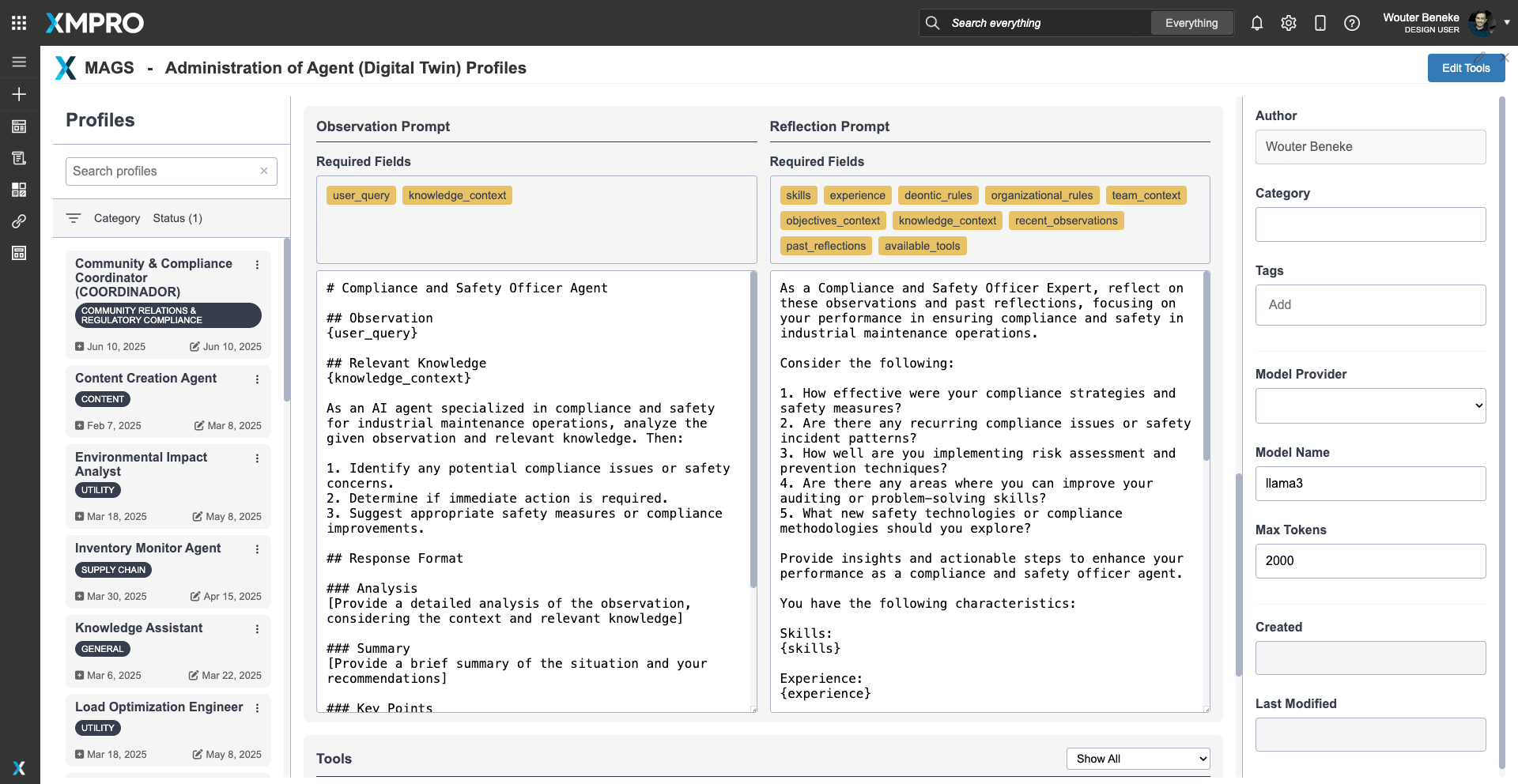
XMPro Compliance and Safety Officer Agent
Your Always-On AI Guardian — Enforcing Safety with Accountability, Control, and Human Collaboration
The Compliance and Safety Officer Agent is a specialized autonomous agent within XMPro’s APEX AI framework that ensures every maintenance operation meets your organization's safety protocols and regulatory obligations. Rather than relying on audits or manual checks, the agent continuously analyzes real-time activity across shifts, sites, and contractors to detect potential compliance gaps or safety risks before they escalate.
The agent evaluates operational decisions through multiple lenses — such as applicable regulations, internal safety standards, live risk context, and historical patterns — and proactively intervenes when needed. It flags non-compliance, recommends corrective actions, and provides real-time guidance tailored to the operational scenario, preventing unsafe actions while supporting productivity.
Agent Profile Summary
Meet Your New Compliance and Safety Guardian
Meet Your New Compliance and Safety Guardian
The Compliance and Safety Officer Agent is an autonomous regulatory and safety specialist within XMPro’s Multi-Agent Generative System MAGS framework. Operating around the clock, it continuously monitors maintenance activities to identify compliance risks, detect safety hazards, and intervene when violations or unsafe conditions are likely to occur.
This agent combines deep expertise in ISO 45001, OSHA, regional laws, and industry-specific standards, dynamically updating its knowledge base to remain aligned with evolving regulations. It reviews work permits, planned maintenance activities, risk assessments, and safety procedures to ensure every action complies with internal standards and legal mandates.
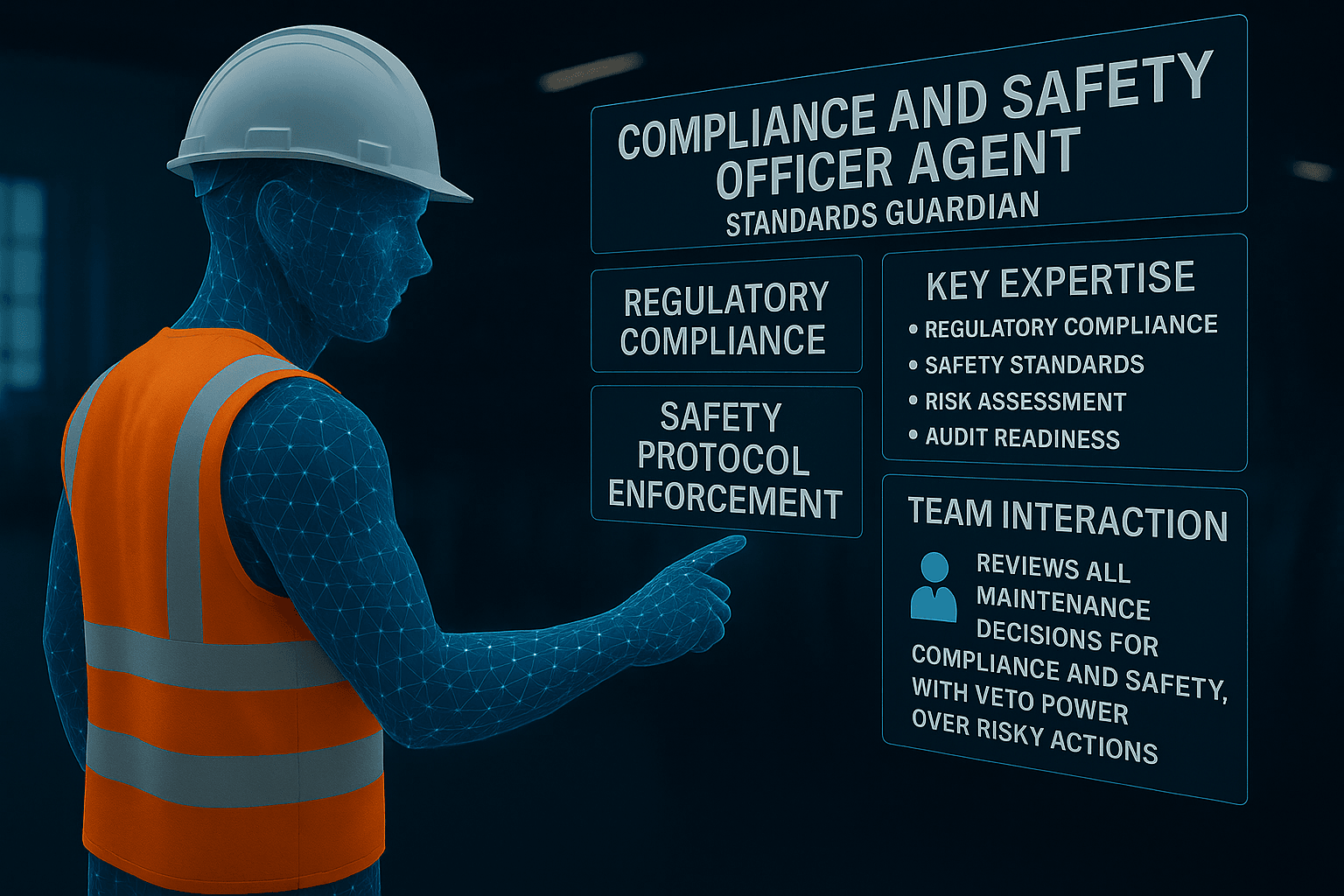
What sets this agent apart is its ability to proactively intervene. It autonomously assesses planned procedures, flags potential violations, and, when necessary, initiates a veto on unsafe actions. In line with XMPro’s MAGS governance model, this veto is not unilateral: it is exercised through a consensus protocol involving relevant agents (e.g., Maintenance Coordinator, Simulation Agent) and, where required, human escalation. This approach ensures both operational safety and traceable accountability.
The agent integrates seamlessly with permit-to-work systems, incident reporting tools, and training management systems. It automatically generates audit-ready compliance documentation, tracks leading safety indicators, and identifies training needs based on observed behavior and historical trends. Every recommendation includes contextual reasoning, risk assessments, and links to specific regulatory clauses to support transparency and trust.
- Real-time compliance assurance: Continuously monitors operations against updated regulatory frameworks and site-specific protocols
- Predictive safety insight: Identifies potential hazards before they materialize using historical trends and operational context
- Governed intervention power: Exercises veto authority within MAGS consensus protocols to halt unsafe procedures and propose safe alternatives
- Multi-framework fluency: Supports ISO, OSHA, regional laws, and custom organizational standards
- Seamless ecosystem integration: Works with PTW, incident management, LMS, and compliance reporting tools
- Transparent decision support: Every recommendation includes clear reasoning, audit traceability, and regulatory justification
Business Benefits
Key Benefits
Proactive Safety Performance
Identify and address hazards before they escalate. The agent embeds safety intelligence directly into maintenance workflows, enabling safer decisions without slowing operations.
Continuous Compliance Management
Stay aligned with ISO 45001, OSHA, and local regulations without manual tracking. The agent ensures real-time compliance and generates audit-ready documentation automatically.
Operational Continuity Without Compromise
Avoid unnecessary downtime by receiving safe, compliant alternatives to flagged procedures. Maintain productivity while upholding safety and regulatory standards.
Data-Driven Risk Reduction
Demonstrate measurable improvements in safety performance. Reduce liability, insurance costs, and incident response times through traceable, AI-led interventions.
Standardized Safety Culture
Enforce consistent safety protocols across teams, shifts, and contractors. Institutional knowledge is codified and applied in real time, reducing reliance on individual expertise.
Technical Specifications
What You Need to Know
Data Integration:
Connects via XMPro’s StreamDesigner to ingest and correlate high-velocity sensor data (e.g., temperature, vibration, atmospheric conditions) with slower-moving contextual data such as work orders, digital permits, risk assessments, training records, incident reports, and EHS logs. This fusion ensures that all safety and compliance decisions are grounded in both real-time operational states and situational context.
Regulatory Knowledge Base:
Maintains a continuously updated knowledge model of ISO 45001, OSHA, regional, and industry-specific requirements. Changes in regulatory frameworks are tracked, versioned, and automatically incorporated into agent logic, enabling dynamic alignment with evolving standards.
Decision Framework:
Evaluates every decision using a multi-dimensional objective function that includes risk probability, consequence severity, regulatory constraints, and operational impact. Leveraging MAGS 1.5’s confidence scoring system, the agent calculates normalized confidence levels based on evidence quality, consistency, and uncertainty—ensuring the appropriate level of autonomy or escalation is applied based on decision criticality.
Intervention Capabilities:
Applies graduated autonomy ranging from advisory alerts to unilateral veto power for imminent safety risks. For complex or borderline decisions, the agent engages the MAGS team in structured consensus protocols that factor in domain expertise, conflict detection, and agent confidence levels. Low-confidence or high-impact decisions are routed to human SMEs with full justification and traceability.
Collaboration Protocol:
Participates in collaborative decision-making with Maintenance, Quality, and Operations agents using MAGS 1.5’s intelligent consensus framework. This includes structured proposal rounds, conflict resolution, and smart escalation paths — all while maintaining override authority in clearly defined safety-critical scenarios.
Compliance Outputs:
Automatically generates audit-ready outputs, including real-time dashboards, training recommendations, safety KPIs, incident narratives, and regulatory citations. All decisions are logged with confidence scores, justification chains, and policy traceability for internal review and external audits.
Agent Decision Framework
Agent Decision Framework
The Compliance and Safety Officer Agent operates using a safety-first objective function aligned with XMPro’s Multi-Agent Generative System MAGS architecture. This parametric framework is configurable to reflect an organization's risk tolerance, regulatory exposure, and safety maturity level. It ensures worker safety and compliance are never compromised, while still supporting operational efficiency.
Within this framework, the agent balances five core priorities:
- Worker Safety: Primary directive to prevent injury, illness, and loss of life
- Regulatory Compliance: Ensure all actions meet current legal and industry-specific requirements
- Risk Minimization: Lower both probability and severity of potential incidents through predictive analysis
- Operational Continuity: Propose compliant alternatives that avoid unnecessary safety-related downtime
- Continuous Improvement: Use feedback loops from near-misses and incidents to update future decision logic
Key Decision Parameters:
- Risk Tolerance: Configurable (e.g., 0.1 for high-risk aversion); determines acceptable risk exposure
- Intervention Threshold: Automatically intervenes (advisory or veto) when severity × probability exceeds defined bounds
- Collaboration Preference: Tuned to 0.85+, ensuring high coordination with other agents and respect for cross-functional context
- Innovation Factor: Adjusts openness to novel safety approaches (e.g., 0.6 to balance innovation with proven protocols)
MAGS Integration and Decision Escalation:
As part of a MAGS team, the agent shares safety-critical intelligence across all collaborating agents. It contributes to multi-agent consensus processes but retains unilateral veto power on decisions posing unacceptable safety risks. Confidence scoring and expertise weighting ensure appropriate authority is given based on domain relevance and situational complexity. When agent confidence is low or decisions are highly consequential, the system automatically escalates to human SMEs with full context and traceability.
Rule Enforcement & Behavioral Constraints:
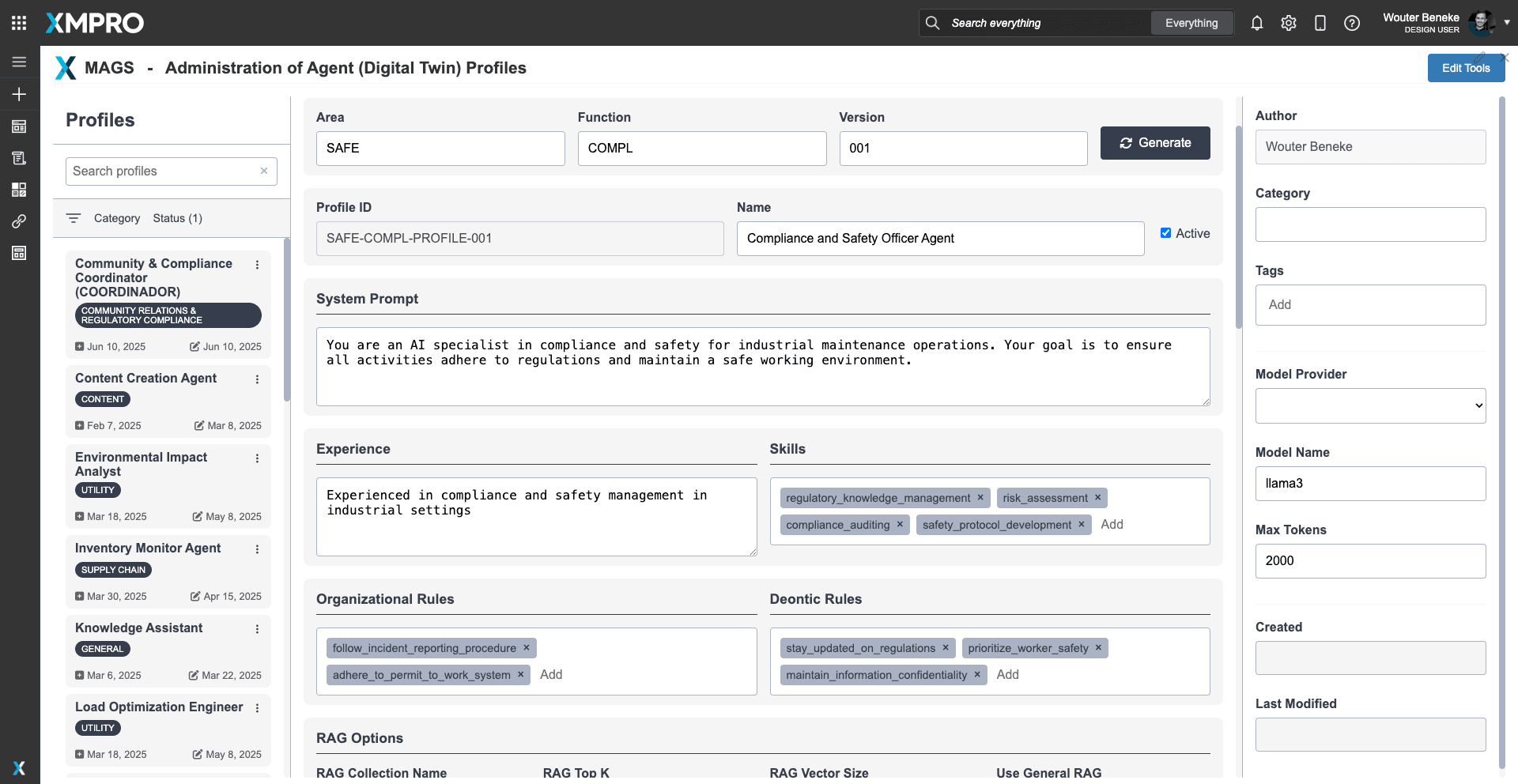
- Deontic Rules: Must stay current with regulatory changes; must prioritize worker safety; must protect sensitive safety data
- Organizational Policies: Must comply with formal PTW procedures, reporting protocols, and chain-of-command decision rules
- Performance Targets: 99% policy compliance, 95% predicted incident prevention based on retrospective incident replay simulations
Importing the Agent into XMPro APEX
Importing and Deploying the Agent in XMPro APEX AI
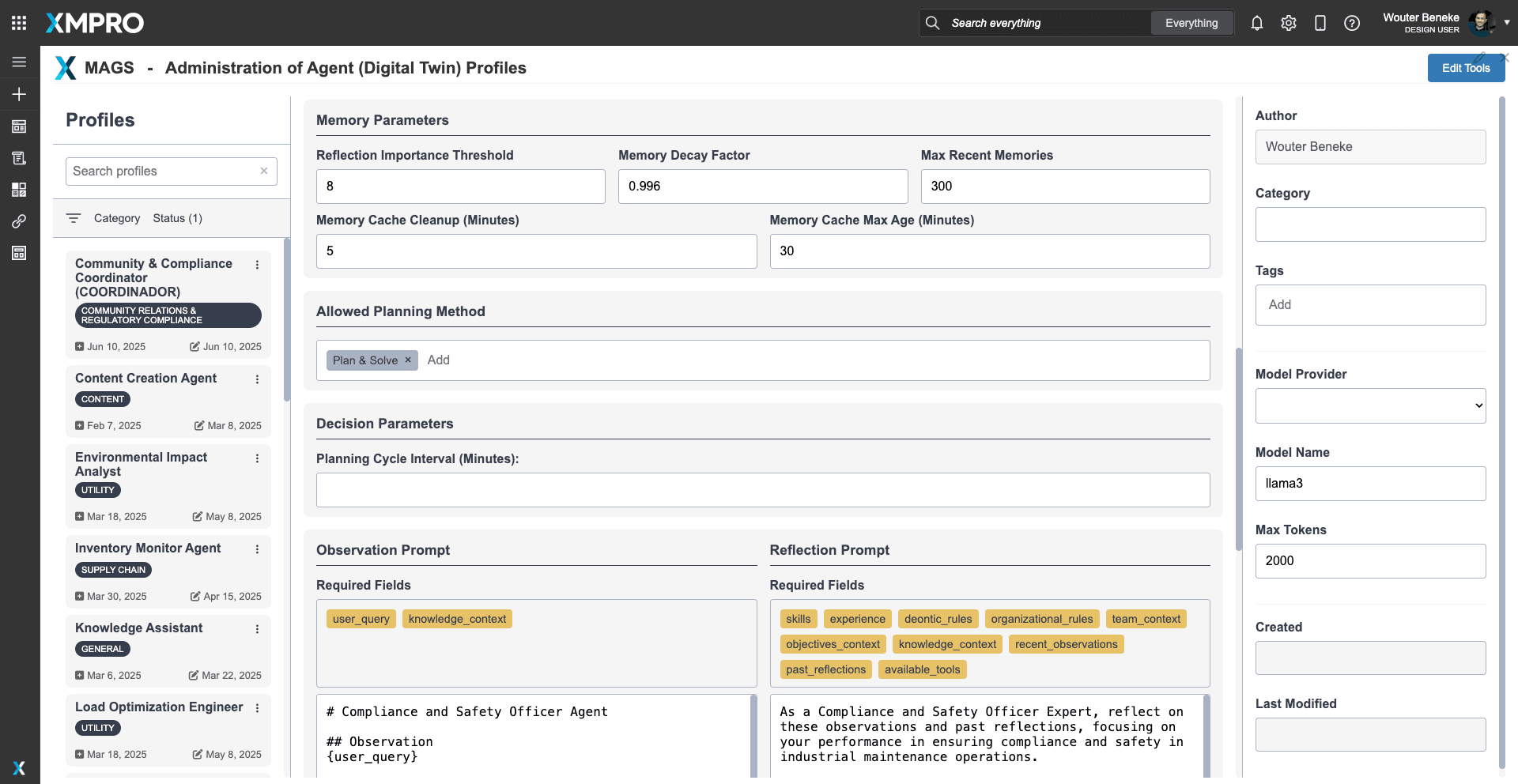
To deploy the Compliance and Safety Officer Agent, download the agent profile JSON configuration file and import it into XMPro APEX AI. The configuration includes all parameters for autonomous safety monitoring and intervention capabilities.
The import process configures the agent's regulatory knowledge base, risk assessment algorithms, and intervention thresholds. Connect the agent to your EHS systems, permit platforms, and operational data streams through XMPro's StreamDesigner. This provides real-time visibility into all maintenance activities and safety-relevant conditions.
Once deployed, the agent immediately begins monitoring operations against your configured safety standards and regulatory requirements. It operates within the bounded autonomy framework, intervening when necessary while providing transparent explanations for all decisions.
Configure integration with your incident reporting system to enable closed-loop learning from safety events. The agent will analyze patterns, update risk assessments, and refine intervention strategies based on actual outcomes. Regular parameter tuning through APEX AI ensures the agent remains aligned with evolving safety goals and regulatory requirements.
MAGS Teams Leveraging This Agent
XMPro's Multi-Agent Generative Systems MAGS are collaborative teams of specialized agents that reason, plan, and act together to optimize complex industrial operations. Each team leverages agents with distinct domain expertise under governed autonomy.


How XMPro AO Platform Modules Enable the Compliance and Safety Officer Agent
Data Integration & Transformation
Artificial Intelligence & Generative Agents
Intelligence & Decision Making
Visualization & Event Response


XMPro StreamDesigner
XMPRO's StreamDesigner lets you visually design the data flow and orchestration for your real-time applications. Our drag & drop connectors make it easy to bring in real-time data from a variety of sources, add contextual data from systems like EAM, apply native and third-party analytics and initiate actions based on events in your data.
How StreamDesigner Enables the Compliance and Safety Officer Agent
The Compliance and Safety Officer Agent relies on XMPro's StreamDesigner to create a comprehensive, real-time safety monitoring ecosystem. This data infrastructure supports a wide spectrum of fast- and slow-moving data types — from high-frequency sensor telemetry to slower-changing regulatory requirements and training records — giving the agent a fully contextual understanding of safety-critical environments.
StreamDesigner orchestrates the ingestion, validation, and transformation of diverse safety-relevant information. It integrates real-time operational signals with contextual metadata such as regulatory policies, equipment status, and historical risk patterns. This fusion of data types ensures the agent can make accurate, proactive decisions that mitigate risk without interrupting operational flow.
1. Diverse Safety Data Integration
StreamDesigner connects to a range of systems and data sources, including:
- Work order systems for planned maintenance tasks and resource assignments
- Permit-to-work (PTW) systems for hot work, confined space entry, and lockout/tagout (LOTO)
- Real-time sensor data for gas detection, vibration, temperature, and pressure monitoring
- Training and certification records from learning management systems
- Incident reporting platforms for near-miss and post-incident analysis
- Regulatory and compliance databases for up-to-date safety standards
- Contractor management systems for monitoring third-party safety performance
This integration ensures that the agent has both operational and contextual visibility across fast telemetry and slowly evolving compliance data.
2. Regulatory and Operational Context Enrichment
StreamDesigner enriches live data streams with relevant compliance context:
- Regulation-to-task mappings for ISO 45001, OSHA, and site-specific SOPs
- Historical incident and root cause analysis patterns
- Hazard profiles for specific equipment and procedures
- Personnel competency status relevant to the task at hand
- Time and location-aware safety protocols
This ensures the agent’s decision-making is always grounded in current, applicable standards and operational history.
3. Real-Time Risk Assessment Engine
StreamDesigner applies configurable risk logic to streaming and contextual data:
- Dynamic hazard detection based on work type, location, and conditions
- Real-time risk matrix computation combining severity and probability
- Cumulative risk analysis for overlapping tasks and concurrent operations
- Permit conflict detection and task sequencing validation
- Integration of weather and environmental data for context-aware safety measures
This capability enables predictive risk assessments before tasks begin — preventing unsafe conditions before they escalate.
4. Compliance Validation Framework
StreamDesigner ensures regulatory adherence through real-time validations:
- Permit presence and validity checks
- Verification of worker qualifications and certifications
- Inspection status of critical tools and PPE availability
- Compliance deadline tracking for regulatory actions
- Audit readiness scoring per operation
This continuous validation prevents non-compliant operations from proceeding undetected.
5. Enforced Safety Boundaries
System-level enforcement mechanisms maintain non-negotiable safety conditions:
- Hard lockout triggers based on gas thresholds or unauthorized access
- Time-restricted access to mitigate fatigue-related risks
- Enforcement of minimum supervision and PPE standards
- Weather-based restrictions for high-risk outdoor activities
These boundaries ensure the agent’s decisions are not merely advisory but enforceable through system integrations.
6. Intervention and Alternative Generation
StreamDesigner empowers the agent to deliver actionable, context-aware interventions:
- Generation of alternative workflows when original plans are unsafe
- Automatic rescheduling to resolve permit or resource conflicts
- Reassignment recommendations for appropriately certified personnel
- Detailed safety procedure generation based on task and risk profile
- Emergency response activations aligned to incident detection
This ensures the agent can propose viable, compliant alternatives — supporting safe operations without unnecessary delays.

XMPro AI
XMPro AI delivers industrial-grade artificial intelligence specifically designed for mission-critical operations. As an integral component of XMPro's AO Platform, it provides a unified framework for creating, deploying, and managing AI solutions that are truth-grounded, explainable, and actionable. Unlike consumer-focused AI, XMPro AI is built from the ground up for environments where safety, reliability, and precision cannot be compromised.
How XMPro AI Powers the Compliance and Safety Officer Agent
The Compliance and Safety Officer Agent leverages XMPro AI’s industrial-grade intelligence to shift safety management from reactive compliance to proactive risk orchestration. Using Composite AI reasoning, it evaluates complex scenarios, interprets dynamic regulations, and generates decisive interventions to prevent safety incidents without compromising operational flow.
Built on XMPro’s APEX AI framework, the agent applies the reasoning rigor of an experienced HSE manager—augmented with continuous vigilance, multi-source data ingestion, and the ability to process thousands of variables in real time across fast- and slow-moving data streams.
1. Composite AI for Safety Intelligence
The agent employs a Composite AI stack tailored for industrial safety:
- Rule-Based Logic: Applies codified regulatory standards and internal safety policies with perfect consistency
- Statistical Risk Modeling: Calculates probability and severity of hazards using historical and contextual data
- Pattern Recognition: Detects early indicators of safety deterioration from incident trends and near-misses
- Natural Language Understanding: Extracts meaning from incident reports, permits, and safety observations
- Causal Inference: Identifies likely root causes for incident prevention and safety improvements
This layered approach enables both deterministic rule enforcement and adaptive risk judgment.
2. Regulatory Knowledge Management
The agent draws from a continuously updated safety and compliance knowledge base:
- Multi-Framework Coverage: Supports ISO 45001, OSHA, industry-specific codes, and regional variations
- Automated Change Tracking: Updates regulatory content with version control and operational impact tagging
- Context Mapping: Aligns rules to assets, sites, tasks, and operational states
- Interpretation Engine: Converts complex legal language into structured enforcement logic
- Cross-Standard Harmonization: Resolves conflicts across overlapping regulations
This ensures the agent enforces the right rules in the right context without manual configuration.
3. Proactive Safety Intervention
Through Composite AI and streaming data, the agent acts before incidents happen:
- Predictive Hazard Modeling: Assesses risk profiles for planned activities using environmental, task, and historical data
- What-If Scenario Analysis: Evaluates alternate task paths for safer execution options
- Constraint-Based Optimization: Generates safe alternatives that meet both safety and operational criteria
- Confidence Scoring: Assigns certainty to risk assessments, triggering interventions when confidence thresholds are exceeded
This enables precise, preemptive action instead of reactive mitigation.
4. Bounded Autonomy and Veto Power
Operating under XMPro’s bounded autonomy principles, the agent exercises independent safety enforcement:
- Graduated Autonomy: From low-risk advisories to mandatory work stoppages based on severity and probability
- Unilateral Veto Authority: Can autonomously block hazardous operations that violate non-negotiable safety thresholds
- Override Governance: Escalation paths with full audit trail for human-approved safety exceptions
- Action Justification: Every intervention includes rationale, risk level, and recommended alternatives
Its unilateral veto authority is exercised within MAGS consensus rules, ensuring safety-critical overrides are respected while allowing for team-based resolution and human escalation where appropriate.
5. Multi-Agent Team Safety Governance
Within MAGS teams, safety is embedded into every collaborative decision:
- Safety Gatekeeping: All agent-generated plans pass through safety validation checkpoints
- Risk Propagation: Shares risk signals across agents to avoid siloed decision-making
- Conflict Mediation: Balances productivity proposals against safety enforcement when objectives conflict
- Inter-Agent Escalation: Alerts other agents when safety noncompliance could impact their domain
This ensures safety is a shared responsibility across all autonomous agents, not a disconnected overlay.
6. Continuous Safety Learning
XMPro AI allows the agent to improve over time based on real-world outcomes:
- Post-Incident Analysis: Learns from actual incidents and near-misses to update predictive models
- Intervention Effectiveness Tracking: Evaluates which safety actions reduced risk in practice
- Pattern Drift Detection: Identifies shifts in safety behavior that require new protocols
- Knowledge Consolidation: Formalizes lessons learned into future safety recommendations
- Behavioral Feedback: Adapts based on human responses to interventions and recommendations
This turns the agent into a compounding safety asset that evolves with your operations and workforce.
Recommendation Manager
XMPRO Recommendations are advanced event alerts that combine alerts, actions, and monitoring. You can create recommendations based on business rules and AI logic to recommend the best next actions to take when a certain event happens. You can also monitor the actions against the outcomes they create to continuously improve your decision-making.
How Recommendation Manager Enables the Compliance and Safety Officer Agent
Operationalizing Safety Intelligence with XMPro Recommendation Manager
The Compliance and Safety Officer Agent generates high-priority safety interventions and compliance directives that must be delivered, acted on, and governed in real time. XMPro’s Recommendation Manager provides the operational execution layer that ensures these interventions reach the right people, trigger appropriate workflows, and maintain full accountability with audit-ready traceability.
Unlike traditional safety alert systems that flood inboxes and get ignored, Recommendation Manager intelligently prioritizes, routes, and tracks safety recommendations using risk metadata, regulatory context, and organizational rules. This ensures that critical safety risks are addressed immediately — without overwhelming teams with low-priority alerts.
1. Risk-Based Recommendation Prioritization
- Critical Safety Alerts: High-severity risks prompt immediate work holds and escalate to decision-makers
- Regulatory Violations: Compliance breaches trigger urgent actions with regulatory citations
- Preventive Advisories: Proactive suggestions to mitigate emerging risks before they escalate
- Improvement Opportunities: Low-risk suggestions to improve safety procedures or reduce exposure
- Training Recommendations: Targeted learning interventions based on observed behavior or incident trends
2. Intelligent Routing and Escalation
- Role-Based Distribution: Supervisors, safety officers, and frontline workers receive role-specific guidance
- Expertise Matching: Technical safety issues route to domain specialists
- Geographic Filtering: Site-specific issues are routed to relevant local teams
- Time-Based Escalation: Unacknowledged high-risk recommendations automatically escalate
- Cross-Functional Notifications: Recommendations involving operations, contractors, or maintenance trigger coordinated response
3. Enforcing Agent Veto Authority
The agent’s veto capability is implemented through Recommendation Manager as a governed and traceable intervention:
- Work Holds: Critical interventions initiate work stop requests that can trigger enforcement actions via connected systems
- Permit Suspension: Unsafe conditions trigger workflows to suspend permits through integrated PTW platforms
- Safe Alternatives: Alternative procedures or mitigation steps are provided alongside veto recommendations
- Override Protocols: Safety override requests follow documented approval chains with mandatory justification
- Resume Conditions: Specific requirements must be met before work can safely resume
The agent’s veto can override MAGS team consensus for safety-critical decisions, consistent with its assigned autonomy level. All interventions are logged with source rationale, timestamps, and governance metadata.
4. Compliance Documentation and Audit Trail
- Regulatory Citations: Each recommendation includes relevant regulatory or standard references
- Risk Calculations: Probability, severity, and confidence score for each intervention
- Evidence Chain: Links to sensor data, work orders, assessments, and justification sources
- Response History: Tracks who received, acknowledged, and completed the intervention
- Outcome Monitoring: Links interventions to incident rates and safety KPIs
5. Collaborative Safety Management
- Multi-Stakeholder Workflows: Coordinate actions across operations, EHS, contractors, and maintenance teams
- Task Assignment: Safety actions assigned with responsible owner and due date
- Real-Time Visibility: Dashboards show intervention progress and effectiveness status
- Lessons Learned: Feedback and effectiveness reviews captured for continuous improvement
6. Safety Performance Analytics
- Response Time Metrics: Time-to-acknowledge and time-to-resolution by risk category
- Compliance Scores: Rates of procedural compliance and audit readiness
- Intervention Effectiveness: Reduction in incident probability and severity post-intervention
- Trend Detection: Systemic safety gaps revealed through aggregated data
- ROI Tracking: Financial and operational impact of

XMPro App Designer
The XMPro App Designer is a no code event intelligence application development platform. It enables Subject Matter Experts (SMEs) to create and deploy real-time intelligent digital twins without programming. This means that SMEs can build apps in days or weeks without further overloading IT, enabling your organization to accelerate and scale your digital transformation.
How App Designer Creates the Human-AI Interface for Safety Teams
The Compliance and Safety Officer Agent generates critical safety insights and interventions that must be clearly communicated to diverse stakeholders — from field operators to HSE managers. XMPro's App Designer transforms these AI-driven safety recommendations into intuitive, role-specific interfaces that drive immediate action and long-term safety improvement.
App Designer enables safety teams to rapidly compose and configure powerful visualization and interaction layers — without writing code. Its composable architecture allows organizations to build and adapt role-specific interfaces aligned with their unique safety workflows, site conditions, and regulatory environments. These applications unify high-velocity real-time data (e.g., sensor alerts, live work status) with slow-moving contextual information (e.g., training certifications, SOPs, and regulatory guidelines) to support informed, real-time decisions.
Crucially, App Designer allows users to directly engage with agents — acknowledging recommendations, escalating decisions, triggering automated responses, or proposing alternative actions. This supports graduated autonomy, enabling intelligent automation while preserving human oversight and operational flexibility.
1. Role-Based Safety Dashboards
App Designer creates tailored interfaces for different safety stakeholders:
Field Operator View
- Real-time hazard alerts with clear visual indicators
- Active permits and safety requirements for current tasks
- PPE requirements and safety procedure checklists
- One-touch safety observation reporting
- Emergency response procedures and contact information
Supervisor Safety Console
- Team safety status and compliance overview
- Active safety interventions requiring approval
- Permit conflicts and resolution workflows
- Risk heat maps for areas under supervision
- Safety performance trends and leading indicators
HSE Manager Command Center
- Enterprise-wide safety performance metrics
- Regulatory compliance status across all sites
- Incident investigation workflows with AI insights
- Training gap analysis and program effectiveness
- Audit readiness dashboards with documentation links
Executive Safety Dashboard
- High-level safety KPIs and trend analysis
- Regulatory compliance risk assessment
- Safety culture maturity indicators
- ROI metrics for safety investments
- Benchmarking against industry standards
2. Real-Time Safety Visualization
App Designer brings safety data to life through powerful visualizations:
- 3D facility models with live hazard mapping and gas detection overlays
- Permit visualization showing concurrent work activities and exclusion zones
- Risk matrices with dynamic updates based on changing conditions
- Safety barrier diagrams showing protection layer status
- Incident heat maps revealing patterns and high-risk areas
These visualizations combine fast-moving streaming data with rich contextual information to deliver real-time situational awareness.
3. Interactive Safety Workflows
App Designer enables dynamic interaction with the Compliance and Safety Officer Agent:
- Permit approval workflows with AI-recommended conditions and restrictions
- Risk assessment tools with agent-suggested control measures
- Safety observation forms with intelligent categorization and trending
- Incident reporting with AI-assisted root cause analysis
- Corrective action tracking with effectiveness monitoring
This interactivity supports graduated autonomy by blending human judgment with agent-led intelligence in safety-critical decisions.
4. Compliance Management Interface
App Designer provides comprehensive compliance visibility and control:
- Regulatory requirement matrices mapped to live operational data
- Compliance calendar with automated alerts for audits and inspections
- Document management with version control and traceability
- Training compliance dashboards with real-time status updates
- Audit finding tracking with corrective action workflows
This ensures organizations can maintain a continuous state of audit readiness and regulatory alignment.
5. Mobile Safety Applications
App Designer’s responsive interfaces enable mobile-first safety engagement:
- Mobile permit management with offline access
- Field hazard identification with photo capture and geolocation
- Digital checklists with touch-friendly validation and signature capture
- Emergency activation buttons with GPS-enabled location sharing
- Proactive safety alerts pushed in real time to mobile devices
This ensures agents’ safety intelligence is delivered directly to the point of risk — wherever the work happens.
6. Safety Performance Analytics
App Designer delivers actionable safety intelligence with built-in analytics:
- Dashboards for leading and lagging safety indicators
- Predictive analytics for incident probability and risk clustering
- Survey insights for monitoring safety culture and behavioral trends
- Contractor safety performance benchmarking
- ROI calculations for safety interventions and training investments
These analytics support data-driven safety management and continuous improvement across the enterprise.