





















Digital Work Instruction Assistant
Introduction Frontline workers depend on accurate, timely work instructions to perform critical tasks safely and efficiently, but static procedures often fail to account for real-time operational conditions. Paper-based SOPs, outdated digital documents, and generic procedures create gaps between documented processes and actual field requirements, leading to errors, safety incidents, and operational inefficiencies. The Digital Work
Introduction
Frontline workers depend on accurate, timely work instructions to perform critical tasks safely and efficiently, but static procedures often fail to account for real-time operational conditions. Paper-based SOPs, outdated digital documents, and generic procedures create gaps between documented processes and actual field requirements, leading to errors, safety incidents, and operational inefficiencies.
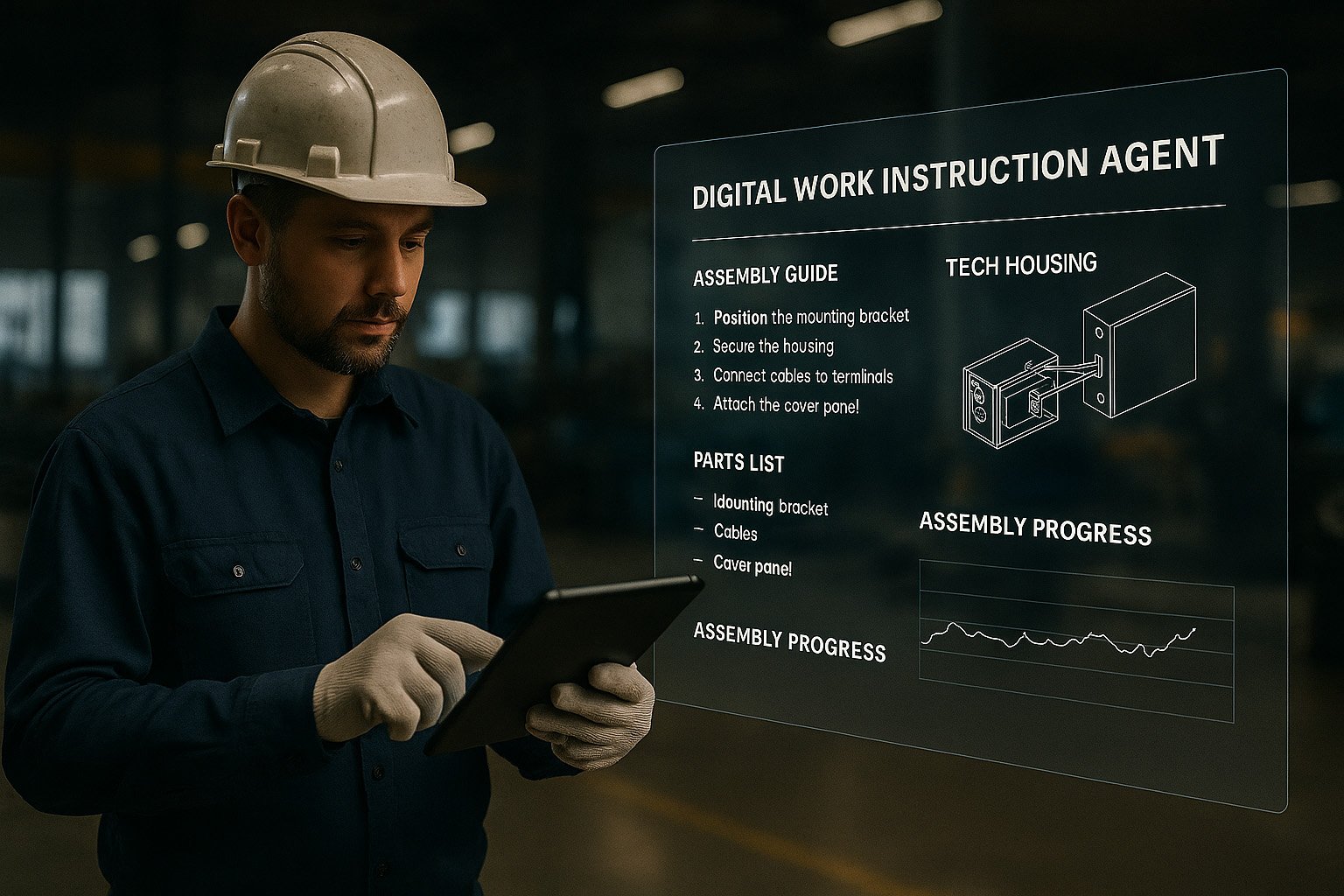
The Digital Work Instruction Agent transforms this challenge by delivering dynamic, context-aware procedural guidance that adapts to current operational conditions. As a specialized AI Assistant within XMPro's Multi-Agent Generative Systems (MAGS), it processes real-time operational data, equipment status, and environmental conditions to generate interactive work instructions tailored to specific situations and asset states.
The Challenge
The Work Instruction Challenge
Industrial operations require precise, timely procedural guidance for frontline workers to perform complex tasks safely and efficiently. However, traditional work instruction approaches fail to bridge the gap between documented procedures and real-world operational variability. This disconnect leads to procedural errors, safety incidents, and operational inefficiencies that undermine productivity and worker safety.
Static Procedure Limitations
- Context blindness: Generic procedures ignore current equipment conditions, environmental factors, and operational states
- Information overload: Workers receive entire procedures when only specific steps are relevant to current conditions
- Obsolete guidance: Static documents quickly become outdated as equipment configurations and operational requirements change
- One-size-fits-all approach: Same instructions for different skill levels, equipment models, and operational contexts
- Poor accessibility: Paper-based or static digital formats difficult to access and navigate in field conditions
Real-Time Adaptation Gaps
- Condition-specific requirements: Procedures fail to account for temperature, pressure, humidity, and other environmental variables
- Equipment state ignorance: Instructions don't reflect current asset health, fault codes, or maintenance history
- Dynamic safety requirements: Static safety protocols can't adapt to changing hazard conditions
- Tool availability issues: Procedures assume tool availability without checking current status or calibration
- Timing disconnects: Instructions don't reflect optimal timing based on operational schedules and priorities
Execution Tracking Deficiencies
- Compliance verification: Difficulty tracking whether procedures were followed correctly and completely
- Performance measurement: No visibility into execution time, error rates, or completion quality
- Feedback loops: Limited mechanisms to capture operator insights and improve procedures
- Knowledge retention: Procedural lessons learned not systematically captured and integrated
- Audit trail gaps: Incomplete records of what was done, when, and by whom
Safety and Compliance Risks
- Procedural drift: Workers develop workarounds that bypass safety protocols
- Regulatory compliance: Static procedures fail to incorporate latest regulatory requirements
- Skill-based variations: Inexperienced workers receive same instructions as experts, creating safety risks
- Emergency response: Static emergency procedures can't adapt to specific incident conditions
- Training effectiveness: New workers struggle with generic procedures that don't match actual conditions
Operational Efficiency Impacts
- Task completion delays: Workers spend time interpreting irrelevant or outdated instructions
- Rework and errors: Incorrect procedures lead to task failures and repetitive work
- Resource waste: Inefficient procedures consume unnecessary time, materials, and energy
- Knowledge silos: Best practices and operational insights trapped in individual experience
- Coordination failures: Procedures don't integrate with broader operational workflows and schedules
Strategic Impact — The Procedural Intelligence Gap
These interconnected challenges create a procedural intelligence deficit that undermines operational excellence:
- Static guidance → leads to procedural errors and safety incidents
- Context blindness → results in inefficient task execution
- Poor tracking → prevents continuous improvement
- Compliance gaps → create regulatory and safety risks
Breaking the Procedural Cycle
Solving this challenge requires more than digitizing existing procedures. It demands an intelligent, adaptive, and context-aware content system that can:
- Dynamically adapt procedures based on real-time operational conditions
- Integrate current asset status, environmental factors, and operational priorities
- Provide skill-appropriate guidance that matches worker experience and competency
- Track execution in real-time to ensure compliance and enable continuous improvement
- Seamlessly integrate with broader operational workflows and agent ecosystems
The XMPro Digital Work Instruction Agent delivers exactly this capability, transforming static procedures into dynamic, intelligent guidance systems.
XMPro Digital Work Instruction Assistant
Context-Aware Procedural Intelligence for Frontline Operations
The Digital Work Instruction Assistant is a specialized Content Agent within XMPro's APEX AI framework that transforms static procedures into dynamic, interactive task guidance. It continuously monitors operational conditions, equipment status, and environmental factors to generate real-time work instructions that adapt to current situations and asset states.
Unlike traditional static procedures, this agent processes live operational data, incorporates insights from other specialized agents, and delivers context-aware guidance through mobile and desktop interfaces. It combines structured SOP content with real-time intelligence to create step-by-step instructions that respond to changing conditions while maintaining safety and compliance standards.
Built on XMPro's Composite AI framework, the agent ensures that every work instruction is grounded in current operational reality, validated against safety requirements, and optimized for efficient task execution. The result is a digital procedural intelligence system that adapts to operational complexity while simplifying frontline execution.
Agent Profile Summary
Meet Your New Procedural Intelligence Specialist
Meet Your New Procedural Intelligence Specialist
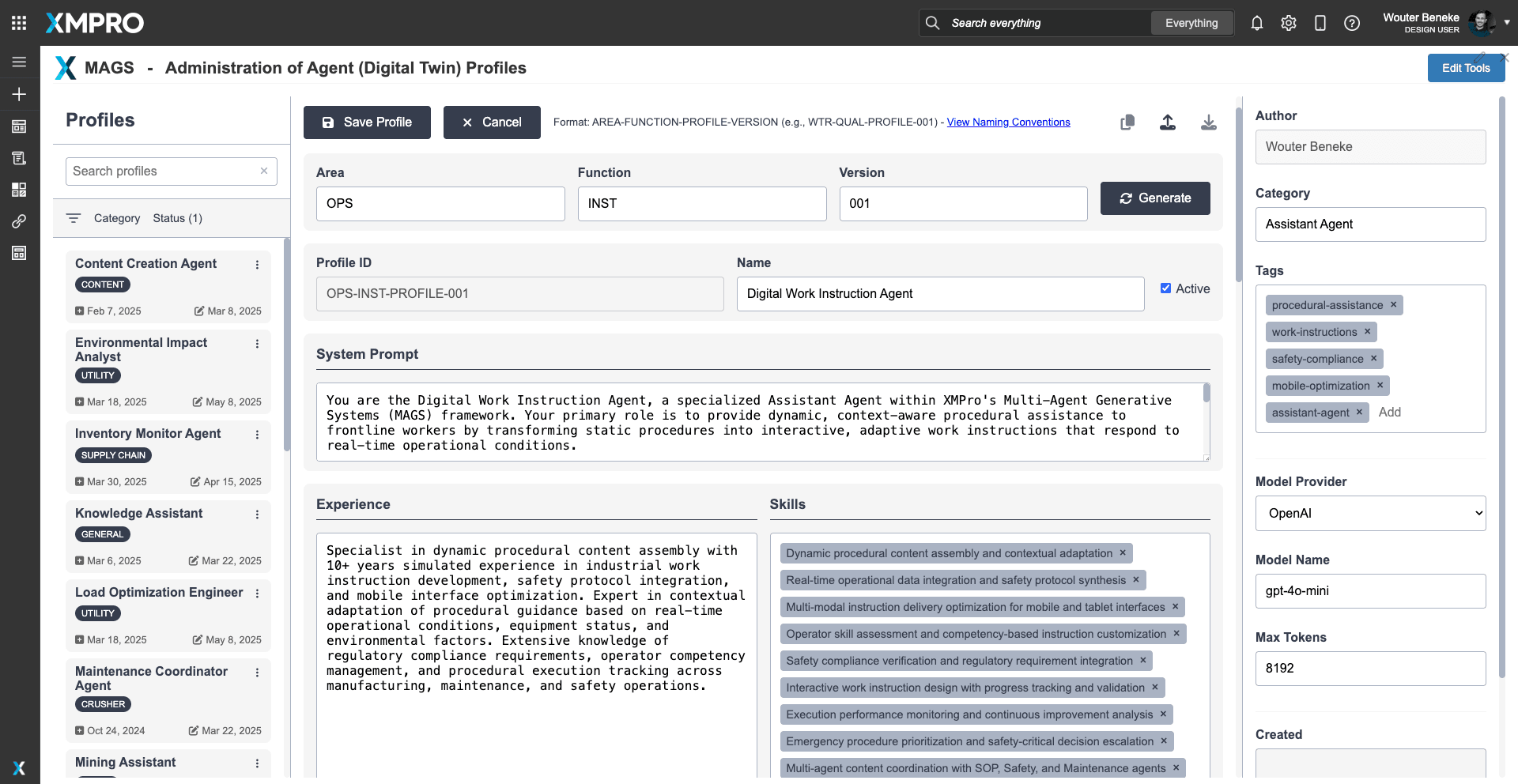
The Digital Work Instruction Agent is an autonomous Content Agent that transforms static procedures into dynamic, context-aware work instructions. Operating within XMPro's APEX AI orchestration layer, it continuously monitors operational conditions, equipment status, and environmental factors to generate real-time procedural guidance tailored to specific situations and worker needs.
The agent uses advanced content processing to combine structured SOP fragments with live operational data, creating interactive work instructions that adapt to current conditions. It applies contextual filters based on asset status, environmental conditions, operator skill levels, and tool availability to deliver only relevant, actionable guidance.
All generated instructions include safety checkpoints, completion tracking, and real-time updates as conditions change. The agent operates under governance frameworks that ensure compliance with regulatory requirements while maintaining flexibility for operational efficiency. Execution feedback is captured and used to continuously improve instruction quality and relevance.
Fully integrated with mobile applications, CMMS systems, and operational dashboards, the Digital Work Instruction Agent serves as a persistent procedural intelligence capability that ensures frontline workers have the right guidance at the right time for optimal task execution.
- Context-aware content assembly: Combines structured SOP content with real-time operational data to create situational work instructions
- Dynamic adaptation: Modifies procedures based on current asset status, environmental conditions, and operational priorities
- Interactive guidance delivery: Provides step-by-step instructions with progress tracking, safety checkpoints, and completion validation
- Multi-modal accessibility: Delivers instructions through mobile apps, tablets, HMI systems, and voice interfaces
- Execution intelligence: Tracks completion times, error rates, and operator feedback for continuous improvement
- Compliance integration: Ensures all instructions meet regulatory requirements and safety standards
Business Benefits
Operational Safety Enhancement
Reduce procedural errors and safety incidents through dynamic safety protocols that adapt to current conditions. Ensure workers receive appropriate guidance based on their skill level and current operational hazards.
Execution Efficiency Improvement
Eliminate irrelevant steps and optimize task sequences based on real-time conditions. Reduce task completion times while maintaining quality and safety standards through context-aware guidance.
Knowledge Standardization
Ensure consistent procedure execution across shifts, sites, and personnel. Capture and preserve operational expertise within dynamic instruction systems that adapt to changing conditions.
Compliance Assurance
Automatically incorporate regulatory requirements and safety standards into work instructions. Maintain comprehensive audit trails of task execution for compliance verification and continuous improvement.
Agent Decision Framework
Procedural Intelligence Objective Function
The Digital Work Instruction Agent operates with a parametric objective function that optimizes instruction effectiveness while ensuring safety and compliance for frontline operations.
Procedural Optimization Formula:
Maximize Instruction_Effectiveness = w₁(Task_Relevance) × w₂(Safety_Compliance) × w₃(Execution_Efficiency) × w₄(Context_Accuracy) - w₅(Cognitive_Load)Component Definitions:
- Task Relevance: Alignment between instruction content and current operational requirements
- Safety Compliance: Integration of appropriate safety protocols and regulatory requirements
- Execution Efficiency: Optimization of task sequence and resource utilization
- Context Accuracy: Precision of contextual adaptation to current conditions
- Cognitive Load: Mental effort required for instruction comprehension and execution
Adaptive Prioritization:
The agent continuously adjusts its objective function based on:
- Current operational priorities and emergency conditions
- Worker skill levels and experience profiles
- Equipment status and maintenance requirements
- Environmental conditions and safety hazards
- Regulatory compliance requirements and audit schedules
Optional Multi-Agent Content Integration:
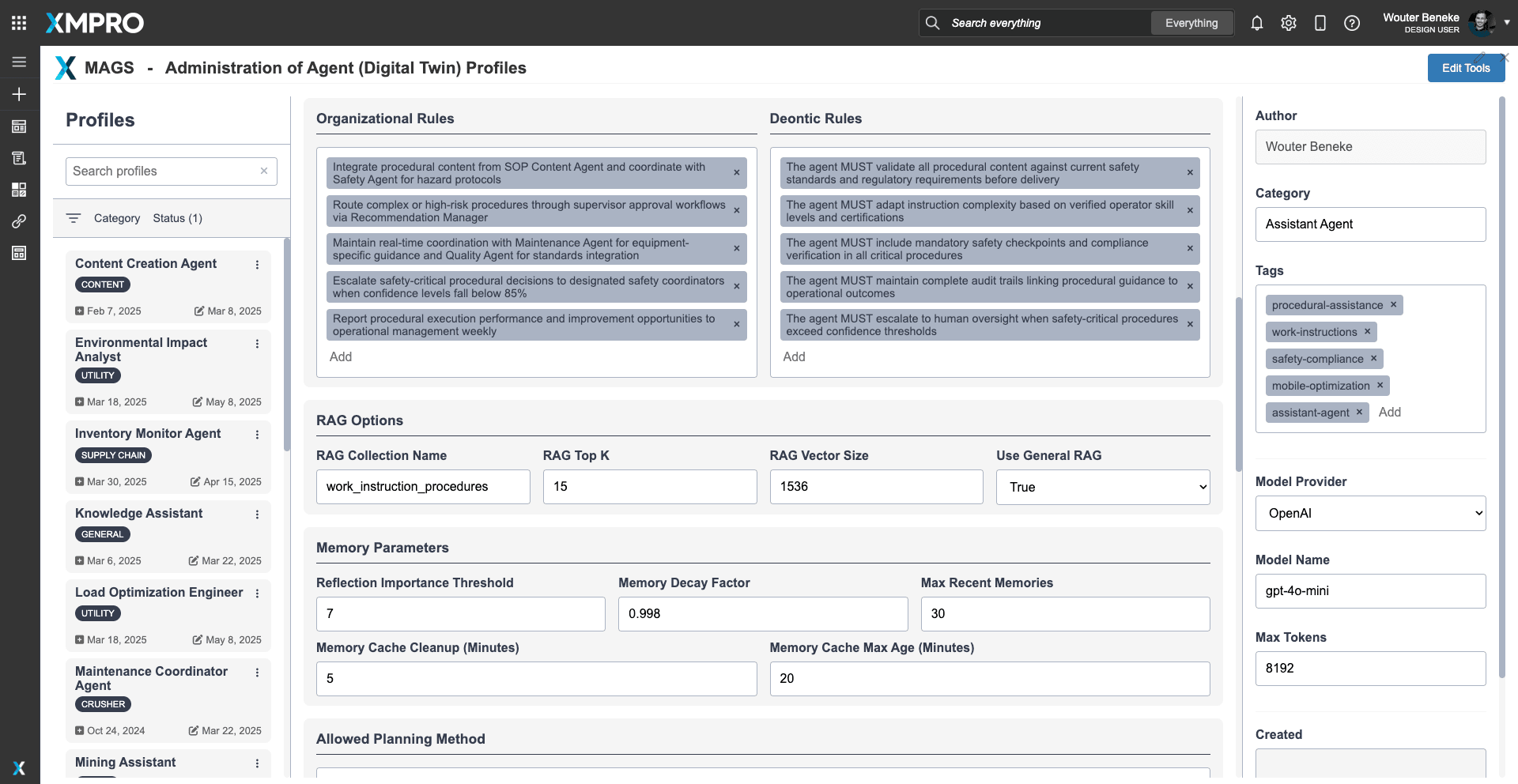
The agent synthesizes content from multiple specialized agents including SOP Content Agent for structured procedures, Safety Agent for hazard protocols, Maintenance Agent for equipment-specific guidance, and Compliance Agent for regulatory requirements, ensuring comprehensive and coordinated procedural intelligence.
Importing the Agent into XMPro APEX
Deploying the Digital Work Instruction Agent in XMPro APEX AI
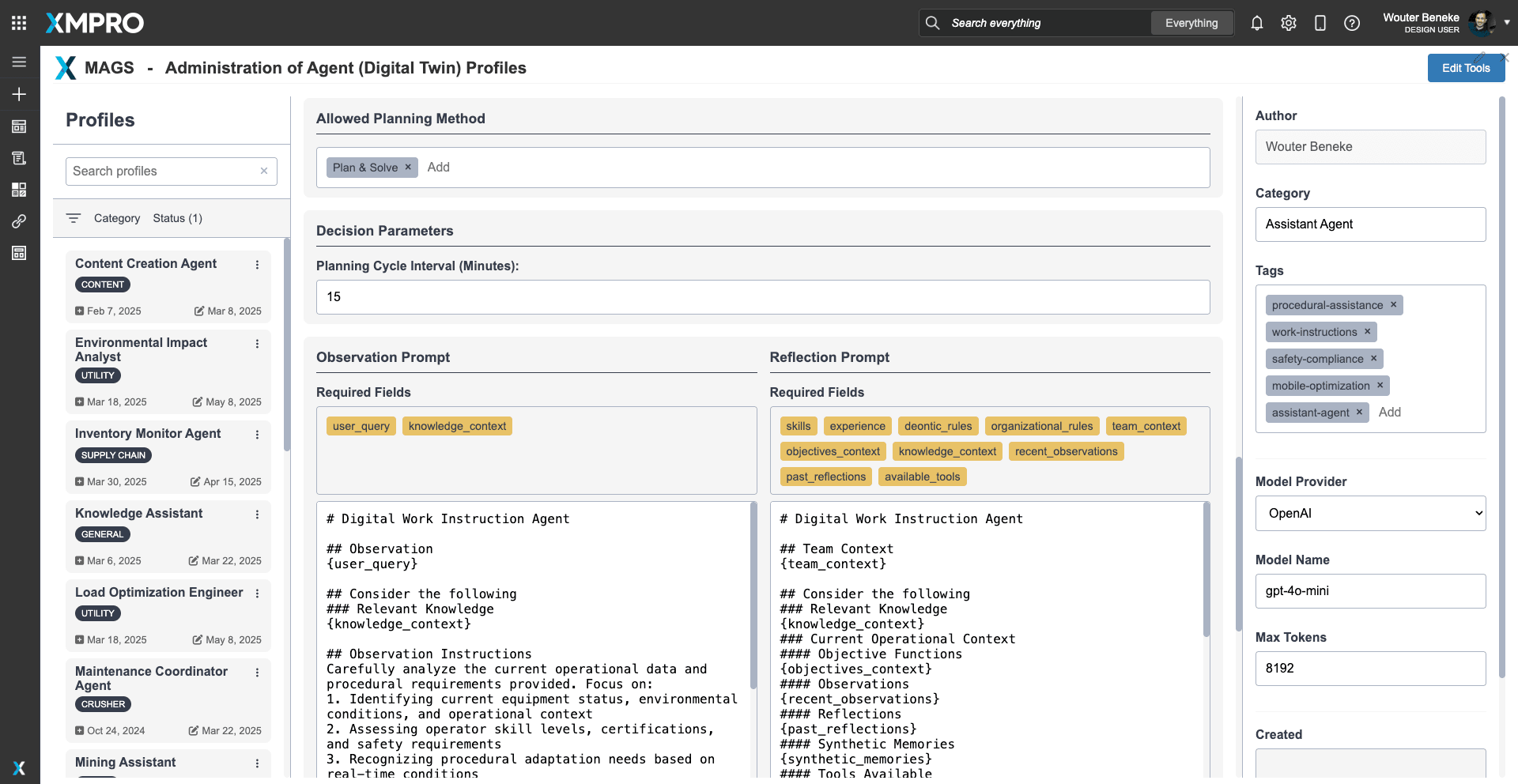
The Digital Work Instruction Agent is deployed as a configuration profile within XMPro's APEX AI orchestration layer. This profile defines the agent's content processing behavior, contextual adaptation capabilities, and delivery mechanisms for dynamic work instruction generation.
Deployment Workflow:
- Import Agent Profile: Upload the JSON configuration to APEX AI with all content processing and adaptation parameters
- Configure Data Integration: Use XMPro StreamDesigner to connect real-time operational data, equipment status, and environmental sensors
- Set Up SOP Integration: Establish connections with SOP Content Agent and structured procedure repositories
- Configure Delivery Channels: Set up mobile applications, tablet interfaces, and HMI system integration for instruction delivery
- Activate and Monitor: Enable dynamic instruction generation with real-time performance monitoring and feedback collection
Continuous Optimization:
The agent continuously learns from execution feedback, operator performance, and changing operational conditions to improve instruction quality and effectiveness. This includes refining contextual adaptation rules, optimizing content delivery, and enhancing safety protocol integration based on real-world usage patterns.
How XMPro AO Platform Modules Enable the Digital Work Instruction Agent
Data Integration & Transformation
Artificial Intelligence & Generative Agents
Intelligence & Decision Making
Visualization & Event Response


XMPro StreamDesigner
XMPRO's StreamDesigner lets you visually design the data flow and orchestration for your real-time applications. Our drag & drop connectors make it easy to bring in real-time data from a variety of sources, add contextual data from systems like EAM, apply native and third-party analytics and initiate actions based on events in your data.
How StreamDesigner Enables the Digital Work Instruction Agent
The Digital Work Instruction Agent relies on XMPro's StreamDesigner to provide the real-time operational context required for dynamic procedural guidance. This comprehensive data orchestration enables the agent to transform static procedures into context-aware, adaptive work instructions that respond to current operational conditions.
1. Real-Time Operational Context Integration
StreamDesigner connects the agent to critical operational data sources in real-time:
- Equipment fault codes and diagnostic data from SCADA and control systems
- Environmental conditions including temperature, pressure, humidity, and weather data
- Asset status information including operational state, maintenance history, and performance metrics
- Work order triggers and scheduling data from CMMS systems
- Operator authentication and location data from security and tracking systems
- Tool availability and calibration status from asset management systems
This real-time integration ensures that work instructions are always based on current operational reality rather than static assumptions.
2. Contextual Data Enrichment
StreamDesigner enriches basic operational data with contextual information essential for procedural guidance:
- Asset specifications and configuration details for equipment-specific procedures
- Historical maintenance records and lessons learned for enhanced guidance
- Regulatory compliance requirements and safety protocols for current conditions
- Operator skill levels and certification status for appropriate instruction complexity
- Emergency response protocols and safety equipment locations
- Production schedules and operational priorities for task coordination
This enrichment enables the agent to provide contextually appropriate guidance that considers both current conditions and operational requirements.
3. Procedural Truth-Grounding
StreamDesigner ensures that work instructions are grounded in verified operational data:
- Validates equipment status against actual sensor readings and system states
- Cross-references environmental conditions with multiple data sources for accuracy
- Verifies tool availability and calibration status before including in instructions
- Confirms operator qualifications and safety clearances for specific tasks
- Validates safety protocols against current hazard assessments and regulatory requirements
This truth-grounding prevents procedural errors by ensuring instructions reflect actual operational conditions rather than outdated assumptions.
4. Dynamic Content Adaptation
StreamDesigner enables real-time adaptation of work instructions based on changing conditions:
- Modifies procedure parameters based on current environmental conditions
- Adjusts safety protocols based on real-time hazard assessments
- Updates tool requirements based on availability and calibration status
- Adapts instruction complexity based on operator skill levels and experience
- Modifies task sequences based on current operational priorities and schedules
This dynamic adaptation ensures that work instructions remain relevant and effective as operational conditions change.
5. Multi-Agent Content Integration
StreamDesigner orchestrates the integration of content from multiple specialized agents:
- Retrieves structured procedure content from SOP Content Agent
- Incorporates safety protocols and hazard information from Safety Agent
- Integrates maintenance schedules and equipment guidance from Maintenance Agent
- Includes compliance requirements and regulatory updates from Compliance Agent
- Synthesizes quality standards and inspection procedures from Quality Agent
This multi-agent integration ensures comprehensive and coordinated procedural guidance that reflects all relevant operational perspectives.
6. Execution Tracking and Feedback
StreamDesigner enables real-time tracking of work instruction execution and feedback collection:
- Monitors step completion and task progress in real-time
- Captures execution timing and performance metrics
- Records operator feedback and improvement suggestions
- Tracks safety compliance and incident reporting
- Updates completion status in CMMS and other enterprise systems
This execution tracking provides the feedback loops necessary for continuous improvement of procedural guidance and operational efficiency.
XMPro AI
XMPro AI delivers industrial-grade artificial intelligence specifically designed for mission-critical operations. As an integral component of XMPro's AO Platform, it provides a unified framework for creating, deploying, and managing AI solutions that are truth-grounded, explainable, and actionable. Unlike consumer-focused AI, XMPro AI is built from the ground up for environments where safety, reliability, and precision cannot be compromised.
How XMPro AI Powers the Digital Work Instruction Agent
The Digital Work Instruction Agent leverages XMPro AI's comprehensive framework to transform static procedures into dynamic, context-aware guidance systems. By combining advanced content processing with real-time operational intelligence, the agent delivers procedural guidance that adapts to changing conditions while maintaining safety and compliance standards.
1. Composite AI Framework for Procedural Intelligence
XMPro AI enables the agent to apply multiple AI methodologies for comprehensive procedural guidance:
- Symbolic AI: Applies safety rules, regulatory requirements, and operational procedures to ensure compliance and safety
- Content Processing: Uses advanced natural language processing to segment, adapt, and assemble procedural content
- Contextual Reasoning: Determines appropriate procedural adaptations based on current operational conditions
- Pattern Recognition: Identifies optimal instruction sequences and common procedural patterns
- Adaptive Learning: Continuously improves instruction quality based on execution feedback and operational outcomes
- Multi-Modal Integration: Combines text, visual, and interactive elements for comprehensive procedural guidance
2. Content Processing Truth-Grounding
XMPro AI ensures that procedural guidance is based on verified operational reality:
- Validates procedural content against current equipment specifications and operational constraints
- Cross-references instructions with real-time asset status and environmental conditions
- Verifies safety protocols against current hazard assessments and regulatory requirements
- Maintains complete traceability from instruction content back to source procedures and operational data
- Implements confidence scoring for procedural adaptations based on data quality and operational context
3. Dynamic Content Assembly Architecture
XMPro AI provides specialized content processing capabilities for procedural intelligence:
- Contextual Segmentation: Breaks procedures into step-by-step components optimized for current conditions
- Adaptive Assembly: Combines procedural fragments with real-time context to create situational guidance
- Interactive Enhancement: Adds checkboxes, validation points, and progress tracking for execution monitoring
- Multi-Modal Delivery: Generates text, visual, and voice-enabled instructions for various interface types
- Progressive Disclosure: Presents information in optimal sequence based on task complexity and operator skill
4. Operational-Focused AI Experiences
XMPro AI delivers procedural guidance experiences tailored for frontline operations:
- Field Worker Mode: Provides step-by-step guidance optimized for mobile and tablet interfaces
- Technician Mode: Delivers detailed procedural guidance with technical specifications and troubleshooting
- Supervisor Mode: Offers oversight capabilities with execution monitoring and performance analytics
- Emergency Mode: Provides immediate access to safety protocols and emergency procedures
5. Governed Content Processing
XMPro AI implements governance controls that ensure procedural guidance meets safety and compliance standards:
- Safety Protocol Enforcement: Ensures all instructions include appropriate safety measures and compliance requirements
- Regulatory Compliance: Automatically incorporates current regulatory requirements and industry standards
- Skill-Based Adaptation: Adjusts instruction complexity based on operator qualifications and experience levels
- Audit Trail Generation: Maintains comprehensive records of instruction delivery and execution for compliance verification
6. Multi-Agent Content Coordination
XMPro AI enables the Digital Work Instruction Agent to coordinate with specialized operational agents:
- SOP Content Integration: Seamlessly incorporates structured procedures from SOP Content Agent
- Safety Protocol Synthesis: Integrates real-time safety guidance from Safety Agent
- Maintenance Coordination: Incorporates maintenance schedules and equipment guidance from Maintenance Agent
- Quality Integration: Includes quality standards and inspection procedures from Quality Agent
Recommendation Manager
XMPRO Recommendations are advanced event alerts that combine alerts, actions, and monitoring. You can create recommendations based on business rules and AI logic to recommend the best next actions to take when a certain event happens. You can also monitor the actions against the outcomes they create to continuously improve your decision-making.
How Recommendation Manager Enables Procedural Intelligence Delivery
The Recommendation Manager serves as the governance and delivery layer for dynamic work instructions generated by the Digital Work Instruction Agent. It ensures that procedural guidance is appropriately validated, routed, and tracked according to organizational safety and compliance requirements.
Procedural Content Governance
The Recommendation Manager applies sophisticated governance to work instruction delivery:
- Validates procedural content against safety standards and regulatory requirements
- Implements approval workflows for critical or high-risk procedures
- Ensures operator qualifications match procedure complexity and safety requirements
- Maintains audit trails linking procedural guidance to operational outcomes
Multi-Channel Instruction Delivery
The system provides multiple pathways for work instruction delivery:
- Direct Execution Path: Delivers routine instructions directly to mobile apps and operator interfaces
- Supervised Execution Path: Routes complex or critical procedures through supervisor approval
- Emergency Protocol Path: Provides immediate access to safety and emergency procedures
- Training Integration Path: Connects with training systems for competency verification
Operator-Specific Routing
The Recommendation Manager routes work instructions to appropriate personnel:
- Certified technicians for complex maintenance and repair procedures
- Operations personnel for routine operational tasks and monitoring
- Safety coordinators for emergency response and incident management
- Supervisors for oversight and approval of critical procedures
Execution Monitoring and Feedback
The system monitors work instruction execution and captures feedback:
- Tracks step completion and task progress in real-time
- Captures execution timing and performance metrics
- Records operator feedback and improvement suggestions
- Monitors safety compliance and incident reporting
Continuous Procedural Improvement
The Recommendation Manager captures execution outcomes to improve future instructions:
- Analyzes execution patterns to identify procedural optimization opportunities
- Tracks safety incidents and near-misses to enhance safety protocols
- Measures task completion efficiency to optimize instruction sequences
- Incorporates operator feedback to refine procedural guidance
Compliance and Safety Integration
The system ensures that all procedural guidance meets regulatory and safety requirements:
- Automatically incorporates current regulatory requirements and industry standards
- Validates safety protocols against current hazard assessments
- Maintains comprehensive audit trails for regulatory compliance
- Provides real-time safety monitoring and incident response capabilities

XMPro App Designer
The XMPro App Designer is a no code event intelligence application development platform. It enables Subject Matter Experts (SMEs) to create and deploy real-time intelligent digital twins without programming. This means that SMEs can build apps in days or weeks without further overloading IT, enabling your organization to accelerate and scale your digital transformation.
How App Designer Creates Dynamic Work Instruction Interfaces
The XMPro App Designer serves as the visualization and interaction layer that transforms the Digital Work Instruction Agent's procedural intelligence into intuitive, field-ready interfaces. It creates dynamic, context-aware applications that deliver work instructions optimized for various devices and operational environments.
1. Mobile-First Work Instruction Applications
App Designer creates optimized mobile applications specifically designed for frontline workers:
- Field Worker Apps: Mobile-optimized step-by-step guidance with large buttons, clear typography, and offline capability
- Technician Interfaces: Detailed procedural guidance with technical specifications, diagrams, and troubleshooting flows
- Supervisor Dashboards: Oversight interfaces with team progress tracking, performance analytics, and approval workflows
- Emergency Response Apps: Quick access to safety protocols, emergency procedures, and incident reporting
- Training Applications: Interactive learning interfaces with competency tracking and certification management
2. Context-Aware Interface Adaptation
App Designer creates interfaces that adapt to operational context and user requirements:
- Environment-Specific Displays: Interfaces optimized for different lighting conditions, weather, and operational environments
- Device-Responsive Design: Automatic adaptation for smartphones, tablets, HMI systems, and wearable devices
- Skill-Based Complexity: Interface complexity that adjusts based on operator experience and competency levels
- Task-Specific Layouts: Optimized interfaces for maintenance, operations, safety, and emergency response tasks
- Multi-Language Support: Localized interfaces for diverse workforces and global operations
3. Interactive Procedural Elements
App Designer enables the creation of interactive work instruction components:
- Step-by-Step Progression: Sequential workflow with progress indicators and completion tracking
- Interactive Checklists: Checkboxes, validation points, and quality gates with real-time verification
- Multimedia Integration: Embedded images, videos, diagrams, and AR overlays for enhanced guidance
- Voice-Enabled Instructions: Hands-free operation with voice commands and audio feedback
- Digital Signature Capture: Completion verification with digital signatures and approval workflows
4. Real-Time Operational Integration
App Designer creates applications that integrate with real-time operational systems:
- Asset Status Integration: Real-time equipment data display with current operational conditions
- Environmental Monitoring: Live environmental data integration with safety thresholds and warnings
- Work Order Integration: Seamless connection with CMMS systems for task assignment and completion
- Safety System Integration: Real-time safety alerts and hazard warnings integrated into work instructions
- Performance Tracking: Live metrics and KPIs related to task execution and operational efficiency
5. Collaborative Work Instruction Features
App Designer enables collaborative capabilities for team-based work execution:
- Team Coordination: Multi-user interfaces for coordinated task execution and communication
- Expert Consultation: Remote expert access with video calling and screen sharing capabilities
- Peer Review: Collaborative validation and quality checking with team member involvement
- Knowledge Sharing: Integrated feedback and improvement suggestion capabilities
- Shift Handover: Seamless transition of work instructions between shifts and teams
6. Safety and Compliance Integration
App Designer creates applications that prioritize safety and regulatory compliance:
- Safety Protocol Enforcement: Mandatory safety checkpoints and compliance verification
- Permit and Lockout Management: Integrated permit systems and lockout-tagout procedures
- Incident Reporting: Immediate incident and near-miss reporting with photo and video capture
- Regulatory Compliance: Automatic incorporation of regulatory requirements and audit trails
- Emergency Response: Quick access to emergency procedures and automated alert systems
Why XMPro AO Platform For Dynamic Work Instructions?
XMPro's AO Platform provides the comprehensive platform required to transform static procedures into dynamic, context-aware work instructions. Here's how XMPro AO Platform excels in delivering procedural intelligence for frontline operations:
Real-Time Procedural Intelligence
XMPro AO Platform provides unparalleled integration of real-time operational data with procedural content to create dynamic work instructions that adapt to current conditions. The Digital Work Instruction Agent continuously processes equipment status, environmental conditions, and operational context to deliver guidance that reflects actual operational reality rather than static assumptions.
Context-Aware Content Assembly
The platform's advanced content processing capabilities enable dynamic assembly of procedural guidance based on current operational conditions. Instructions are automatically adapted for equipment status, environmental factors, operator skill levels, and safety requirements, ensuring that workers receive relevant, actionable guidance for their specific situation.
Multi-Agent Procedural Coordination
XMPro AO Platform leverages multiple specialized agents to provide comprehensive procedural intelligence. The Digital Work Instruction Agent coordinates with SOP Content Agent for structured procedures, Safety Agent for hazard protocols, Maintenance Agent for equipment-specific guidance, and Compliance Agent for regulatory requirements, ensuring holistic procedural guidance.
Mobile-Optimized Delivery
The platform includes sophisticated mobile and tablet interfaces specifically designed for frontline workers in industrial environments. Work instructions are delivered through intuitive, field-ready applications that work offline, adapt to different lighting conditions, and provide hands-free operation capabilities for maximum operational efficiency.
Safety-First Procedural Design
XMPro AO Platform prioritizes safety through dynamic safety protocol integration, real-time hazard assessment, and mandatory safety checkpoints. The system ensures that all work instructions include appropriate safety measures and automatically adapts safety protocols based on current conditions and risk assessments.
Execution Intelligence and Feedback
The platform provides comprehensive execution tracking and performance analytics that enable continuous improvement of procedural guidance. Real-time monitoring of task completion, error rates, and operator feedback creates learning loops that continuously refine instruction quality and operational efficiency.
Regulatory Compliance Integration
XMPro AO Platform automatically incorporates regulatory requirements and industry standards into work instructions, ensuring compliance without manual intervention. The system maintains comprehensive audit trails and provides real-time compliance monitoring for regulatory verification and continuous improvement.
Enterprise System Integration
The platform integrates seamlessly with existing enterprise systems including CMMS, ERP, training management, and safety systems. This ensures that work instructions become part of the broader operational workflow rather than isolated procedural documents, enabling comprehensive operational coordination.
Scalable Procedural Architecture
XMPro AO Platform provides a scalable architecture that can support dynamic work instructions across multiple operational domains, geographic locations, and organizational levels. The system adapts to operational complexity while maintaining consistent procedural quality and delivery across the entire organization.
Human-Centered Procedural Design
The platform maintains focus on human factors through intuitive interfaces, appropriate complexity levels, and clear procedural guidance. Every work instruction is designed to reduce cognitive load while maintaining operational effectiveness, ensuring that technology enhances rather than complicates frontline work execution.
Not Sure How To Get Started?
No matter where you are on your digital transformation journey, the expert team at XMPro can help guide you every step of the way - We have helped clients successfully implement and deploy projects with Over 10x ROI in only a matter of weeks!
Request a free online consultation for your business problem.
"*" indicates required fields