




























Pieter Van Schalkwyk
CEO at XMPRO
Boston Consulting Group's AI Platforms Group recently published a briefing on building effective enterprise agents that deserves serious attention. After two years of experimentation across 300+ agent deployments, they arrive at a conclusion that validates what we've been saying at XMPro: "The limiting factors for agents aren't LLMs, but legacy systems and processes."
Everyone's debating model capabilities, context windows, and reasoning benchmarks. BCG's research across 300+ agent deployments suggests none of that matters if your agents can't access your data or act on your systems. Their opening statement captures the problem: most published guidance on AI agents is 'theoretical, provides guidance that works only at small scale, is hyperbolic, or conveniently ignores the complexities of the world's businesses: old technology stacks, messy data, international footprints and complex governance.'
The Five Blockers That Actually Matter
BCG identifies five critical obstacles preventing agents from delivering real enterprise value:
- Unreliable enterprise data: Siloed, low-trust, and slow-moving data makes agent decisions brittle; success at scale demands clean, real-time, well-governed data
- Governance and audit overhead: Enterprises demand explainability, guardrails, and policy compliance from day one to avoid regulatory and reputational risk, increasing upfront complexity
- Operating model and scale frictions: Moving from PoC to durable operations requires proper ownership, incident management, cost/latency control, versioning, and change tracking in complex environments
- Brownfield integrations: Stitching agents into legacy stacks, heterogeneous APIs, and fine-grained RBAC creates security, approval, and change-control risks
- Lack of evaluations: Complex reasoning agent paths hide failure modes; tracing tool calls, red teaming, and evaluating on comprehensive data is non-trivial
These challenges hit hardest in industrial and operational environments. Decades of investment in these sectors have created a maze of interconnected systems: ERP systems (SAP, Oracle, Microsoft Dynamics), SCADA networks and industrial control systems, manufacturing execution systems (MES), IoT infrastructure, and proprietary protocols with fine-grained access controls.
BCG's research reveals that 75% of technology leaders fear "silent failure," spending heavily on AI without measurable impact. This fear exists precisely because their agents can't reliably access operational data or safely act within existing systems.
The Real Problem
Most organizations approach agentic AI as a technology problem requiring technology solutions. Build smarter agents, train better models, create more sophisticated prompts. BCG's findings suggest this frame is backwards.
This is an integration problem masquerading as an AI problem.
BCG's "agent suitability framework" reinforces the point. They recommend building "deep agents" that work with legacy systems, not replacing those systems first. Their horizon model shows that while fully autonomous "agent mesh" architectures remain early R&D, practical "deep agents" coordinating specialist sub-agents are ready for enterprise deployment today.
When agents can't integrate with legacy systems, organizations face three difficult choices:
- Modernize everything first: Expensive system overhauls that may take years
- Build custom integration layers: Creating technical debt that becomes unmaintainable
- Abandon agent initiatives: Missing competitive advantages as others move faster
Each path carries significant risk, cost, and opportunity cost. But there's a fourth option that BCG's framework points toward without explicitly naming.
Leverage, Don't Replace
At XMPro, we built MAGS (Multi-Agent Generative Systems) around a different premise. Legacy system integration isn't a problem to solve. It's existing infrastructure to leverage.
Rather than requiring agents to directly connect to industrial systems (with all the protocol complexity, security concerns, and change management that entails), MAGS agents access operational data through XMPro DataStreams. This is the same proven integration layer already connecting 200+ enterprise and industrial systems in production environments.
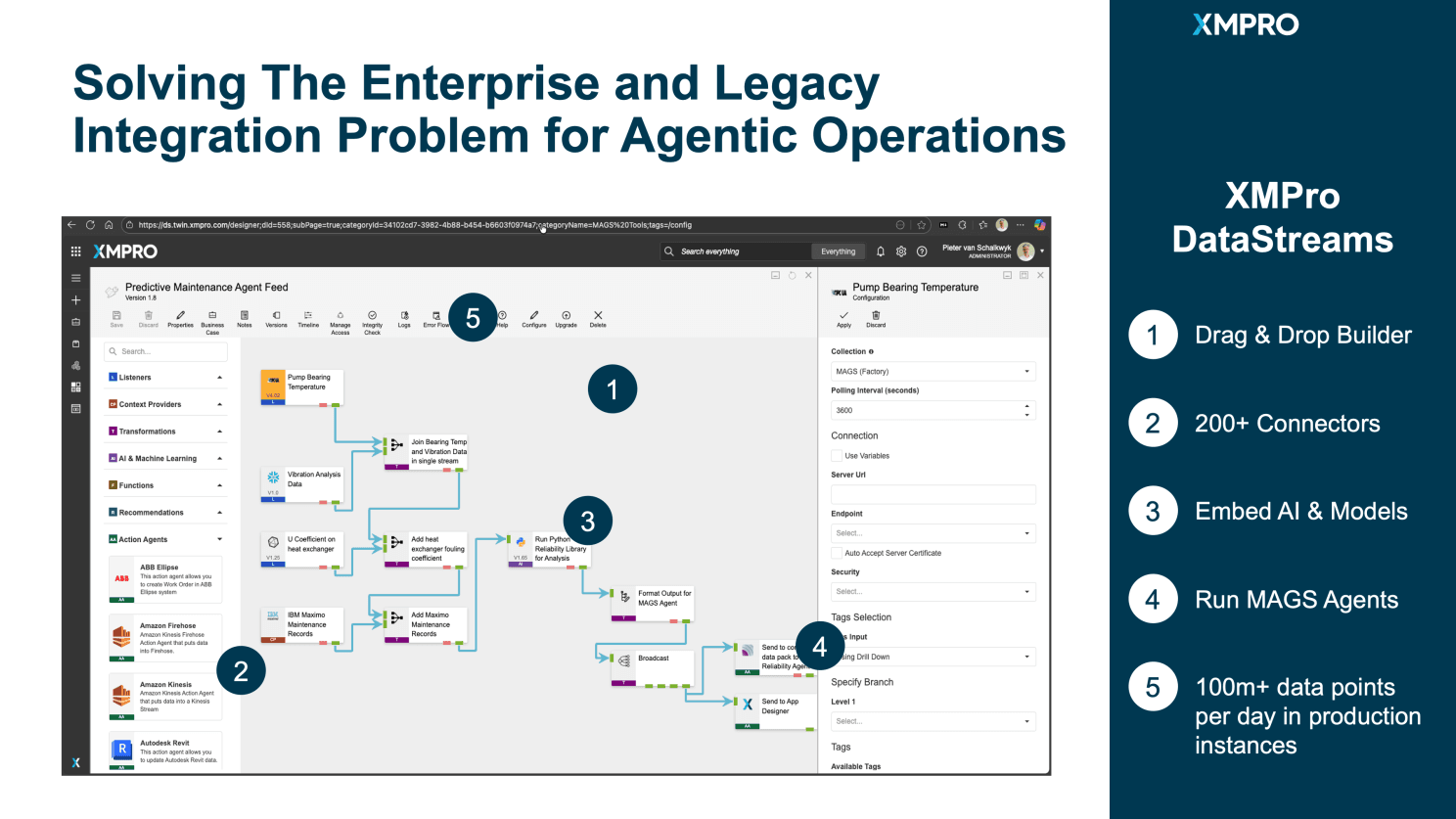
XMPro DataStreams enables two operational modes:
- "Receive" mode: Agents subscribe to real-time data streams from manufacturing processes, equipment sensors, or business systems within configurable time windows
- "Send" mode: Agents query systems and trigger actions using LLM-formatted requests that automatically conform to expected data structures
If an XMPro DataStream already connects to a system, MAGS agents can immediately interact with it. No custom integration work. No protocol translation. No new security vulnerabilities to manage.
Addressing BCG's Framework Systematically
The XMPro MAGS architecture directly addresses each of BCG's five blockers:

1. Unreliable Data Agents access real-time streams with built-in validation. No more stale, siloed information. Structured data handling with expected JSON schemas ensures agents work with reliable information. This aligns with BCG's emphasis that "success at scale demands clean, real-time, well-governed data."
2. Governance and Audit Every interaction flows through XMPro's existing security and access controls. The infrastructure inherits proven audit trails and compliance mechanisms. Full conversation tracking with unique identifiers provides traceability. BCG specifically notes enterprises need "explainability, guardrails, and policy compliance from day one."
3. Operational Friction Comprehensive telemetry and progress tracking make agent behavior observable and debuggable. Built-in metrics capture response times, success rates, and resource usage. BCG emphasizes moving "from PoC to durable ops requires proper ownership, incident management, cost/latency control, versioning, and change tracking."
4. Brownfield Integration Agents connect through existing DataStream infrastructure. No changes required to legacy systems. The platform leverages 200+ pre-built connectors to industrial and enterprise systems. BCG recommends treating "agents as 'just another' system actor" and using "MCP to connect agents through existing integration backbones."
5. Evaluation Challenges Conversation-based interactions provide full traceability. Teams can understand exactly what agents did and why. Cancellation support enables user intervention when needed. BCG stresses that "tracing tool calls, red teaming and evaluating on comprehensive data is non-trivial."
What This Looks Like in Practice
Consider a practical example. A MAGS agent monitoring equipment health doesn't need custom connectors to SCADA systems, OSISoft PI historians, maintenance management systems, or IoT sensor networks.
Instead, it subscribes to existing DataStreams already aggregating that data. It processes incoming information using LLM intelligence to identify patterns. It triggers maintenance workflows through the same integration layer. All while maintaining existing security boundaries, access controls, and audit requirements.
The agent gains sophisticated reasoning capabilities without requiring organizations to rearchitect their operational technology infrastructure.
What This Means
BCG's approach recommends building on shared enterprise foundations and standardizing around common components: "agent runtimes, model gateways, guardrails, observability, and FinOps to improve reusability, reliability, and time-to-scale across teams."
By building on proven infrastructure rather than creating parallel integration paths, XMPro MAGS architecture:
- Reduces deployment risk: Uses existing, validated integration patterns
- Accelerates time-to-value: No need to build custom connectors
- Maintains governance: Inherits XMPro's security and access controls
- Enables real-time operation: Streaming data rather than batch processing
- Provides observability: Built-in tracing, logging, and metrics
The Broader Point
BCG's research challenges a common assumption in enterprise AI: that agent success requires modernizing legacy systems first. Our experience suggests the opposite. The fastest path to production-grade agents leverages existing integration infrastructure, allowing organizations to capture AI value while legacy systems continue operating unchanged.
This matters because the timeline pressure is real. As BCG concludes: "While 2025 brought a wave of experimentation with agents but limited enterprise value, 2026 will be the year they are put to work to deliver real value."
The organizations that succeed will be those that solve the integration challenge, not those with the most advanced LLMs.
The question for senior leaders isn't "how do we build smarter agents?" It's "how do we connect agents to the operational reality they need to understand and act upon?"
BCG says 2026 is when agents move from experimentation to real work. The integration problem isn't going away. It's becoming the differentiator.
Pieter van Schalkwyk is the CEO of XMPro, specializing in industrial AI agent orchestration and governance. Drawing on 30+ years of experience in industrial automation, he helps organizations implement practical AI solutions that deliver measurable business outcomes while ensuring responsible AI deployment at scale.
About XMPro: We help industrial companies automate complex operational decisions. Our cognitive agents learn from your experts and keep improving, ensuring consistent operations even as your workforce changes.
Our GitHub Repo has more technical information. You can also contact me or Gavin Green for more information.
Read more on MAGS at The Digital Engineer