


























Wouter Beneke
Marketing Lead at XMPRO
This article builds on The Dashboard Graveyard, exploring how Decision Support forms the essential foundation for intelligent operations.
Decision Support is the prerequisite for safe, scalable AI...
Without it, autonomous agent teams remain out of reach.
With it, organizations can shift from alert overload to orchestrated action.
🔍 What You’ll Discover in This Article
- Why industrial operators face 1,000+ alarms daily—and how this flood of noise hides critical failures in plain sight
- The psychological reality of alert fatigue, and why better dashboards aren’t the answer
- How traditional "solutions" actually multiply complexity and cost
- A strategic breakdown of the five pitfalls destroying decision intelligence value in industrial environments
- Why Decision Support is the essential foundation for safe, scalable AI and automation — not just another monitoring tool
- How XMPro closes the loop from detection to orchestration, reducing false alarms by 95% and delivering 10X ROI
- Case studies across asset intensive and mission-critical industries that show real, measurable impact in less than 30 days
Whether you're leading industrial operations, driving digital transformation, or deploying AI at scale, this article offers a grounded, actionable roadmap to move beyond dashboard overload, and build intelligence that orchestrates outcomes, not just visualizes problems.
The Familiar Problem - Dashboard Overload
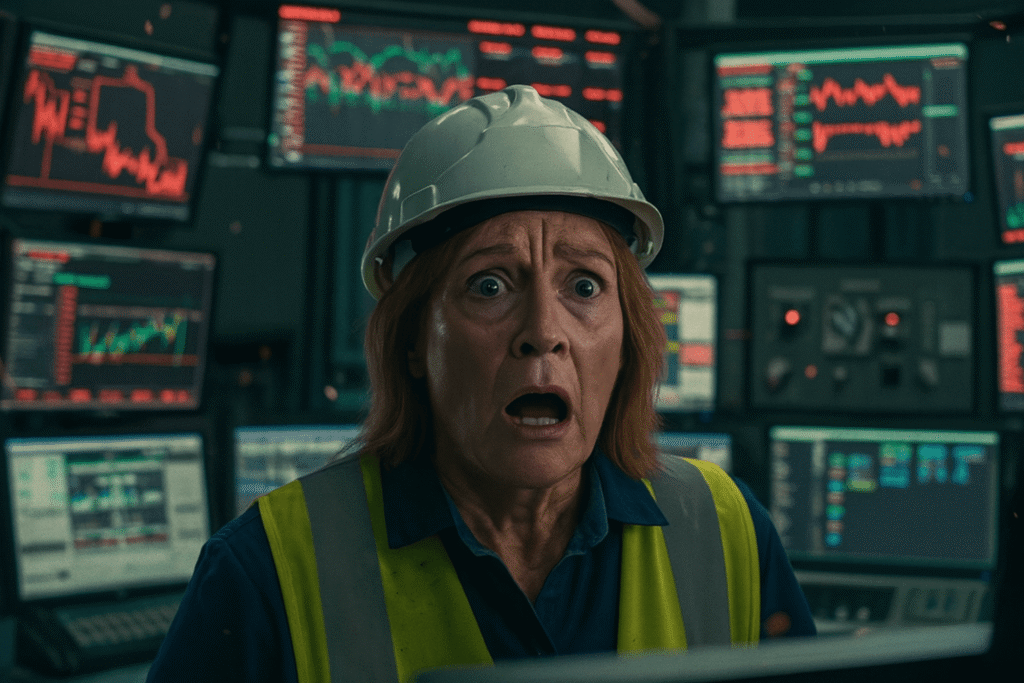
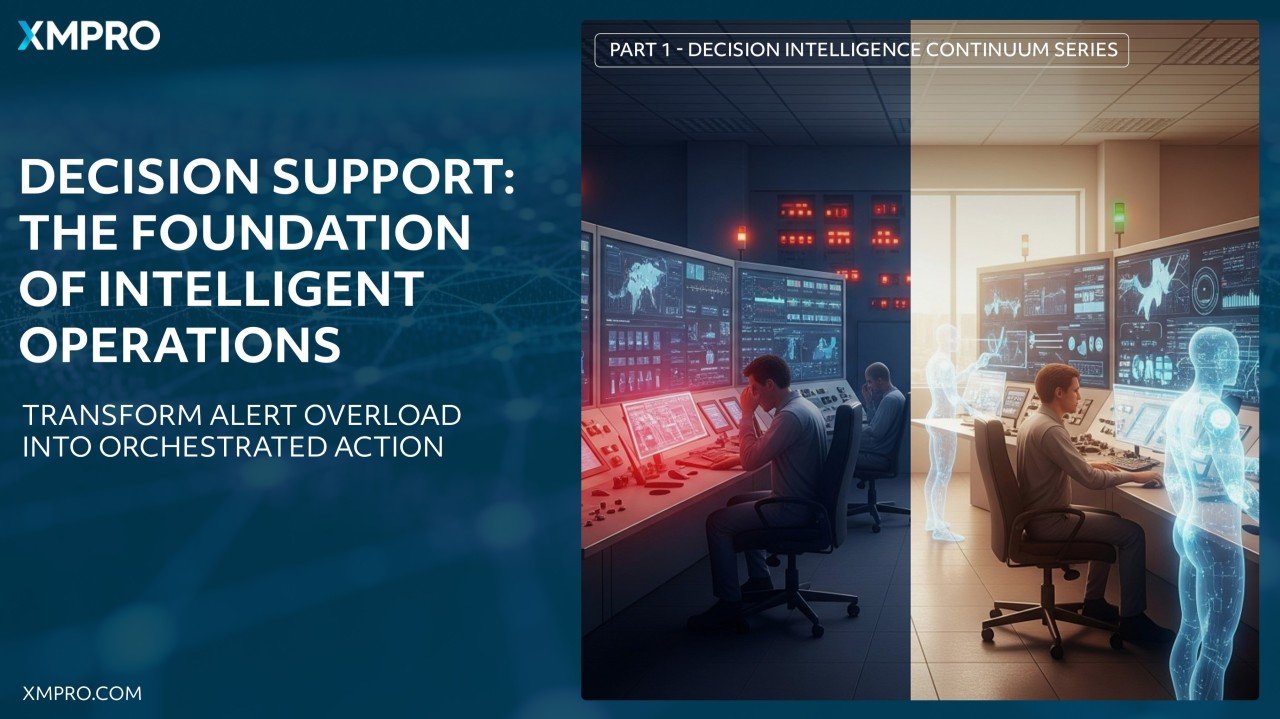
Picture this: It's 3 AM in a control room. An operator sits before a wall of screens... SCADA alarms flashing red, historian trends scrolling endlessly, IoT dashboards pinging with notifications. In the next 10 minutes, they will receive a flood of new alerts. Which ones matter? Which can wait? Which might signal the early warning of a catastrophic failure?
This scene plays out daily across industrial operations worldwide. What was once a fear of not having enough data has swung to the opposite extreme, a paralyzing deluge of information that drowns out critical signals in an ocean of noise.
The Abnormal Situation Management (ASM) Consortium calculated that better handling of abnormal events could save the U.S. petrochemical industry $10 billion annually. Globally, alarm fatigue and slow response create an estimated $20+ billion annual drag on industrial productivity.
The statistics reveal the scope of the crisis:
- Modern operators face over 1,000 daily alarms, compared to 60-100 historically
- 68-99% of industrial alarms don't actually require intervention
- 65% of security incidents go undetected despite sophisticated monitoring tools
- Responding to a single threat requires juggling 19 different tools on average
But focusing on dollars and data points misses the human cost:
The Psychology of Alert Fatigue
Alert fatigue isn't just an operational annoyance, it's a fundamental human limitation. Research shows it's the result of normalization, desensitization, or habituation: the more you're exposed to something, the more you tolerate, normalize, and ignore it. This isn't a training problem that can be solved with better procedures; it's hardwired into human psychology.
Under high alarm load, an operator's likelihood of responding correctly plummets below 50%, versus ~99% reliability under minimal load. The consequences can be devastating.
The Cascading Impact
- Operational blindness: When operators routinely dismiss alarms, real issues hide in plain sight. A pump vibration spike that could be addressed in 10 minutes goes unnoticed until it becomes a 4-hour shutdown costing millions.
- Safety deterioration: Major industrial disasters like Texas City (2005) and Buncefield (2005) were linked to overwhelmed operators missing critical signals amid the noise.
- Talent exodus: One refiner reported 40% annual turnover in control room staff, experienced operators leaving due to stress, taking decades of expertise with them. This exacerbates the skills gap as senior engineers retire faster than they can be replaced.
- Competitive disadvantage: While you're drowning in false alarms, competitors using intelligent systems are preventing failures before they happen, optimizing operations in real-time, and capturing market share.
The Five Critical Pitfalls Destroying Decision Intelligence Value
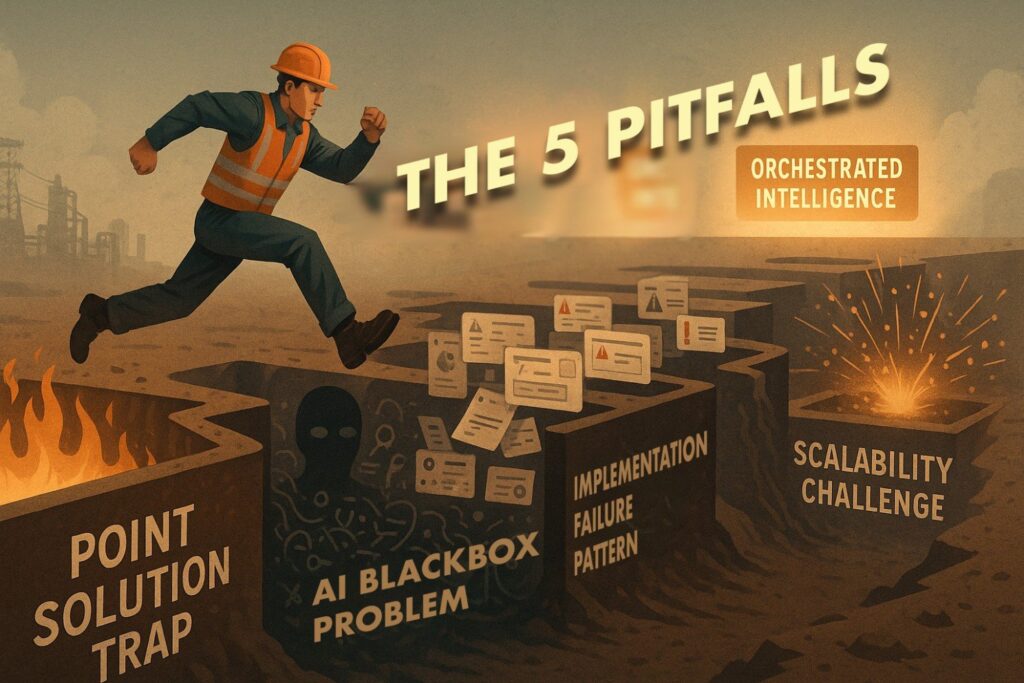
As organizations scramble to solve these problems, most fall into predictable traps that make things worse, not better:
1. The Point Solution Trap: Death by a Thousand Cuts
Organizations deploy separate tools for predictive maintenance, quality control, energy management, and safety monitoring, each generating 50-200 alerts daily. The result: integration hell, data silos, alert multiplication, and vendor management nightmares.
2. The AI Black Box Problem
As organizations look beyond dashboards and explore AI-driven decision-making, a new challenge emerges: opacity. In industrial settings where AI decisions can trigger physical actions affecting millions in assets and human safety, black-box models are unacceptable.
If we are to safely introduce autonomous AI agents in these environments, they must demonstrate the ability to learn from experience, make transparent decisions within clearly defined boundaries, and adapt responsibly based on changing conditions.
3. The Implementation Failure Pattern
67% of AI projects fail due to unclear objectives, poor data quality, integration complexity, skills gaps, and over-reliance on AI in unpredictable environments.
4. The Cognitive Overload Paradox
Systems meant to help operators often make things worse. Adding intelligence without reducing complexity just creates new failure modes.
5. The Scalability Challenge
As operations grow, complexity explodes exponentially. Perfect coordination remains elusive as the number of possible interactions pushes the boundaries of current technologies.
The Surprising Competitor: Inaction Disguised as Simplicity
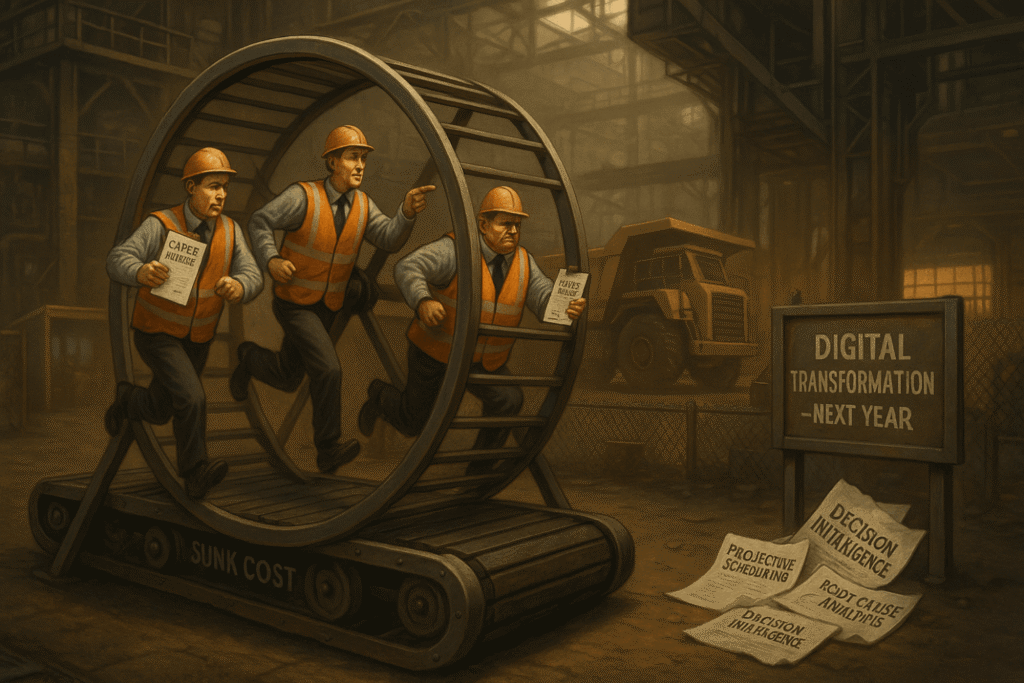
When intelligent decision support is proposed, it’s rarely rejected outright. It’s quietly sidelined, outcompeted by the familiar, the tangible, and the path of least resistance.
The CapEx Comfort Zone
Buying another haul truck or duplicate centrifuge feels easier than diagnosing root causes or optimizing operations. It's faster to approve, easier to explain, and fits existing procurement habits. But these decisions often ignore deeper inefficiencies:
- One mining firm added three trucks before realizing fleet utilization was just 65%.
- A brewery installed extra centrifuges at four sites... only to find smarter scheduling could’ve boosted throughput by 40%.
- Redundant assets can trap millions in sunk costs while productivity gaps persist.
The Firefighting Culture
In many plants, “we’ll fix it when it breaks” has become culture. Heroic repairs get praise. Firefighting earns respect. But the costs are real:
- Unplanned downtime costs 3–5x more than planned
- Morale erodes under constant crisis
- Safety risks surge during emergencies
- Tribal knowledge vanishes as burned-out experts walk away
The Cost of Doing Nothing
Sometimes, the biggest risk is delay. Faced with data overload and unclear ROI, many organizations simply pause:
- Year 1: A few inefficiencies
- Year 2: Key talent leaves
- Year 3: Competitors deploy predictive systems
- Year 4: A major incident no one "saw coming"
- Year 5: A rushed, expensive transformation - under pressure and behind the curve
The hardest competitor to beat isn’t another tool. It’s the default behavior of “wait, buy, or patch.” And it’s costing millions.
The Exponential Scaling Problem
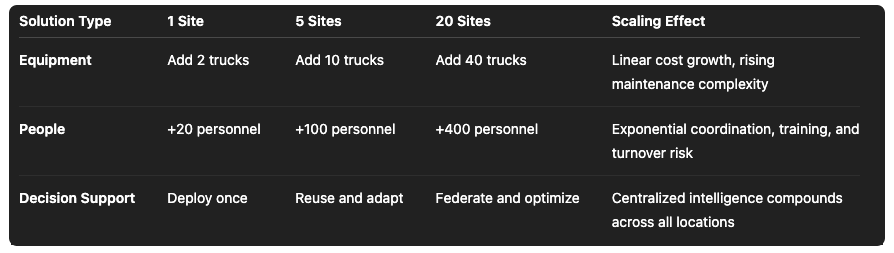
Here's where the true cost differential becomes staggering. Physical and human solutions scale linearly, or worse:
Why We Keep Choosing Pitfall “Solutions”
These non-technical responses endure because they offer psychological comfort:
- Familiarity: Buying equipment follows established procurement processes
- Visibility: Physical assets feel more real than software
- Attribution: It's easier to blame equipment failure than decision failure
- Politics: CapEx budgets are often easier to access than OpEx for innovation
But every one of these choices is actually a decision to accept:
- Higher long-term costs
- Increased operational risk
- Competitive disadvantage
- Workforce burnout
“But We Already Have Dashboards”: Why That’s Not Enough...
Even when organizations do invest in technology, they often fall into the dashboard trap. As Google's former Chief Decision Scientist Cassie Kozyrkov observed, "Dashboards are great for informing you what you already know and how you got here, but they are not designed to help you discover where to go next."
This cuts to the heart of the problem: we've optimized for visibility, not decision velocity.
Enter Decision Support: The Foundation of True Decision Intelligence
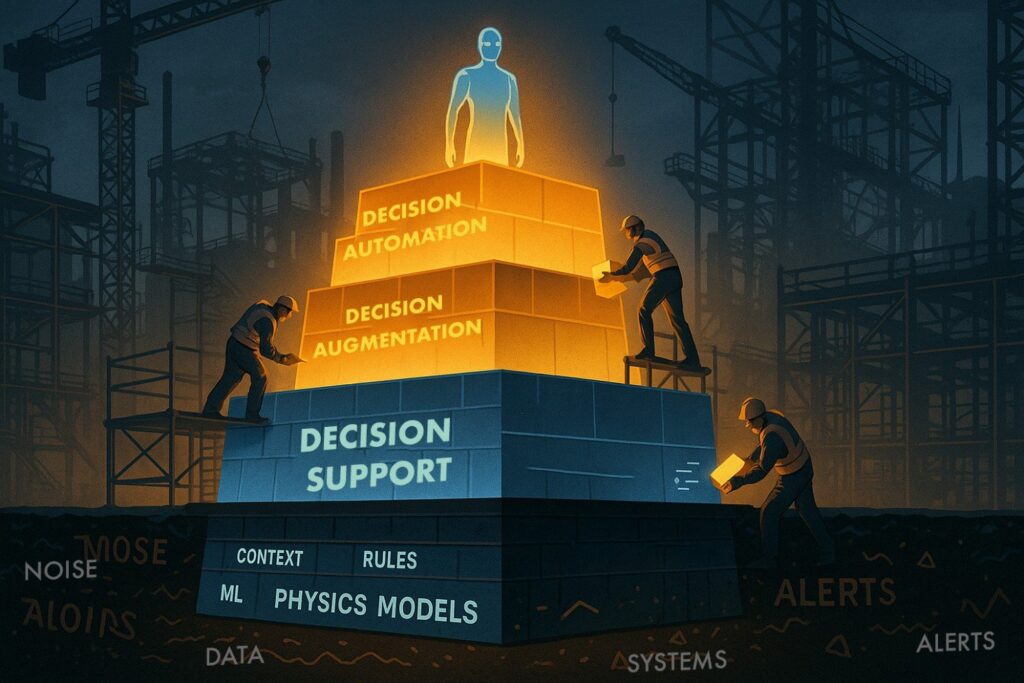
Decision Support represents a fundamental paradigm shift. It's the critical first stage of the Decision Intelligence journey... the foundation upon which all higher levels of intelligence are built. Without this layer, AI Advisors and autonomous agentic AI agents cannot operate safely or effectively on noisy, unstructured, or siloed data.
But what exactly is Decision Support?
At its core, Decision Support systematically transforms operational data into clean, contextualized, triaged, and explainable intelligence. It provides structured intelligence that enables both human operators and automated systems to make timely, accurate, and trusted decisions. In short, it filters noise and drives focused action.
The Core Principles of Effective Decision Support
1. Intelligent Triage, Not Information Overload
Operators don’t need more dashboards, they need clarity. Decision Support continuously evaluates incoming data and surfaces the 5–10 most urgent, high-impact actions so nothing critical gets lost in the noise.
2. Context Is Everything
A sensor reading alone can be misleading. Decision Support systems combine signals with operational context such as operating mode, load, maintenance history, related process stages, and current production targets. This ensures that the same reading is interpreted correctly based on the real-world situation.
3. Composite Intelligence
No single method is enough. Decision Support blends expert rules, physics models, machine learning, and historical insights, each adding a layer of confidence to complex operational decisions.
4. Trust Through Transparency
Every recommendation must be explainable. Operators need to see the logic behind guidance... what triggered it, what data supports it, and what the system expects to happen, so they can act confidently and safely.
5. Human-Centric Design
Clarity beats complexity. Recommendations should use plain language, include confidence levels, and provide links to supporting evidence. They must be designed for the people making decisions under pressure, not just analysts behind a desk.
Building Decision Support With XMPro: From Concept to Reality
Phase 1: Intelligent Data Integration
XMPro’s Data Stream Designer enables organizations to rapidly compose real-time data flows that integrate and orchestrate information across OT, IT, and engineering systems. Instead of manually coding integrations or relying on siloed analytics tools, users can connect over 200 systems through a no-code interface and run logic either at the edge or in the cloud. This allows streaming data to be filtered, enriched, and interpreted in motion by embedding business logic, machine learning models, and conditional rules directly into the flow. The result is not just integration. It is operational orchestration that prepares data for high-confidence decision support.
Phase 2: Contextual Signal Processing
Once data is flowing, XMPro applies layered intelligence to identify, filter, and prioritize what matters. This includes composite logic using expert rules, historical behavior, physics thresholds, and AI models to distinguish real issues from noise. Dynamic filtering suppresses alerts during known non-critical conditions such as scheduled maintenance or mode transitions. This reduces unnecessary operator load. Context such as time of day, asset status, or recent activity is used to accurately triage events. Each event is scored and ranked by operational impact to ensure that the highest-risk, highest-value insights rise to the surface for action.
Phase 3: Prescriptive Action
XMPro’s Recommendation Manager transforms raw events into clear, actionable guidance. Instead of flooding teams with alerts, it delivers a small set of prioritized recommendations. Each action includes next steps, confidence scores, impact assessments, and supporting evidence such as diagrams or procedures. Operators know what to do, why it matters, and what happens if it's ignored.
Phase 4: Closed-Loop Execution
Most systems stop at alerting, but true Decision Support ensures that insights lead to coordinated action and continuous improvement. XMPro closes the loop by automating responses such as creating work orders with failure details, adjusting setpoints within safe limits, triggering procurement for needed parts, and notifying the right personnel. It also learns from outcomes by tracking which actions were taken, comparing predicted and actual results, refining models based on technician feedback, and capturing knowledge for future use.
Why This Architecture Matters
Traditional monitoring provides visibility. Decision Support transforms that visibility into orchestrated action... a shift that’s not incremental, but transformational.
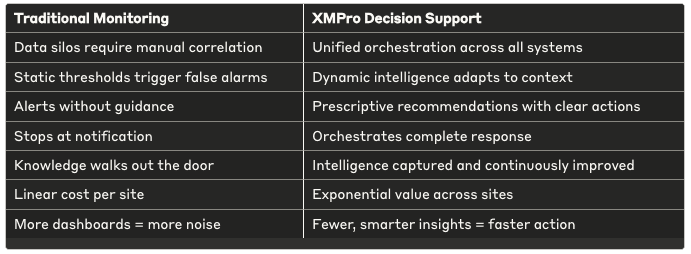
Real-World Results: Proof in Production
Underground Mining: $10 million saved annually through 30% reduction in unplanned downtime
Challenge: The world's largest potash producer operated 50 miles of underground conveyors generating thousands of signals daily. Engineers were drowning in nuisance alerts while missing critical failure warnings.
Solution: XMPro's Decision Support layer intelligently filtered and correlated conveyor data, applying predictive analytics and expert rules to generate targeted recommendations.
Results:
- 30% reduction in unplanned downtime without adding conveyors
- 9,000 tons of additional production monthly
- 95% reduction in false alarms
- $10 million annual savings
- 30-day initial deployment
Oil & Gas: $16 million saved annually through 18% reduction in unnecessary field trips
Challenge: A global supermajor struggled with maintenance prioritization across hundreds of remote wells, with field teams overwhelmed by disparate alarms and reports.
Solution: XMPro created a unified decision support system ingesting real-time sensor data, maintenance history, and operational constraints to generate prioritized work orders.
Results:
- $16 million annual savings
- 18% reduction in unnecessary field trips
- 95% reduction in planning time
- Avoided hiring: Existing team became 4x more effective
- Scalable across thousands of assets
From Support to Autonomy: The Continuum of Intelligent Decisions
With a solid Decision Support foundation in place, organizations can confidently advance through the Decision Intelligence Continuum. Clean, contextualized data and explainable recommendations provide the groundwork for AI augmentation, where intelligent advisors assist human decision-makers with trusted insights. As patterns are validated and confidence grows, these same decision flows become candidates for safe, governed automation. What begins as support evolves into augmentation, and ultimately, into autonomous action, with each stage building on a trusted, traceable foundation.
We’ll explore these next stages in depth in upcoming articles, including deep dives into AI Advisors, autonomous agents, and how organizations can scale their decision intelligence maturity. Stay tuned for links to the full series.
Conclusion: From Data Chaos to Decision Clarity
The shift from dashboards to decision intelligence isn't optional, it's essential. The real choice isn't which software to buy, but whether to keep scaling cost and complexity, or build intelligence that compounds value.
Decision Support isn’t just another tool. It’s the foundation that makes AI trustworthy, automation safe, and digital transformation real. Without it, every system struggles. With it, every site makes the next one smarter.
The choice is simple: keep firefighting… or start orchestrating.If you’re planning to scale AI, don’t do it without a decision support foundation. The cost of skipping this step is exponential.
Learn more about implementing XMPro's Decision Support at xmpro.com or see real-world implementations at our Demo Hub.
Getting Started: From Concept to Value in 30 Days
For organizations ready to act, implementation doesn’t require months of disruption or a full digital overhaul. With the right decision support foundation in place, most teams begin seeing measurable results in as little as 30 days.
References and Citations
- Abnormal Situation Management Consortium Study: "Better handling of abnormal events could save the U.S. petrochemical industry $10 billion per year." ASM Consortium Study, 1995. Referenced in multiple industry publications including Control Global (2009).
- Industrial Alarm Statistics: "68-99% of alarms in industrial settings do not require intervention." Dashboard Graveyard to Decision Intelligence Research Insights, XMPro Internal Research Document, 2025.
- Modern Operator Overload: "Modern operators face over 1,000 daily alarms per operator (compared to 60-100 historically) while monitoring up to 7 screens simultaneously." Getting Past Dashboard Information Overload, XMPro, April 24, 2025. Available at: https://dev.xmpro.com/getting-past-dashboard-information-overload-reducing-cognitive-strain-with-augmented-decision-intelligence/
- Security Incident Detection: "65% of security incidents go undetected despite sophisticated monitoring tools." Industry security monitoring effectiveness studies, 2024.
- Tool Complexity: "19 different tools on average are required to respond to a single threat incident." What Is Alert Fatigue?, IBM Think, June 2025. Available at: https://www.ibm.com/think/topics/alert-fatigue
- Milford Haven Refinery Incident: "275 alarms flooded the control room in the 11 minutes before the explosion." Milford Haven refinery explosion, 1994. UK Health and Safety Executive Report. Available at: https://www.exida.com/images/uploads/exida_Whitepaper_Use_Alarm_Management_to_Make_Your_Plant_Safer.pdf
- Alert Fatigue Psychology: "Alert fatigue is the result of normalization, desensitization, or habituation—the more you're exposed to something, the more you tolerate, normalize, and ignore it." Understanding and fighting alert fatigue, Atlassian. Available at: https://www.atlassian.com/incident-management/on-call/alert-fatigue
- Healthcare Overdose Case: "A boy who should have taken a single pill took 38... Both the doctor and the pharmacist ignored the system's alert." Understanding and fighting alert fatigue, Atlassian. Available at: https://www.atlassian.com/incident-management/on-call/alert-fatigue
- Human Reliability Under Load: "Under high alarm load, an operator's likelihood of responding correctly plummets to below 50%, versus ~99% reliability under minimal load." To Minimize Operational Risk, Start by Preventing Alarm Overload, Virtual Facility, 2023. Available at: https://medium.com/@virtualfacility/to-minimize-operational-risk-start-by-preventing-alarm-overload-198aedaed33a
- Operator Turnover: "One refiner reported 40% annual turnover in control room staff." Industry human resources studies, 2023.
- Texas City and Buncefield Disasters: Major industrial disasters linked to alarm management failures. UK Health and Safety Executive and U.S. Chemical Safety Board investigation reports, 2005.
- AI Project Failure Rate: "67% of AI projects fail to deliver expected results." 10 Tips on How to Avoid Common AI Implementation Errors, Netguru, April 10, 2025. Available at: https://www.netguru.com/blog/10-tips-on-how-to-avoid-common-ai-implementation-errors
- Decision Intelligence Market Growth: "The global decision intelligence market is valued at USD 13.3 billion in 2024 and is estimated to reach USD 50.1 billion in 2030, registering a CAGR of 24.7%." Global Decision Intelligence Research Report 2024-2030, Globe Newswire, April 9, 2024. Available at: https://www.globenewswire.com/news-release/2024/04/09/2859893/28124/en/Global-Decision-Intelligence-Research-Report-2024-2030.html
- Gartner Agentic AI Prediction: "By 2028, at least 15% of day-to-day work decisions will be made autonomously through agentic AI (up from 0% in 2024)." Gartner research, cited in Dashboard Graveyard to Decision Intelligence Research Insights, XMPro Internal Research Document, 2025.
- EEMUA 191 Standard: "Target an average rate of <1 alarm per 10 minutes per operator in steady operations." EEMUA Publication 191: Alarm Systems - A Guide to Design, Management and Procurement, 4th Edition, 2024. Available at: https://www.eemua.org/products/publications/digital/eemua-publication-191
- ISA-18.2 Standard: "Management of Alarm Systems for the Process Industries." ANSI/ISA-18.2-2016. International Society of Automation. Available at: https://www.isa.org/standards-and-publications/isa-standards/isa-standards-committees/isa18
- Kozyrkov Quote: Cassie Kozyrkov, former Chief Decision Scientist at Google. LinkedIn posts and public presentations on decision intelligence, 2023-2024.
- Agent Washing Warning: Michael Carroll, "Is 2025 the Year of Agent Washing?" LinkedIn, 2025. Available at: https://www.linkedin.com/pulse/2025-year-agent-washing-michael-carroll-fsyze/
- XMPro Mining Case Study: "World's largest potash producer: 30% reduction in unplanned downtime, $10 million annual savings." Customer Case Study: Digital Twins in Mining Operations and Maintenance, XMPro, 2023. Available at: https://dev.xmpro.com/customer-case-study-digital-twins-in-mining-operations-and-maintenance/
- XMPro Oil & Gas Case Study: "Global supermajor: $8 million value in 6 months, 95% reduction in maintenance planning time." XMPro Internal Case Studies, 2024.
- XMPro Fleet Management Case Study: "95% reduction in operator alarms, 4× improvement in monitoring efficiency." XMPro Internal Case Studies, 2024.
- Manufacturing Skills Gap: "2.1 million manufacturing jobs will go unfilled by 2030." Creating pathways for tomorrow's workforce today, Manufacturing Institute & Deloitte, 2021.
- McKinsey Decision-Making Study: "Organizations excelling at both decision quality and speed enjoyed significantly higher growth and returns." Effective decision making in the age of urgency, McKinsey & Company, 2019. Available at: https://www.mckinsey.com/capabilities/people-and-organizational-performance/our-insights/decision-making-in-the-age-of-urgency
- Digital Twin Consortium Definition: "Digital twins use real-time and historical data to represent the past and present while simulating potential futures to drive optimal decision-making and action." Digital Twin Consortium Unveils Updated Definitions, October 3, 2024. Available at: https://www.digitaltwinconsortium.org/press-room/10-03-24/
- Van Schalkwyk Quote: Pieter van Schalkwyk, CEO of XMPro. Various LinkedIn posts and XMPro blog articles, 2024-2025.
Disclaimer: All case study results and ROI figures are from actual XMPro implementations but individual results may vary based on specific operational conditions and implementation approaches.