























Wouter Beneke
Marketing Lead at XMPRO
This article continues our Decision Intelligence series. Missed the previous articles? Read The Dashboard Graveyard and Decision Support: The Foundation first.
Decision Support is the prerequisite for safe, scalable AI...
Decision Augmentation is the bridge between human expertise and machine intelligence...
🔍 What You'll Discover in This Article:
- Why filtered alerts still leave operators struggling with complex decisions
- The three types of AI augmentation that transform alerts into expert guidance
- How Composite AI creates trusted recommendations that single-method systems can't match
- Why truth-grounded AI prevents costly "theoretical" recommendations
- How Decision Augmentation prepares your operations for eventual automation
Whether you're building on existing Decision Support or planning your next intelligence upgrade, this article shows how AI augmentation transforms every operator into an expert-level decision maker.
You've Solved the Noise Problem... Now What?
Congratulations. You've implemented Decision Support. Your operators now receive 5-10 prioritized alerts instead of drowning in 1,000 random alarms. The cognitive overload crisis is behind you, and your team can finally see what matters most.
But here's the challenge that emerges: knowing what's happening isn't the same as knowing what to do about it.
Recent LNS Research reveals this exact dilemma across industries: 96% of organizations recognize they need AI agents, but 67% refuse to give them full control¹. This gap between wanting AI intelligence and being ready for autonomous operation is precisely what Decision Augmentation addresses.
Picture this: It's 2 AM. Your Decision Support system alerts an operator to a critical pump vibration signature. The noise is filtered, the priority is clear, and the context is provided. But the operator, hired just six months ago, stares at the screen wondering: "What exactly should I do about this? How urgent is it really? What are the trade-offs of different responses?"
This is the gap between Decision Support and Decision Augmentation. One tells you what's happening. The other tells you what to do about it... with the expertise of your best engineers available 24/7.
The New Problem: From Alert to Action

The industrial skills gap isn't just about having enough people, it's about having enough expertise. When your senior vibration analyst retires after 30 years, their replacement doesn't just lack experience; they lack the pattern recognition, contextual understanding, and decision-making intuition that made the expert valuable.
According to the Manufacturing Institute and Deloitte, 2.1 million manufacturing jobs will go unfilled by 2030 due to the skills gap², with experienced operators retiring faster than they can be replaced.
Decision Support solved the data problem. Decision Augmentation solves the expertise problem.
Here's what the gap looks like in practice:
With Decision Support: "High vibration detected on Pump 247. Priority: Critical. Context: Similar to three incidents last month."
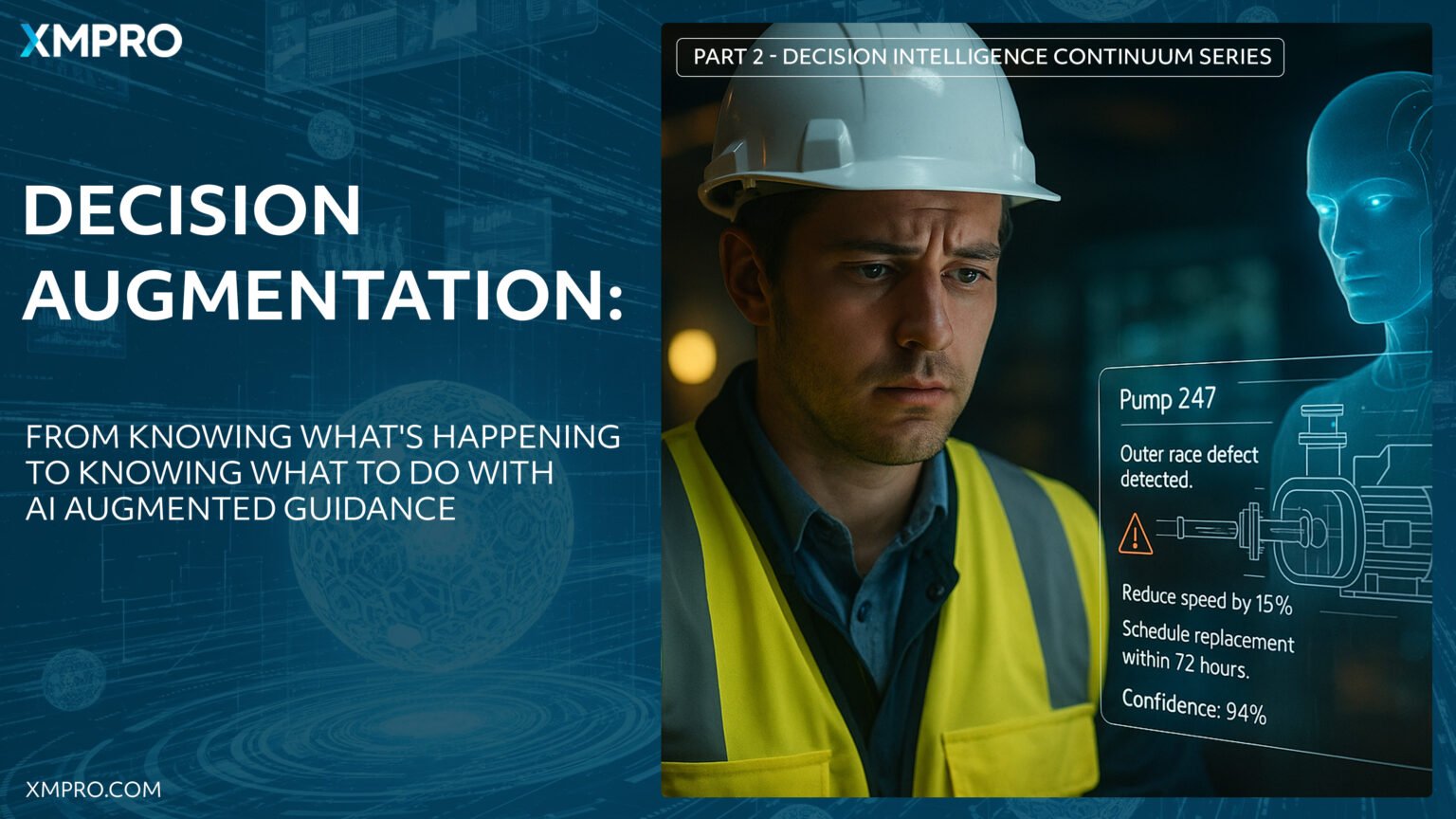
With AI Decision Augmentation: "High vibration detected on Pump 247. Bearing signature indicates outer race defect. Recommended action: Reduce speed by 15% and schedule replacement within 72 hours. This recommendation aligns with actions taken in 8 prior similar scenarios, where failures were successfully avoided. Alternative: Emergency shutdown (higher cost, 4-hour production loss). Confidence: 94%."
The difference? The first requires an expert to interpret. The second provides expert-level guidance to any operator.
The Three Types of AI Augmentation
XMPro's Decision Augmentation operates through three specialized AI types, each designed for different aspects of industrial decision-making:
AI Experts: Static Knowledge Specialists
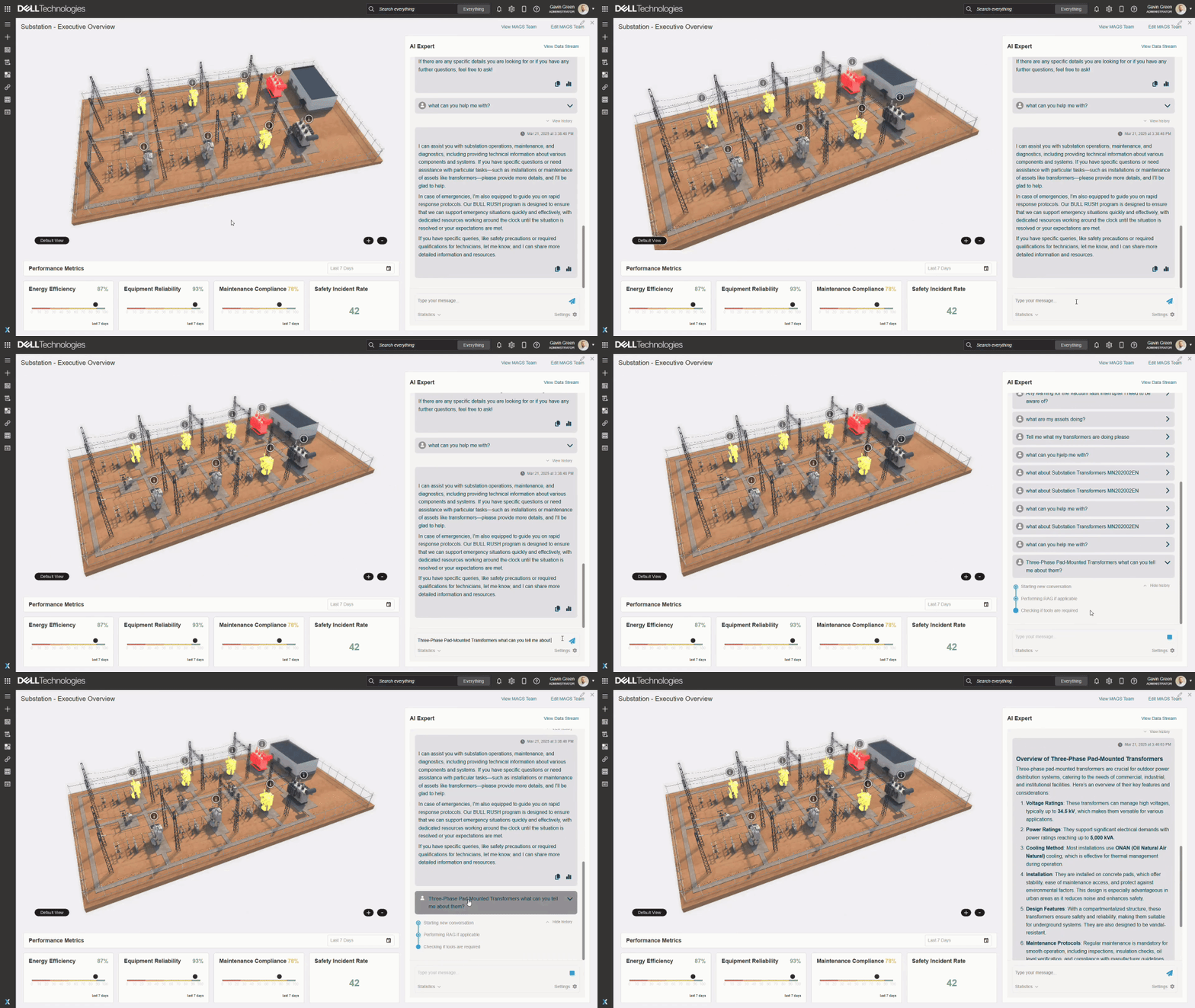
What They Do: Specialized agents that provide rapid access to institutional knowledge through RAG (Retrieval-Augmented Generation) technology. They excel at retrieving and contextualizing information from static knowledge repositories.
How They Work: AI Experts use advanced RAG techniques to interrogate equipment manuals, company SOPs, maintenance procedures, and historical documentation. They understand industrial terminology and can quickly locate relevant information from vast knowledge bases.
When Used: When context needs to be accessed quickly and effectively from static sources during decision-making processes.
Example: An operator facing an unusual equipment alarm asks, "What's the startup procedure for Pump 247 after a bearing replacement?" The AI Expert instantly retrieves the specific procedure from the equipment manual, cross-references it with company safety protocols, and provides step-by-step guidance with relevant warnings and checkpoints.
AI Assistants: Real-Time Situational Awareness, On Demand
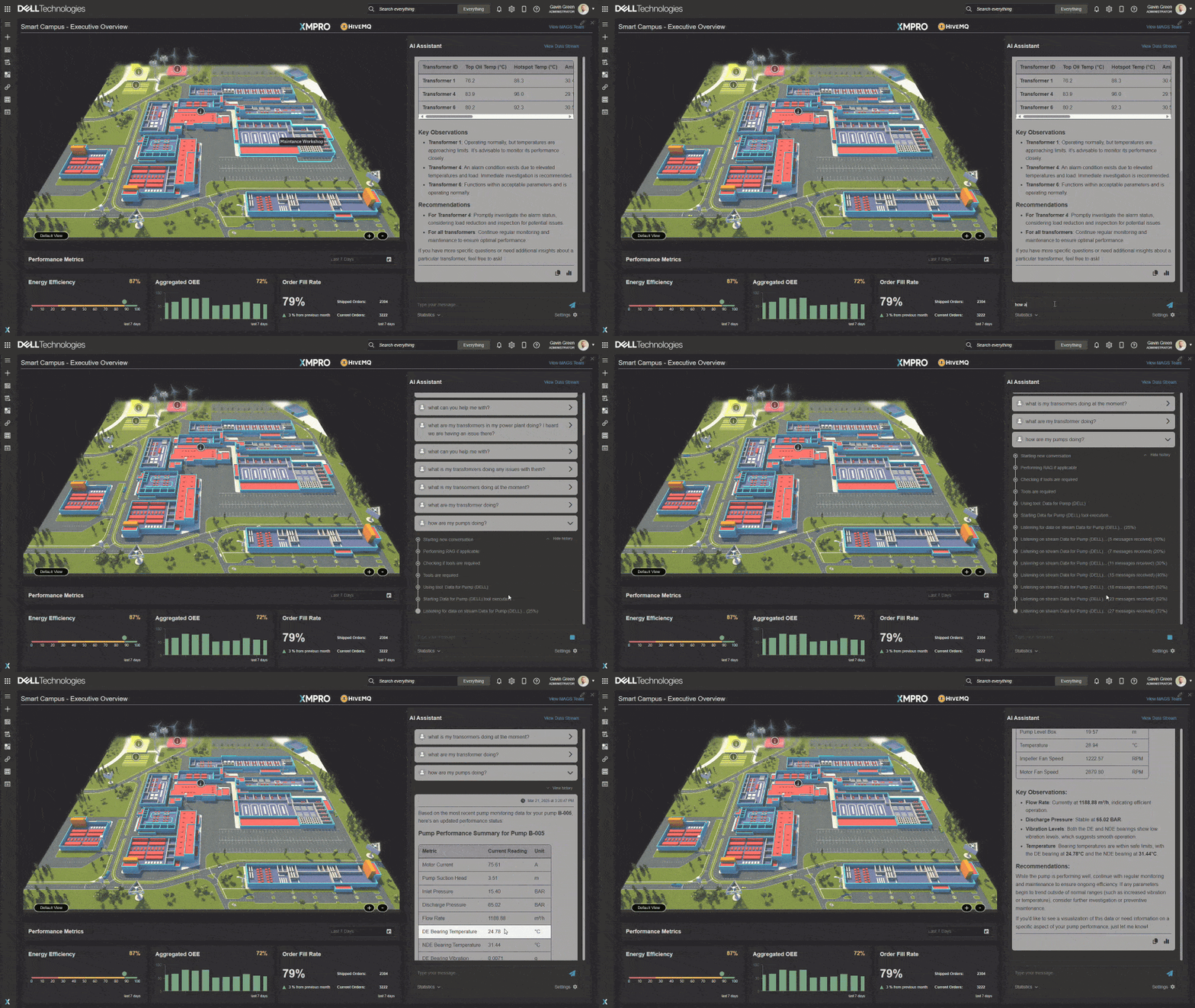
What They Do: Interactive intelligence that provides conversational access to live operational data through real-time data pipelines. They transform complex operational queries into actionable insights.
How They Work: AI Assistants connect directly to XMPro's real-time data streams, enabling natural language queries about current operational conditions, equipment status, and process performance. They understand context and can correlate data across multiple systems.
When Used: When real-time decision augmentation is necessary... asking questions about current operational data to inform immediate decisions.
Example: An operator asks, "What's the current vibration trend on Pump 247 over the last 2 hours, and how does it compare to normal operating ranges?" The AI Assistant queries live data streams, analyzes trends, and responds: "Vibration has increased 15% in the last 30 minutes, now at 4.2 mm/s—approaching the warning threshold of 4.5 mm/s. This matches the pattern from the bearing failure three months ago."
AI Advisors: Always-On Operational Intelligence
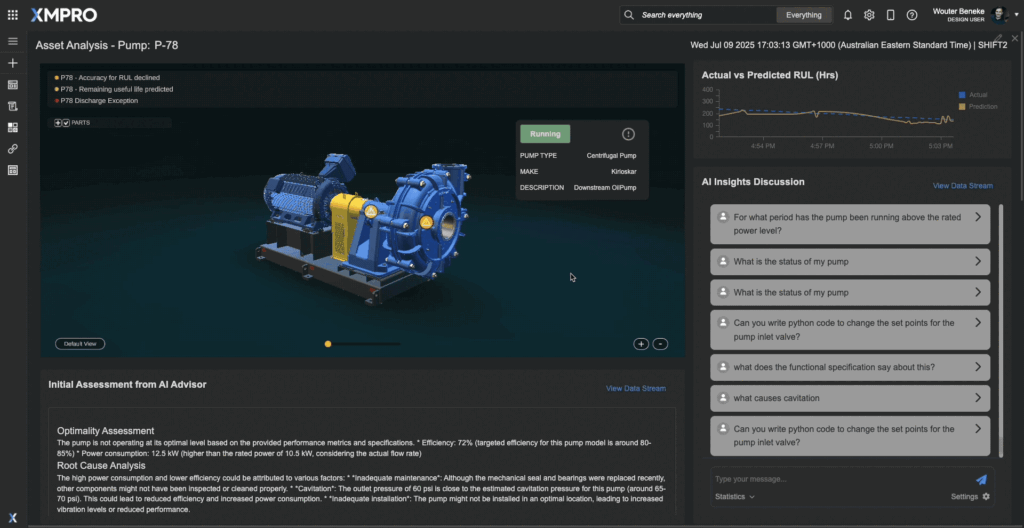
What They Do: Proactive intelligence that continuously monitors operations and creates meaning from constant observation. They provide first-glance insights and strategic guidance without being prompted.
How They Work: Using the ORPA cycle (Observe-Reflect-Plan-Act), AI Advisors continuously analyze operational conditions, identify patterns, and generate proactive recommendations. They don't wait for questions, they surface insights automatically.
When Used: For first-glance insight, meaning, and advice that helps operators understand what's happening and what actions to consider.
Example: Whether displayed on an always-on interface in the control room or triggered when a user opens the dashboard, the AI Advisor dynamically presents the latest recommendation in real time:
“Pump 247 vibration has increased steadily over the past 4 hours—pattern matches a previous bearing failure. Recommend reducing speed by 10% and scheduling inspection within 24 hours. Current production impact: minimal. Estimated delay risk: $47K if failure occurs during peak demand tomorrow.”
The Power of Composite AI: Why Multiple Methods Matter
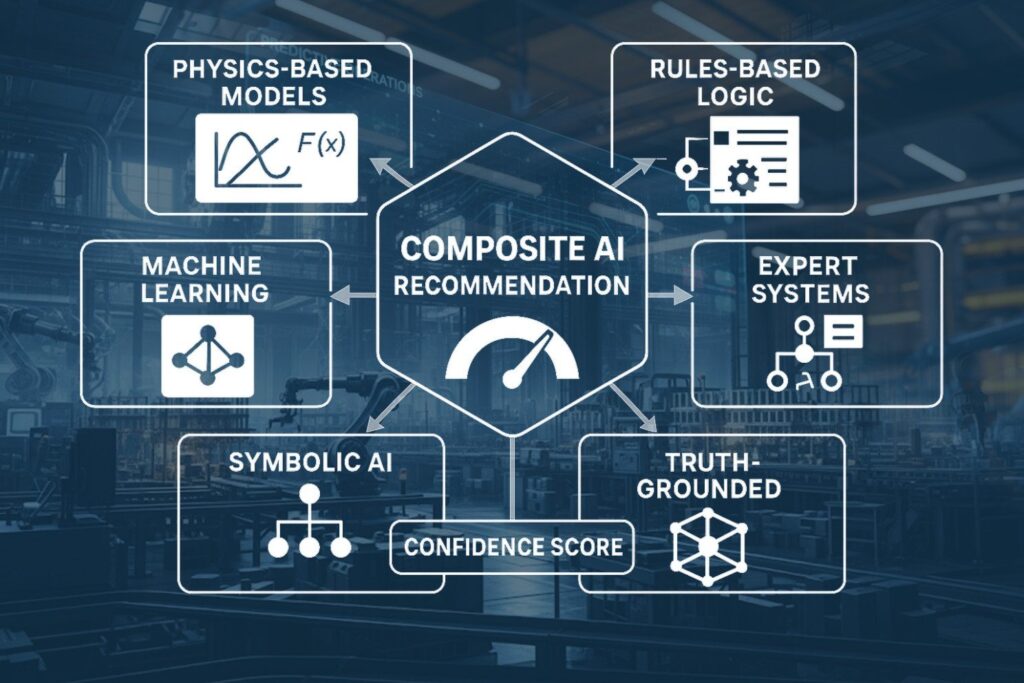
Most industrial AI systems rely on single methods—either rules-based logic, machine learning, or physics models. This creates blind spots that can lead to costly mistakes.
XMPro's Composite AI approach combines multiple AI methods to create more robust, trustworthy recommendations:
The Five-Method Integration
Physics-Based Models: Incorporating engineering principles, thermodynamic laws, and equipment specifications ensures recommendations align with physical reality.
Rules-Based Logic: Expert knowledge and operational procedures provide proven decision pathways for common scenarios.
Machine Learning: Pattern recognition from historical data identifies subtle correlations that rules and physics models might miss.
Symbolic AI: Reasoning and knowledge representation enable complex decision logic that adapts to changing conditions.
Expert Knowledge Systems: Codified expertise from domain specialists ensures institutional knowledge is preserved and accessible.
Multi-Method Consensus
Instead of relying on a single AI approach, XMPro's system validates recommendations across multiple methods. A predictive maintenance recommendation might be supported by:
- Physics model showing stress concentration
- Rules engine confirming maintenance protocols
- Machine learning detecting pattern similarities
- Expert knowledge validating intervention timing
This multi-method consensus creates confidence scores that help operators understand when to trust AI recommendations and when to seek additional input.
Reality-Checked Intelligence: How Composite AI Stays Grounded
Composite AI builds confidence through multi-method consensus, but confidence alone isn’t enough. XMPro validates every recommendation against the real-time operational truth, ensuring decisions work not just in theory, but in practice.
The costliest AI failures in industrial settings occur when recommendations work "on paper" but fail in reality. This happens when AI systems operate on stale data or simplified models that don't reflect current operational conditions.
XMPro's truth-grounding architecture ensures AI recommendations remain connected to physical reality:
Live Digital Twin Integration
AI Experts, Assistants, and Advisors reason over Digital Twins that are continuously updated with real-time operational data from 200+ industrial connectors. This ensures recommendations consider current equipment status, operational modes, and environmental conditions.
Real-Time Validation
Every AI recommendation is validated against current physical constraints, operational limits, and safety boundaries. If conditions change between analysis and action, the system automatically updates or withdraws recommendations.
Edge-to-Cloud Continuum
Truth-grounding requires ultra-low latency processing. XMPro's edge-capable StreamHosts enable real-time AI processing close to operational data, ensuring recommendations remain current even in bandwidth-constrained environments.
From Reactive to Proactive Operations
Decision Augmentation transforms operational culture from responding to problems to preventing them. This shift requires more than technology, it demands a fundamental change in how teams approach decision-making.
The Proactive Intelligence Advantage
Traditional Reactive Approach:
- Equipment fails
- Operators respond
- Production stops
- Repairs cost 3-5x more than prevention
Augmented Proactive Approach:
- AI predicts potential failure
- Operators receive optimized intervention strategy
- Maintenance occurs during planned windows
- Production continues with minimal disruption
The Competitive Advantage: Why Augmentation Matters Now
Recent LNS Research reveals a striking consensus: 96% of organizations recognize they need AI agents¹. Only 4% want to avoid them entirely. Yet 67% refuse to give agents full control¹, creating the exact gap that Decision Augmentation addresses.
This isn't about choosing between AI and human decision-making, it's about finding the right balance. Stanford University research shows that 45.2% of workers prefer collaborative autonomy³ over full automation, validating Decision Augmentation as the "sweet spot" most organizations actually want.
Organizations that master Decision Augmentation gain several competitive advantages:
- Expertise Multiplication: One expert's knowledge becomes available 24/7 across all operations
- Decision Consistency:Eliminate shift-to-shift variation in decision quality
- Proactive Operations:Prevent problems instead of responding to them
- Automation Readiness:Build the foundation for eventual autonomous operations
- Knowledge Preservation:Capture institutional expertise before it walks out the door
The alternative? Watching competitors operate with expert-level decision-making while your teams struggle with complex choices, manual analysis, and reactive responses.
Conclusion: The Bridge to Intelligent Operations
Decision Augmentation isn't just better alerting, it's the transformation of every operator into an expert-level decision maker. By combining AI Experts, Assistants, and Advisors through Composite AI approaches, organizations move from knowing what's happening to knowing what to do about it.
This isn't a distant future capability. XMPro clients are achieving these results today, with typical implementations showing measurable value within 30 days and ROI exceeding 10X within the first year.
The question isn't whether to implement Decision Augmentation, it's whether you'll lead this transformation or scramble to catch up while competitors operate with expert-level intelligence across their entire operations.
Ready to move beyond Decision Support to Decision Augmentation?
Learn more about XMPro's AI-powered augmentation capabilities at xmpro.com or explore real-world implementations at our Demo Hub.
If you're evaluating how to scale expertise through AI augmentation, I'd be happy to connect → Wouter Beneke
Preparing for Automation: The Governance Bridge
Decision Augmentation serves a dual purpose: improving immediate decision quality while building the foundation for eventual automation. This requires structured governance that adapts to organizational comfort levels. Stay tuned for our next article exploring the next step in the Decision Intelligence Continuum : Decision Automation: When AI Takes the Wheel.
Next in our series: "Decision Automation: When AI Takes the Wheel" - exploring how organizations safely transition from augmented to autonomous decision-making.
About the Author
Wouter Beneke leads global marketing at XMPro, where he works closely with industrial clients to communicate the real-world impact of Decision Intelligence and AI augmentation. He brings a background in engineering-first storytelling, helping operations leaders cut through hype and focus on what works in complex, high-stakes environments. His writing explores how AI Experts, Assistants, and Advisors are transforming industrial decision-making at scale.
#DecisionIntelligence #IndustrialAI #AIAugmentation #DigitalTwins #XMPro #OperationalExcellence #CompositeAI #IndustrialAutomation #AIAssistants
References
- "Human Agency Controls: Why 96% of Organizations Need Dynamic Authority Over AI Agents." LinkedIn, July 4, 2025. [References LNS Research findings by Niels Erik Andersen on industrial AI agent adoption preferences and operational domain framework]
- Manufacturing Institute & Deloitte. "Creating pathways for tomorrow's workforce today: Beyond reskilling in manufacturing." 2021. Available at: https://www.themanufacturinginstitute.org/research/creating-pathways-for-tomorrows-workforce-today/
- "Human Agency Controls: Why 96% of Organizations Need Dynamic Authority Over AI Agents." LinkedIn, July 4, 2025. [References Stanford University research on worker preferences for AI collaboration across 1,500 workers in 104 occupations]
- Abnormal Situation Management Consortium. "Better handling of abnormal events could save the U.S. petrochemical industry $10 billion per year." ASM Consortium Study, 1995.
- Kozyrkov, Cassie. Former Chief Decision Scientist at Google. LinkedIn posts and public presentations on decision intelligence limitations of traditional dashboards, 2023-2024.
- Digital Twin Consortium. "Digital Twin Consortium Unveils Updated Definitions." Press release, October 3, 2024. Available at: https://www.digitaltwinconsortium.org/press-room/10-03-24/
- Gartner. "Emerging Tech Impact Radar: Decision Intelligence." Referenced in David Pidsley LinkedIn posts, 2024.
- McKinsey & Company. "Effective decision making in the age of urgency." McKinsey Global Survey, 2019. Available at: https://www.mckinsey.com/capabilities/people-and-organizational-performance/our-insights/decision-making-in-the-age-of-urgency
- XMPro. "Getting Past Dashboard Information Overload - Reducing Cognitive Strain With Augmented Decision Intelligence." XMPro Blog, April 25, 2025. Available at: https://dev.xmpro.com/getting-past-dashboard-information-overload-reducing-cognitive-strain-with-augmented-decision-intelligence/