

































Beyond Predictive Maintenance: How Causal Analytics Eliminates Recurring Failures
Author: Marcos Augusto Burgos Saavedra
The Early Detection Approach
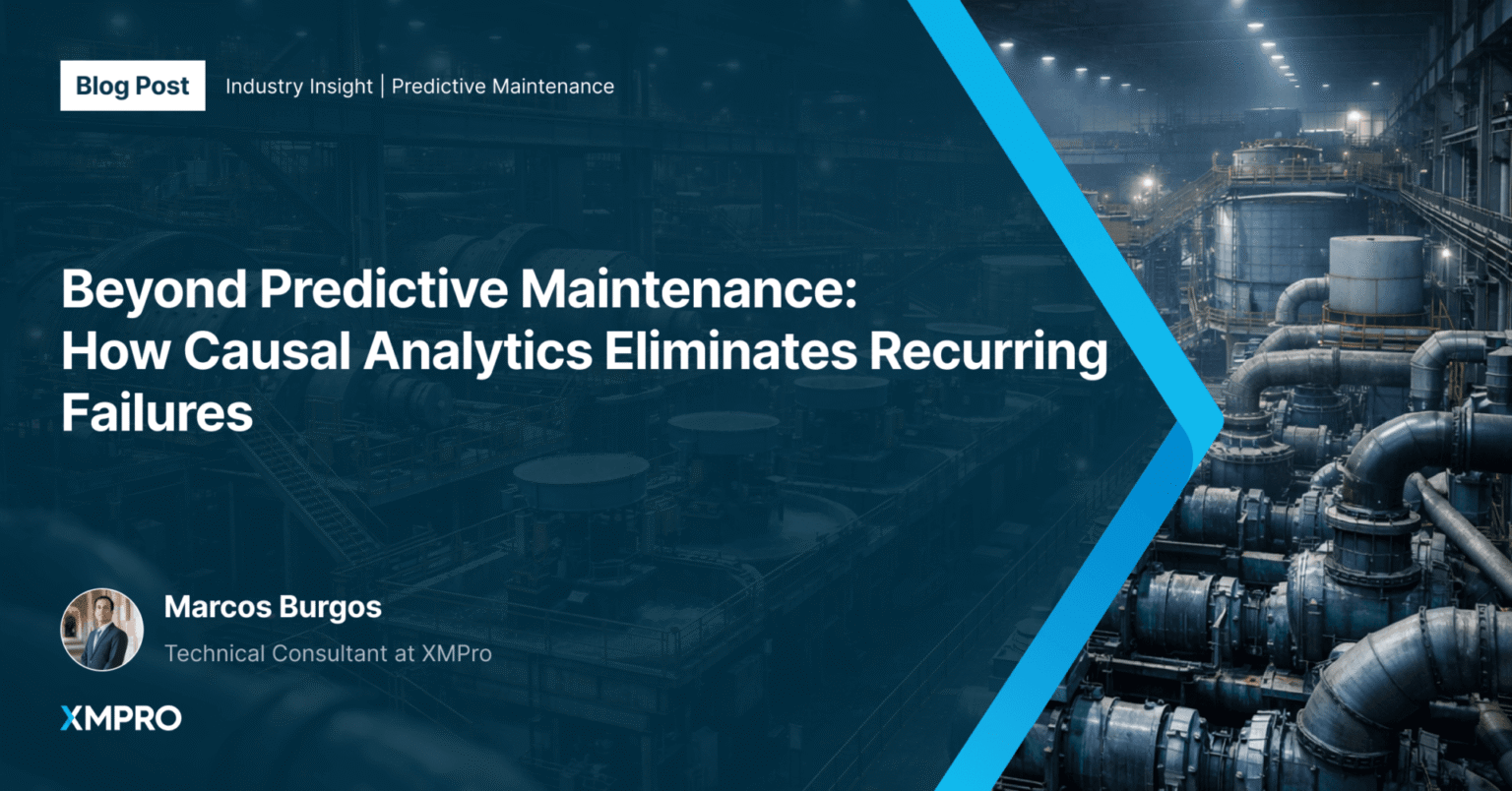
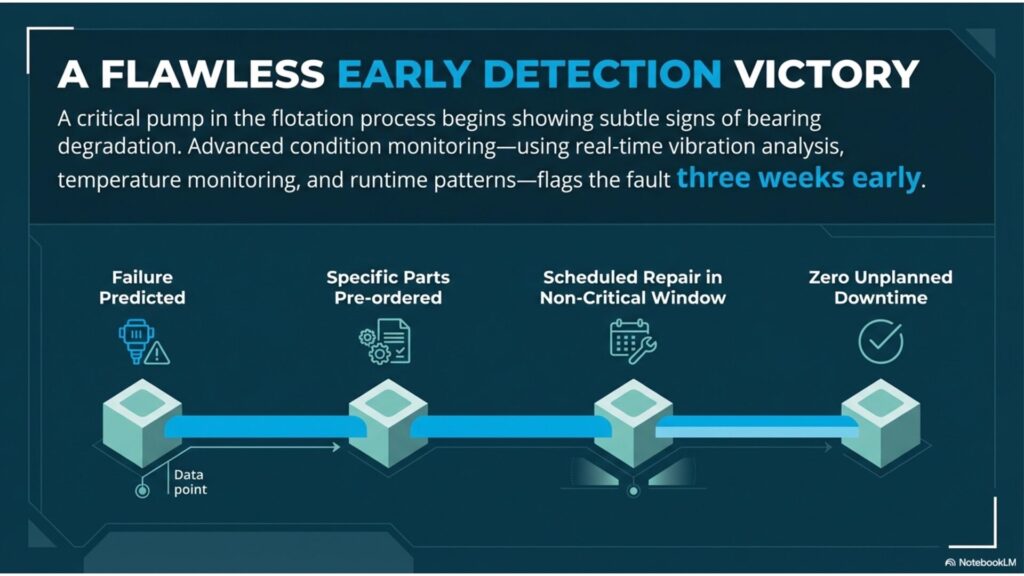
A critical pump in the flotation process at a mining site begins showing subtle signs of bearing degradation. In a traditional maintenance environment, this issue would go unnoticed until catastrophic failure, resulting in flooding, production shutdown, and potential safety hazards. But with predictive maintenance systems powered by advanced condition monitoring, maintenance teams detected abnormal bearing behavior weeks before failure. By integrating real-time vibration analysis, temperature monitoring, and runtime patterns, the system flagged the developing fault early enough for maintenance planners to schedule an intervention during a non-critical production window. The result? Zero unplanned downtime, no cascading operational disruptions, and a repair completed in hours instead of days.
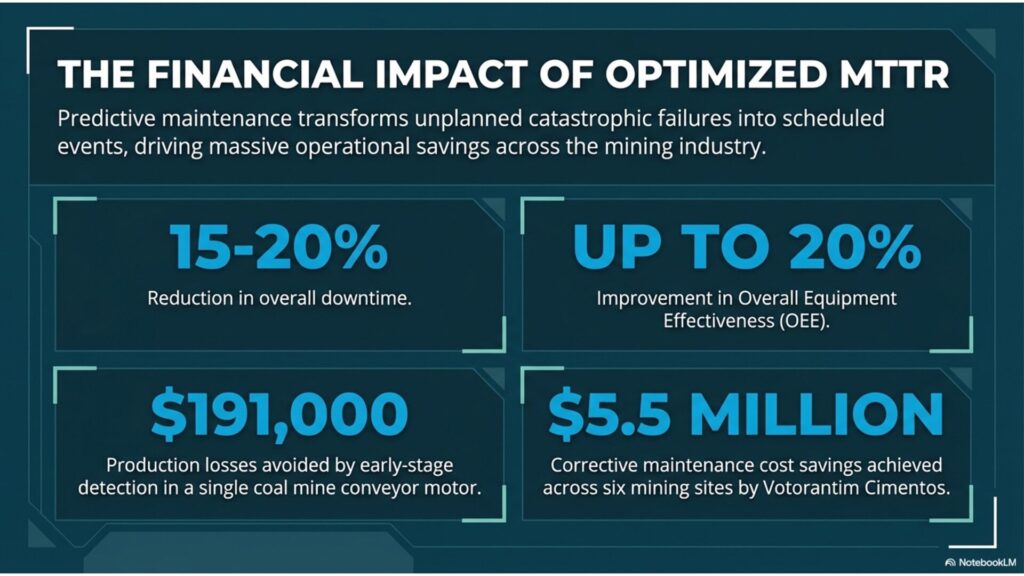
This scenario illustrates the value of predictive maintenance in reducing Mean Time to Repair (MTTR), a critical metric that measures how quickly maintenance teams can respond to and resolve equipment failures. With advance warning ranging from weeks to months depending on fault type and monitoring technology, maintenance teams can pre-diagnose the exact issue, pre-order specific replacement parts, schedule maintenance during planned downtime, and assemble the right expertise for efficient first-time fixes. Mining operations implementing these systems report 15-20% reductions in downtime, significant decreases in emergency repair costs, and up to 20% improvements in overall equipment effectiveness. Real-world implementations validate these benefits: at a coal mining facility, early-stage bearing deterioration was detected in a conveyor motor, avoiding approximately $191,000 in production losses, while Votorantim Cimentos achieved $5.5 million in corrective maintenance cost savings across six mining sites using predictive analytics.
The importance of these systems in mining cannot be overstated. Mining operations face uniquely harsh conditions, abrasive slurries, corrosive substances, extreme temperatures, and continuous mechanical loads, that accelerate pump degradation. A single pump failure can halt entire dewatering systems, flood mine shafts, or shut down processing plants, costing hundreds of thousands of dollars per hour in lost production. Beyond financial impact, predictive maintenance delivers operational continuity by transforming unplanned catastrophic failures into scheduled maintenance events, cost optimization through early intervention before minor issues escalate, and enhanced safety by enabling controlled maintenance during planned shutdowns rather than emergency repairs under pressure in hazardous confined spaces.
But here's what we should be asking: Early detection tells us WHEN a failure will happen, but does it tell us WHY? Are we optimizing our response to failures, or can we prevent them from occurring in the first place?
The Recurring Failure Trap: Treating Symptoms, Not Causes
The predictive maintenance system successfully identified the bearing degradation three weeks early, the maintenance team replaced the worn component during a scheduled window, and operations resumed without incident. Six weeks later, the same pump experiences the same bearing failure. Then again. And again.
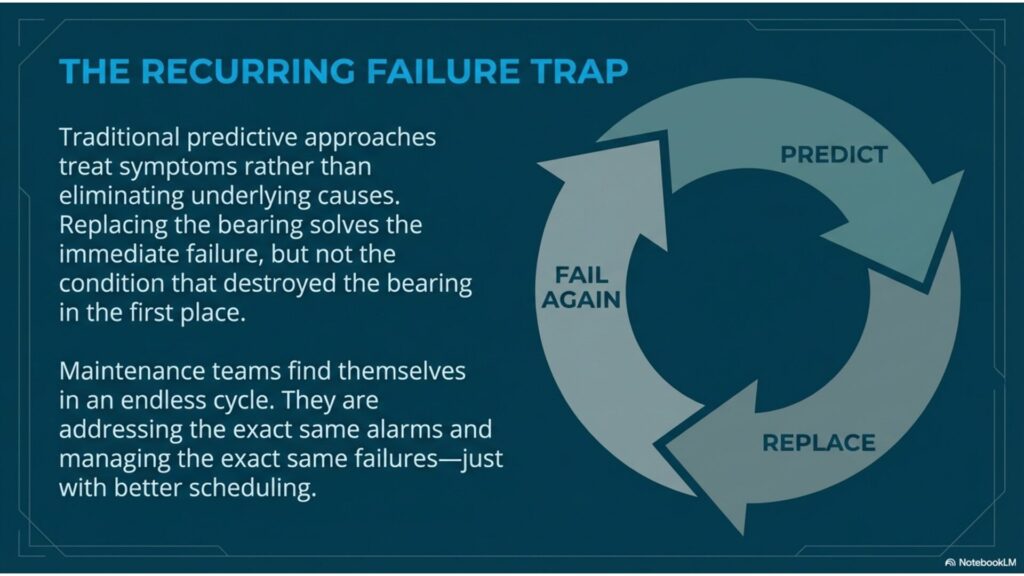
This is the recurring failure trap. Traditional maintenance approaches, even predictive ones, often treat symptoms rather than eliminating underlying causes. The bearing replacement solved the immediate failure but not what caused the bearing to fail prematurely in the first place. Teams find themselves in an endless cycle, replacing the same components, addressing the same alarms, managing the same failures, just with better scheduling.
Consider the full picture of our flotation pump scenario. The bearing didn't fail in isolation. Upstream in the mineral processing chain, the grinding circuit may be producing inconsistent particle size distribution, increasing slime content that changes slurry viscosity. The cyclone separation process might have suboptimal parameters, leading to higher solids concentration reaching the flotation pumps. Chemical dosing variations in earlier stages could be altering slurry properties. Any of these upstream process conditions can create excessive mechanical stress, accelerating bearing wear in the flotation pump.
Yet the predictive maintenance system, focused on the pump itself, sees only the symptom, the degrading bearing. It cannot trace the causal chain back through the process. So maintenance teams replace bearings, swap out impellers, rebuild seals, treating each failure as an isolated equipment issue rather than recognizing them as symptoms of upstream process dysfunction.
Without identifying deeper causes, organizations treat symptoms rather than removing the conditions that allow failure to recur. A machine that frequently breaks down in the same way can be fixed temporarily by replacing worn components, but true root cause analysis may uncover faults elsewhere in the system that result in excessive stress being placed on those components. In mining operations, when a slurry pump stops, the whole process flow can collapse within minutes, from cyclone feed to tailings discharge, yet the root cause may originate hours earlier in the grinding circuit.
From Detection to Understanding: The Causal Analytics Imperative
This is where causal analytics transforms the maintenance paradigm. Instead of asking "when will this bearing fail?" causal approaches ask "what process conditions are causing premature bearing failure, and how do we optimize them?"
Traditional machine learning techniques have significant limitations in root cause analysis due to their inability to capture causality, often failing to distinguish true root causes from mere symptoms. Correlation-based predictive models can tell you that high vibration precedes bearing failure, but they cannot tell you whether adjusting slurry density by 8%, modifying pump speed by 12%, or changing upstream grinding parameters would extend bearing life from six weeks to six months.
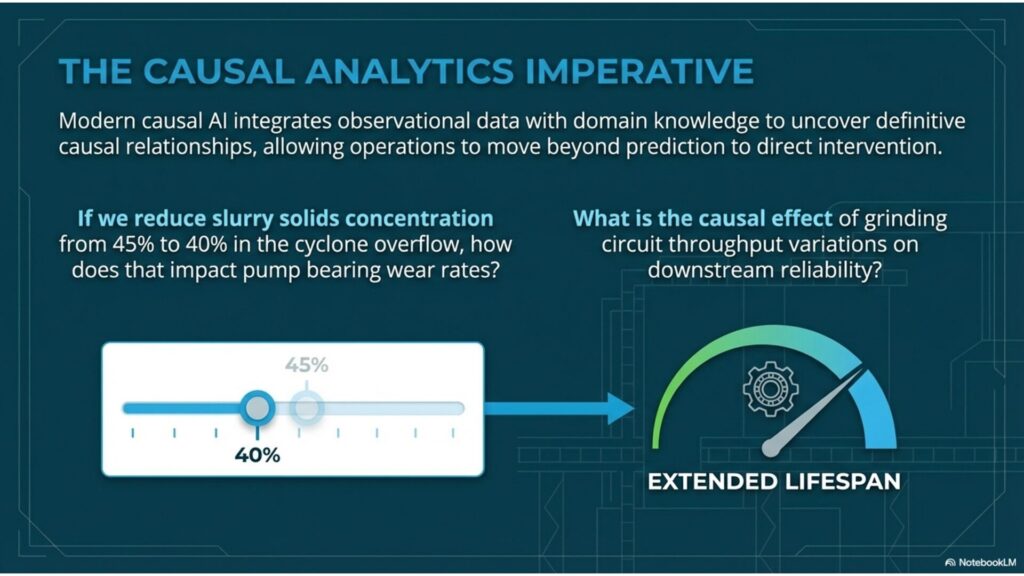
Causal machine learning addresses this fundamental gap. Modern causal AI utilizes domain knowledge and integrates observational data to uncover causal relationships among key variables in complex processes. These methods move beyond prediction to intervention, answering questions like:
- If we reduce slurry solids concentration from 45% to 40% in the cyclone overflow, how does that impact pump bearing wear rates in flotation?
- What is the causal effect of grinding circuit throughput variations on downstream pump reliability?
- Which upstream process adjustments deliver the greatest reduction in flotation pump failures?
Revealing causal relationships is important for improving production capacity, product optimization, and fault tracing. By implementing frameworks that combine causal analysis with process optimization, mining operations can transition from optimizing failure response to optimizing failure prevention. The goal shifts from efficiently replacing bearings to creating operating conditions where bearings last their designed lifespan or beyond.
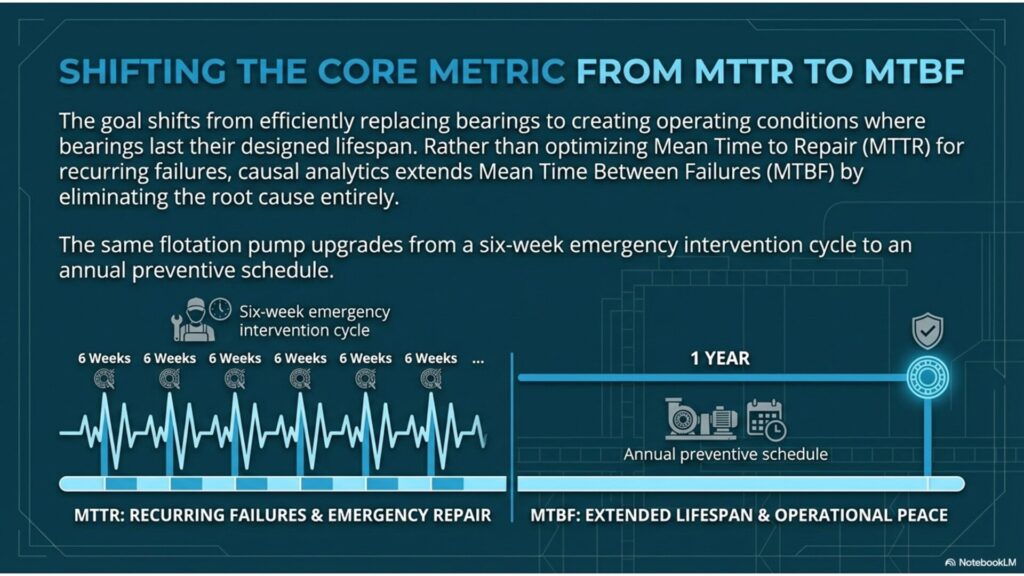
This causal approach delivers benefits that predictive maintenance alone cannot achieve. Rather than optimizing MTTR for recurring failures, causal analytics extends Mean Time Between Failures (MTBF) by eliminating root causes. Instead of preparing for the next predictable breakdown, operations prevent the breakdown entirely. The same flotation pump, operating under causally-optimized process conditions, may require bearing replacement on an annual preventive schedule rather than every six weeks as an emergency intervention.
Rather than optimizing MTTR for recurring failures, causal analytics extends Mean Time Between Failures (MTBF) by eliminating root causes. Instead of preparing for the next predictable breakdown, operations prevent the breakdown entirely. The same flotation pump, operating under causally-optimized process conditions, may require bearing replacement on an annual preventive schedule rather than every six weeks as an emergency intervention.
The Path Forward: Implementing Causal Analytics in Mining Operations
At XMPro, we deliver causal analytics solutions that move beyond correlation to establish genuine cause-and-effect relationships in complex operational environments. The implementation requires embedding causal analytics methodology in automated systems to perform reliable analysis at scale, transforming one-time manual investigations into continuous process intelligence.
Based on this experience, implementing causal analytics for mining operations follows a systematic approach:
1. Build a Causal Representation of the Complete Process
Comprehensive causal representations add value by managing a collaborative web of interconnected systems, facilitating advanced cross-domain analysis and dynamic context considerations. This means creating a comprehensive causal model that represents not just individual equipment, but the entire mineral processing chain from crushing and grinding through flotation to tailings. The model captures how upstream processes influence downstream equipment performance, encoding domain knowledge about physical relationships, material flows, and operational dependencies.
2. Connect Interconnected Sub-Processes as They Operate in Reality
Mining operations don't exist as isolated units. These causal models represent mine sites, machinery, and operations across the entire mining lifecycle, from extraction to processing and logistics. The causal representation must reflect these interdependencies, connecting grinding circuit models with cyclone separation models with flotation pump models, mirroring the actual process flow. This interconnected approach enables the system to trace failure causes across process boundaries, identifying when a flotation pump issue originates in upstream grinding variability.
3. Develop Causal Models that Encode Both Data and Domain Knowledge
Causal AI employs sophisticated mathematical models and fault tree analysis to uncover root causes and map complex event relationships in industrial systems. These models go beyond statistical patterns to incorporate engineering knowledge about causation. For instance, the model understands that increased slurry density doesn't just correlate with bearing wear, it causes increased mechanical load, which causes accelerated bearing degradation. This distinction between correlation and causation enables the system to recommend interventions that actually address root causes rather than symptoms.
4. Validate Model Performance Through Rigorous Testing
Before deploying causal models in production, confidence in their recommendations is essential. The experimental phase of MLOps focuses on data collection, model experimentation, and iterative improvement, where models are designed, tested, and refined. This includes testing causal predictions against historical data, validating intervention recommendations through controlled experiments, and ensuring the model accurately represents known cause-effect relationships in the process. Only models that demonstrate reliable causal inference should progress to operational deployment.
5. Deploy to Production with Continuous MLOps Improvement
MLOps in Industry 4.0 refers to the processes, tools, and organizational structures used to develop, test, deploy, and manage ML models reliably and efficiently. Once deployed, causal models require continuous monitoring to ensure they perform optimally over time as process conditions evolve. This includes tracking model prediction accuracy, monitoring for concept drift as equipment ages or operating parameters change, and systematically incorporating new data and domain knowledge to refine causal relationships. The goal is not a static model but an evolving intelligence that grows more accurate and valuable as it learns from operational experience.
This systematic approach transforms causal analytics from a theoretical concept into operational reality. Mining operations implementing these practices gain the ability to ask and answer the questions that predictive maintenance cannot address. When that flotation pump bearing shows signs of early wear, the system can identify whether the root cause lies in grinding circuit variability, cyclone parameter drift, chemical dosing inconsistency, or pump operating conditions, and recommend the specific process adjustments that will eliminate the recurring failure.
The early detection approach represented a significant advancement over reactive maintenance. Causal analytics represents the next evolution, one that doesn't just predict failures earlier but prevents them from occurring in the first place.
The early detection approach represented a significant advancement over reactive maintenance. Causal analytics represents the next evolution, one that doesn't just predict failures earlier but prevents them from occurring in the first place.
Sources: - Proactive Maintenance of Pump Systems in Mining - PMC - Condition Monitoring for Mining - Samotics - Mean Time to Repair (MTTR): The Ultimate Manager's Guide - Factory AI - Predictive Maintenance IoT Impact on Mining - Infinite Uptime - DataMind AI Prevents Conveyor Motor Failure - Razor Labs - Predictive Maintenance and AI in Mining - Mining Technology - AI-Driven Predictive Maintenance for Pumps - Mining Technology - Root Cause Failure Analysis in Manufacturing - ATS - 8 Factors Affecting Mineral Flotation Process - Xinhai - Flotation Process Audit and Bottleneck Identification - Metso - Root Cause Analysis: Prevent Recurring Incidents - Innovapptive - Why Do Slurry Pumps Fail in Mining - Pansto Pump - Manufacturing Root Cause Analysis with Causal AI - Databricks - Reconstructing Causal Networks for Industrial Processes - ScienceDirect - Causal Analytics in IIoT - XMPro - Graph-enabled Cognitive Digital Twins for Causal Inference - Taylor & Francis - Exploring Digital Twin Systems in Mining Operations - ScienceDirect - Agentic Supervisory Interfaces - XMPro - Understanding MLOps Lifecycle - Ideas2IT - MLOps: A Multiple Case Study in Industry 4.0 - arXiv